


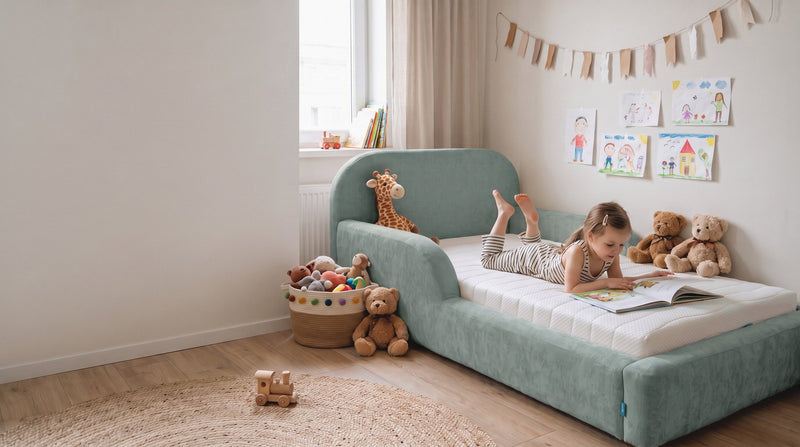

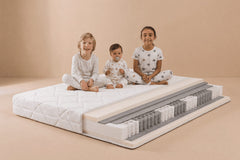

At two years old, bedtime becomes properly demanding for the first time. Your child now understands what a sequence is, remembers yesterday, says "no" with conviction, and notices exactly when a boundary can be shifted. At the same time, they need more security in the evening than ever before, because the day, with daycare, playgroup and a language explosion, is full of impressions. A bedtime routine from age 2 provides exactly this framework: a fixed sequence that runs the same way every evening and leads from dinner to lights out in about an hour. In this guide you get a concrete schedule from 6:30 to 7:30 pm, explained step by step, plus a weekly plan for introducing it, a checklist and solutions for the typical stumbling blocks. You can adopt the plan as it is or adapt it to your own times.
The short answer: an effective bedtime routine for two-year-olds lasts around 60 minutes from the end of dinner to lights out and consists of six fixed steps: quiet playtime, washing or a bath, brushing teeth and pyjamas, getting into bed, a story or a song, and a clear goodbye. The order stays the same every evening; the times can be adapted to your daily life. You give your child small choices such as the book or the pyjamas; the big decision, that it is now time to sleep, stays with you. After two to three weeks, the routine is firmly established for most children.
- Two-year-olds usually need 11 to 14 hours of sleep in 24 hours, including the daytime nap. For most, bedtime falls between 7 and 8 pm.
- The routine starts before the bath: 20 minutes of quiet playtime in dimmed light prepare your child.
- Six steps, always in the same order, about 60 minutes in total, of which 15 to 20 minutes are in bed.
- Thirst, the toilet and "one more story" are built firmly into the routine so that there is no reason for extras later on.
- A weekly plan helps with the introduction: in week 1 only the order counts; in weeks 2 and 3 the goodbye and consistency are practised.
Why a bedtime routine from age 2 works so well
The second and third years of life are a phase of enormous development. Vocabulary grows within months from a few dozen to several hundred words, your child wants to do everything themselves, and they discover that they have a will of their own. In the evening, the nervous system is often full to the brim. A routine takes away the decisions that your child can no longer make at that moment.
Paediatricians and developmental experts therefore recommend making bedtime as predictable as possible from this age. Observations from family studies show that toddlers with a fixed evening routine fall asleep faster on average and lie awake for less time at night. What your child knows, they do not need to control.
Then there is the autonomy aspect. Two-year-olds want to have a say, and that is exactly what can be built into a routine well. Which pyjamas, which book, which cuddly toy: these choices give your child control without the structure wobbling. If you want an overview of what experts say about rituals in general, you will find it in the article Bedtime rituals for toddlers. This article is about the concrete implementation, with times.
The schedule: 6:30 to 7:30 pm at a glance
The following plan assumes a bedtime of 7:30 pm. If your child gets up at 7 am and still naps for an hour at lunchtime, that suits most two-year-olds. If they wake at 6 am or have already dropped the daytime nap, move everything forward by 30 minutes. How much sleep is normal at which age is shown in the article How much sleep does my child need?.
| Time | Step | Duration | What matters |
|---|---|---|---|
| 6:30–6:50 pm | Quiet playtime | 20 min | Dim the lights, screens off, puzzles or books instead of romping |
| 6:50–7:00 pm | Bath or washing | 10 min | Warm water, no splashing games, child helps |
| 7:00–7:08 pm | Brushing teeth, toilet, pyjamas | 8 min | Let them choose the pyjamas, last sip of water |
| 7:08–7:10 pm | Into bed, prepare the room | 2 min | Curtains closed, night light on, cuddly toy into bed |
| 7:10–7:25 pm | One story or one song | 15 min | Announce beforehand: "One book, then lights out" |
| 7:25–7:30 pm | Goodbye and lights out | 5 min | Always the same phrase, then leave the room |
Dinner is deliberately placed before the plan, at about 6:00 to 6:30 pm. It is part of the evening, but not yet a signal to rest. The actual routine begins with the switch to quiet playtime.
The six steps in detail
Step 1: Quiet playtime (6:30–6:50 pm)
After dinner, the ceiling light and the volume are turned down. Twenty minutes of puzzles, picture books, Duplo or drawing at the table. No chasing, no tickling, no tablet. In this phase the body begins to adjust to the night.
Step 2: Bath or washing (6:50–7:00 pm)
Warm water relaxes, and the slight cooling afterwards supports falling asleep. A full bath does not have to happen every evening; two to three times a week is enough, otherwise wash face, hands and feet. Let your child take the soap or hold the flannel.
Step 3: Brushing teeth, toilet and pyjamas (7:00–7:08 pm)
Your child may go "first by myself", then you brush again afterwards. Being allowed to choose between two pairs of pyjamas often saves the whole discussion. Now is also the time for the last sip of water and the trip to the toilet or potty, if your child is already that far. That way there is no legitimate reason left to get up after lights out.
Step 4: Into bed and prepare the room (7:08–7:10 pm)
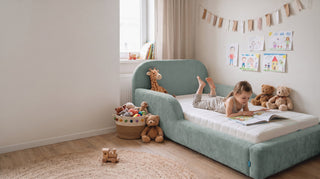
Close the curtains or blinds, switch on the night light, put the cuddly toy into bed. These two minutes are a strong signal, precisely because your child is allowed to do them: "You switch the light on, I'll close the curtain."
Step 5: One story or one song (7:10–7:25 pm)
You sit by or on the bed, your child lies down. One book, clearly announced beforehand. Short picture books with recurring phrases fit best now. Your voice gets quieter and slower towards the end.
Step 6: Goodbye and lights out (7:25–7:30 pm)
Always the same phrase, the same kiss, the same gesture. Then you leave. If you would like to stay a little longer, sit quietly on a chair without talking, and shorten this time from evening to evening.

Weekly plan: how to introduce the routine in three weeks
A new routine takes time. Allow three weeks and do not start right before a holiday, a move or the start of daycare.
Week 1: Practise the order. The only goal is for the six steps to take place in the same order every evening. Stay for the goodbye as long as you have been used to so far. Hang the steps up as picture cards in your child's room and let them turn over each completed card.
Week 2: Shorten the goodbye. The sequence is in place; now the ending becomes clearer. Shorten the time you stay in the room after the goodbye phrase by two to three minutes each evening. Introduce the "guardian" cuddly toy, which keeps watch until you come back in the morning.
Week 3: Consistency on difficult evenings. Weekend, visitors, grandparents: the routine still runs, even if it starts 30 minutes later. Give the grandparents the picture cards. From now on, the rule also applies: anyone who gets up is brought back calmly and without discussion.
From week 4: Observe. If falling asleep after lights out regularly takes longer than 30 minutes, bedtime is probably too early or the daytime nap too long. Shift in steps of 15 minutes.
Get CHF 25 off
Subscribe to the newsletter and receive a one-time CHF 25 discount. ✓ 100-night trial ✓ 5-year warranty ✓ Free delivery
Checklist for the evening
You can print out this list and stick it on the fridge. It helps above all on evenings when one parent is alone or someone else is putting your child to bed.
- Dinner finished by 6:30 pm at the latest, no screens after that
- Ceiling light off, floor lamp or dimmed light on
- Pyjamas and cuddly toy laid out ready, bath prepared
- Child has had a drink of water and been to the toilet or potty
- Curtains closed, night light on, room temperature around 18 degrees, window aired briefly beforehand
- One book chosen and announced: "One book, then lights out"
- Goodbye phrase said, kiss, leave the room
- If they get up: bring them back calmly, one short sentence, no discussion
If there are two of you, take turns, but keep the steps the same. That way your child learns that the routine lives from the sequence and not from who carries it out.

Typical stumbling blocks with two-year-olds and how to solve them
"One more story!"
Announce before reading that there will be one book. After the book: "That was the story for today. Tomorrow we'll read again." Stay friendly and repeat the sentence without discussing. After a few evenings, the asking usually stops. You will find more ideas on this in the article "Just one more story".
"I'm thirsty, I need the toilet"
Both are built into step 3. If your child still calls out afterwards, you can calmly answer: "You've had a drink and been to the toilet. Now it's time to sleep."
"Stay here!"
Separation anxiety is common at this age, especially in phases of change such as starting daycare. The guardian cuddly toy helps, as does a calm, confident goodbye. Anyone who leaves with a trembling voice passes on the insecurity.
Your child climbs out of bed
After the move from the cot to the big bed, your child can suddenly get up by themselves. Bring them back calmly, every time, with the same words. In the first two weeks, several attempts per evening are normal; after that it becomes noticeably less. You can read how to make the move to the big bed a success in the article Transition from the cot.
The routine no longer works after a holiday
That is normal. Simply get back into it, without making a fuss. After two to three evenings, the sequence usually takes hold again.
Common mistakes that weaken a bedtime routine
- Starting too late. If the ritual only starts when your child is already overtired, it barely works. Overtired two-year-olds become silly and fast, not calm. Watch for early signs of tiredness such as eye-rubbing or leaning against you.
- The routine becomes a negotiating table. "If you go to bed now, you can…" turns bedtime into a trade. The routine works because it is non-negotiable. Choices exist within the steps, not about them.
- Screens as a calming aid. Even a short video before bed delays falling asleep for many children.
- A routine that is too long. If the part in bed grows to 40 minutes or more, it loses its effect. Trim back to one book and one goodbye.
- Everything different at the weekend. Two unstructured evenings are enough to make Monday difficult. The time may shift, the sequence may not.
- Giving up too early. Three evenings without success are no reason to change everything. Give the routine the full three weeks.

Frequently asked questions about the bedtime routine from age 2
When should a two-year-old go to bed?
Most two-year-olds fall asleep between 7 and 8 pm. Count back from waking time: with a 7 am wake-up and a daytime nap of about an hour, 7:30 pm suits many children. Without a daytime nap, it can be 30 to 60 minutes earlier.
How long does it take for the routine to work?
With consistent practice, first improvements often show after five to seven days. The routine is usually firmly established after two to three weeks. After holidays or illness, it generally takes hold again within a few evenings.
What should I do if my child keeps getting up after lights out?
Bring them back to bed calmly and with the same short words, without discussion and without extra attention. In the first evenings this may be necessary several times. Also check that thirst and the toilet have already been dealt with in the routine.
Should the routine be kept up during illness too?
With a mild cold, yes, as far as possible, perhaps shortened. With a fever or severe symptoms, wellbeing comes first; then the routine can be skipped. Afterwards you simply get back into it.
Can the routine start earlier or later than 6:30 pm?
Yes, the times are an example. What matters is that the sequence and the duration of the steps stay the same. If you get home from work later, shift the whole plan, but do not leave out any step.
How many choices should I give my child?
One or two per step are enough, always between two concrete options: these pyjamas or those, this book or that one. Open questions such as "What would you like?" overwhelm two-year-olds and drag the routine out.
This article is for general information only and does not replace paediatric advice. If problems persist, please consult your paediatrician.


