



It is late June, just after half past five in the morning, and the children's room is already in full daylight. Your child is sitting bolt upright in bed, calling for you, and will stay awake for the rest of the day – even though they only fell asleep at half past eight. In winter it is the other way round: at 6.30 p.m. you are wrestling with a child who refuses to get tired while it has long been dark outside. Light is the strongest regulator of the sleep-wake rhythm, and in a children's room it is routinely underestimated. Blacking out a children's bedroom therefore does not simply mean "close the curtains", but closing a few very specific centimetres in the right places. We explain how dark the room really needs to be, which solution suits which window, and why the narrow strip of light at the side is more disruptive than the whole curtain surface.
The short answer: for restorative sleep, the room should be dark enough that after two minutes of adjustment you can just about make out the outline of your own hand in front of your face – you need no more darkness than that, and any less does too little in the early morning. What matters is not the fabric itself but how well the edges are sealed: a blackout roller blind fitted inside the window reveal with two centimetres of play at the sides performs markedly worse in June than a plain thick curtain hung wide and floor-length across the whole wall. Allow 20 to 40 centimetres of overhang on each side and a drop to the floor. A small warm night light does not contradict blackout – it simply replaces the ceiling light, which is what really disrupts sleep.
- Morning light ends sleep, evening light delays it – both work through the same internal clock.
- Children's eyes let more light reach the retina than adults' eyes; the same brightness has a stronger effect on your child.
- It is not the fabric that decides, but the edges: side overhang, floor-length drop and mounting above the reveal.
- Blackout curtains, roller blinds and honeycomb blinds solve different problems – combining two is often cheaper than one expensive single solution.
- A very dim, warm night light near the floor is compatible with blackout and takes the fear out of the dark for many children.
Why light steers children's sleep so strongly
Alongside the cells used for vision, the eye contains light-sensitive cells that report directly to the internal clock in the brain: it is daytime. When light reaches these cells, the body throttles the release of melatonin, the hormone that initiates sleepiness. Once it gets dark, melatonin rises again. This mechanism is particularly sensitive in children: their pupils are larger and the lens of the eye is clearer than in adults, so more light – especially the short-wavelength, bluish component – actually reaches the back of the eye. Studies in preschool children show that bright light in the hour before bedtime can noticeably suppress melatonin release and that it recovers more slowly afterwards than in adults.
In practice this means the same ceiling light that merely feels cosy to you in the evening can push a three-year-old's sleep pressure noticeably later. And the bright summer morning that does not wake you, because your own blinds are down, pulls your child out of sleep because their window has only a thin curtain. Darkness is therefore not a comfort question but the cheapest lever you have in a children's room.

How dark should the room really be?
There is no absolute figure, but there is a useful everyday test. Go into the darkened room, close the door and wait two minutes for your eyes to adjust. If you can then see the outlines of furniture but no colours and no text in a book, the darkness is good enough for children's sleep. If you have to feel your way blindly, it is darker than necessary – which is no problem as long as your child is happy with it. If, however, you can read the time on a wall clock or make out the pattern on the bedding, it will be too bright on a summer morning.
The difference between evening and morning matters. For falling asleep, moderate darkening is often enough, because the internal clock is switching over to sleep anyway. In the early morning, by contrast, sleep is light, your child is in a final dream-sleep stretch and reacts to any brightening. That is why many parents do not fail in the evening but between five and six in the morning. If your child is regularly awake before six, look at the window before you change bedtime – more on this in our article on the child who wakes too early.
| Age | Recommended darkness | What matters most |
|---|---|---|
| 6–18 months | Heavily darkened, including for the nap | Daytime sleep in a bright room stays short and restless |
| 18 months–3 years | Heavily darkened, night light optional | Early summer waking is most common at this age |
| 3–5 years | Darkened, a very dim warm night light is usual | Fear of the dark begins – never force darkness |
| 5–8 years | Darkened, the child has a say on the night light | Dim the evening light throughout the home |
| From 8 years | Darkened, rhythm now matters more than darkness | Evening screens are now the bigger light source |
Curtain, roller blind or honeycomb blind?
The decision depends less on budget than on the type of window. A floor-to-ceiling window or a balcony door calls for a curtain, because a blind always leaves a light gap at the bottom as soon as the door is opened. A classic Swiss period window with a deep reveal can be closed very well with a blind mounted in front of the reveal, and almost never with one mounted inside it. Roof windows need a model with side guide rails, or nothing will help.
Honeycomb blinds are the special case: their air cells insulate as well, which noticeably reduces heat at the window in summer and cold in winter. In an attic room that climbs to 28 degrees in July, a honeycomb blind solves two problems at once. If you are working on a sleep-friendly children's bedroom anyway, combine the two: a blind inside against the surface, a floor-length curtain outside against the edges.
| Solution | Strength | Weakness | Price range in Switzerland |
|---|---|---|---|
| Floor-length blackout curtain | Covers the edges generously, also dampens noise | Needs wall space, toddlers like to pull on it | approx. CHF 60–200 per window |
| Roller blind in front of the reveal | Flat, affordable, quick to fit | Side light gap if chosen too narrow | approx. CHF 40–120 |
| Honeycomb blind with side rails | Seals all round, insulates against heat and cold | More expensive, measurements must be exact | approx. CHF 120–350 |
| External roller shutter or slatted blind | Best blackout, keeps summer heat outside | Rarely retrofittable in rented flats | usually already installed |
| Stick-on travel blind | Portable, removable without residue | A stopgap only, will not last | approx. CHF 15–40 |
The light gap is the real problem
Blackout fabric lets practically no light through across its surface. And yet the room stays bright – because light runs past the edges and scatters off a white wall or ceiling. A two-centimetre gap along one side of a window 1.4 metres high adds up to almost 300 square centimetres of open area. In June, at half past five in the morning, enough light comes through that to brighten a room as if you had switched on a small lamp.
Three places are responsible. First the sides: mount the blind or curtain pole at least 15 to 20 centimetres wider than the window and hang the curtain so that it lies flat against the wall. Second the top: a blind hung beneath a pelmet board throws light over its upper edge into the room – a box or valance solves this. Third the bottom: curtains must touch the floor, and a blind needs side rails or at least a heavy bottom bar. Dealing cleanly with those three points using inexpensive fabric gets you further than the most expensive material on a badly mounted pole.

Step by step: blacking out a children's room in one afternoon
1. Measure rather than guess. Window width plus 2 × 20 centimetres gives the pole or blind width. For the height, measure from the planned pole position to the floor and take off one centimetre so the curtain does not bunch up.
2. Test in the morning, not in the evening. Clip a woollen blanket temporarily over the window and look at the room at six the next morning. That shows you where the light really comes in.
3. Take stock of light sources in the room. Standby LEDs on the baby monitor, the humidifier or the power strip are often brighter than a night light. Tape them over or move the device.
4. Mount and seal. Pole wide and high, curtain to the floor, blind with a valance or side rails.
5. Watch for three nights. Note the time of falling asleep and of waking. If waking shifts 20 to 40 minutes later, the measure has worked.
6. Bring the light back in the morning. Open the curtains as soon as you get up. Bright mornings stabilise the rhythm – blackout is only meant for the sleep window.
Common mistakes
Bought too narrow. By far the most common error: a curtain or blind exactly the width of the window. The sides stay open and the effect evaporates.
Dimout instead of blackout. "Dimout" fabrics absorb most of the light, but not all of it. That is fine for a living room and often not enough for a children's room in June.
Cords near the bed. For safety reasons, blind and venetian cords belong out of reach, secured with a wall cleat, and never within grabbing distance of the bed. The same applies to long curtain tiebacks.
Changing everything at once. If you black out the room, shift bedtime and rework the routine simultaneously, you will not know afterwards what worked. One change, three nights, then the next.
Darkness against the child's will. If your child is afraid of the dark, complete blackness makes falling asleep worse. A little brighter with warm light is the better choice – see our article on a child who is afraid of the dark.
Summer, winter and Swiss daylight
On the Swiss Plateau the sun rises shortly after half past five at the end of June, and it is noticeably light a good half hour before that. At the end of December, by contrast, it stays dim until after eight. For your child that means two completely different tasks: in summer the job is to shut the morning out, in winter to bring the light down in good time in the evening and get enough brightness into the room in the morning.
In practice, the blackout stays mounted all year but you use it differently. In winter, open the curtains first thing and make sure the breakfast table is brightly lit. In summer, close the shutters as early as the afternoon so the room does not heat up – that helps the blackout and the temperature. And if you end up in a bright hotel room on holiday, pack a stick-on blind or a few clothes pegs; that is often the difference between restful and ragged holidays.
Blackout alone is not enough
Darkness is one of four environmental factors. The other three are temperature, noise and the bed itself. A room at 22 degrees stays restless even in pitch darkness; around 18 degrees is recommended for sleeping. Street noise wakes a child reliably, even with a perfectly closed blind – heavy curtains, a rug and, where needed, a very quiet and even background sound help here.
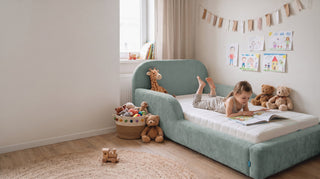
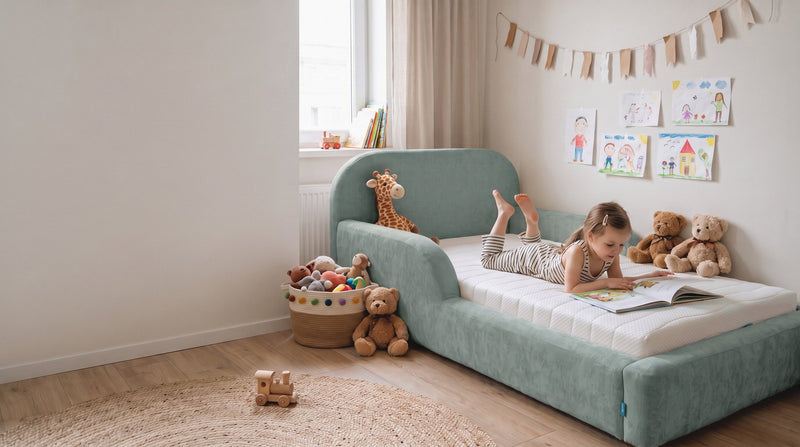
And then there is the bed. A child who bumps into a hard edge at night, or who feels they are about to roll out, wakes up – regardless of the light. A low bed with soft, upholstered sides removes exactly those two interruptions from the night. If you are reworking the room anyway, look at how things work together: blackout, temperature and a bed in which your child feels safe are far more effective in combination than any single measure. For the wider picture, read our overview of how much sleep your child actually needs.

Get CHF 25 off
Subscribe to the newsletter and receive a one-off CHF 25 discount. ✓ 100 nights' trial ✓ 5-year guarantee ✓ Free delivery
Frequently asked questions about blacking out a children's room
Is complete darkness harmful for children?
No. Darkness at night is the natural state and supports sleep. What matters is only that your child is comfortable with it and gets enough daylight during the day – bright light in the morning stabilises the rhythm at least as strongly as darkness at night.
From what age is blackout worthwhile?
From the first year of life, above all for the nap. The younger the child, the more daytime sleep duration depends on darkness. From about two years, early summer waking is the most common reason parents retrofit.
How dark does it need to be for the nap?
About as dark as at night. A child napping in a bright room usually sleeps considerably shorter and more restlessly. If the nap suddenly lasts only 25 minutes, brightness is one of the first things to check.
Does a night light undermine blackout?
A very dim, warm night light near the floor barely matters, because it stimulates the eye far less than bright, bluish light. The problems are glaring ceiling lights, blue standby LEDs and screens. If your child cannot fall asleep without light, a dimmed warm light is the better choice than enforced darkness.
What can you do in a bright holiday room?
A stick-on blind, a travel blackout curtain or simply a dark cloth held over the curtain pole with strong clips help immediately. Think about the door too: in hotels, the strip of light from the corridor is often brighter than the window.
My child wakes at five despite blackout – what now?
First check that no light is getting in, by looking into the room yourself at that hour. If it stays dark and your child still wakes, the cause is usually the amount of sleep, the nap or too early a bedtime. In that case the daily schedule helps more than the window.
This article is for general information and does not replace paediatric advice. If problems persist, please speak to your paediatrician.


