



Few topics unsettle parents as reliably as the question of the right temperature in a children's room. Grandmother says the child is cold. The internet says 18 degrees. And you are standing there in the evening with a child who kicks off every cover in their sleep while the first frost has settled outside. Add to that the Swiss reality: a period flat heated by a single stove, an attic room that climbs to 28 degrees in July, or a new build where the underfloor heating is set identically across the whole floor. The good news is that room temperature is one of the few sleep factors that can be measured and controlled reliably. We explain which values apply, how to measure properly and why "too warm" is the bigger problem than "slightly cool".
The short answer: for sleeping, around 18 degrees Celsius is ideal in a children's room, and a range between 16 and 20 degrees is perfectly fine. More important than the exact figure is that the temperature stays stable through the night and that clothing, sleeping bag or duvet match it. In summer this mark often cannot be held – then the aim is to keep the room below 25 degrees and to cover more lightly, not to force the number. To check whether your child is at the right temperature, do not look at their hands but at the back of the neck: warm and dry is right, sweaty is too warm, cool is too cold.
- Around 18 °C is the recommendation for a bedroom, 16–20 °C a good everyday range.
- Overheating is riskier than a slightly cool environment – official safe infant sleep recommendations expressly advise against bedding a baby too warmly.
- The neck test beats any thermometer: warm and dry means correctly dressed.
- Measure at bed height in the middle of the room, not by the radiator and not against an external wall.
- Humidity belongs in the picture: 40–60 % is comfortable, below 30 % heated air becomes a problem in winter.
Why room temperature steers children's sleep
Falling asleep is physiologically a cooling process. In the evening the body releases heat through hands, feet and head, core temperature drops by a few tenths of a degree, and it is precisely this drop that forms one of the signals initiating sleep. In a room that is too warm, that release works poorly: the child tosses, kicks off the covers, becomes restless. In a room that is too cold the opposite happens – the body has to produce heat, and that disturbs sleep too, especially in the early morning hours when core temperature is at its lowest anyway.
Young children are at a disadvantage here: their body surface is larger in relation to their weight than an adult's, so they lose heat faster, yet they also shed excess heat less well because sweat regulation is not yet mature. That explains why a toddler can wake up drenched in a room that feels pleasantly warm to you. If your child regularly startles awake at night, check the temperature before you rework the routine – background on this is in our article on children waking at night.

The right temperature by age
The recommendations differ less by age than many people assume. The biggest difference concerns infants in the first year of life, where overheating is to be expressly avoided. From toddler age onwards the principle is essentially: cool, but not draughty.
| Age | Recommended night temperature | Bedding | What to watch |
|---|---|---|---|
| 0–12 months | approx. 18 °C | Sleeping bag, no loose blankets or pillows | On the back, own cot in the parents' bedroom, do not overheat |
| 1–2 years | 17–19 °C | Sleeping bag, gradual move to a duvet | Kicking off covers is normal, the sleeping bag keeps them warm |
| 2–4 years | 17–19 °C | Light duvet, thin pyjamas | Thin layers beat one thick one |
| 4–8 years | 16–19 °C | Duvet according to season | The child may have a say on whether they want the duvet |
| Summer, all ages | aim for below 25 °C | Sheet only or thin muslin | Black out during the day, cross-ventilate at night |
How to measure properly
A thermometer sitting on the radiator measures the radiator. One on an external wall measures the wall. For the figure that matters to your child you need three things: the measuring point sits at bed height, roughly 30 to 50 centimetres above the floor, it is at least a metre from radiator, window and door, and you read it not in the evening but at six in the morning. The lowest room temperature of the night occurs shortly before sunrise – and that is exactly when a child who has kicked off the covers gets cold.
Simple analogue thermo-hygrometers for ten to twenty francs are entirely sufficient. If you want more precision, take a device with a minimum-maximum memory: after three nights you will know how far your room cools down. In new builds with underfloor heating the temperature usually varies by only one or two degrees; in older buildings with individual stoves, five degrees between evening and dawn is not unusual. That spread is the number that actually matters, not the pleasant reading at eight in the evening.
Why too warm is riskier than too cool
The official recommendations for safe infant sleep in the first year name overheating, alongside sleeping on the tummy, as one of the points parents should actively avoid. What is recommended: back sleeping, the baby's own cot in the parents' bedroom, a sleeping bag instead of loose blankets and pillows, and a room temperature of around 18 degrees. It is the combination of an overheated room plus thick pyjamas plus an extra blanket that the warning is about – not a room that feels fresh to you.
For older children, overheating is no longer a safety issue, but it remains a sleep issue: it leads to restless sleep, more night waking, and in the morning to sticky hair and a bad mood. The practical test stays the same at every age. Slide your hand to the back of the neck or between the shoulder blades of the sleeping child. Warm and dry is right. Damp or hot means one layer less. Cool means one layer more. Cold hands and feet are normal in children and are not a sign of being cold.

Sleeping bag, duvet, pyjamas: the right combination
Room temperature alone says little – it is only together with the bedding that a sleep climate emerges. Sleeping bags therefore carry a TOG rating describing thermal insulation. The cooler the room, the higher the TOG value. As a rule of thumb: at 16 to 18 degrees, a 2.5 TOG sleeping bag plus long-sleeved pyjamas; at 19 to 21 degrees, 1.0 TOG plus short sleeves; above 24 degrees, 0.5 TOG or just a bodysuit.
| Room temperature | Sleeping bag (TOG) | Pyjamas | Alternative with a duvet |
|---|---|---|---|
| 24 °C and above | 0.5 | Bodysuit or short sleeves | Muslin cloth instead of a duvet |
| 21–23 °C | 1.0 | short sleeves | thin summer duvet |
| 18–20 °C | 2.0–2.5 | long sleeves, thin | all-season duvet |
| 15–17 °C | 2.5–3.5 | long sleeves, socks if needed | winter duvet, merino layer |
Important: TOG figures are manufacturers' guide values, not a standard with guaranteed comparability. In the first year of life it also applies that loose blankets and pillows do not belong in the bed – here the sleeping bag is the clear recommendation.
Summer: keeping the attic room below 25 degrees
On hot days, 18 degrees is unattainable, and nobody needs to try. What is realistic is slowing the rise. Close the shutters as soon as the sun hits the window, which depending on orientation may be from ten in the morning – blackout helps twice over here, because it shuts out heat and light at once; how to do it properly is in our article on blacking out a children's bedroom. Only ventilate once the outside temperature falls below the inside temperature, in Switzerland usually after 10 p.m., and then create a draught between two opposite windows.
A fan may run as long as it does not point directly at the child and is not within reach of the bed. Skip damp cloths above the bed, which drive humidity up – in summer, humid warmth is more unpleasant than dry heat. And dress your child too lightly rather than too warmly: a bodysuit, or just a nappy at 27 degrees, is right, not careless.
Winter: heated air, ventilation, humidity
In winter the problem is less the temperature than the dry air. As soon as there is frost outside and heating inside, relative humidity often falls below 30 per cent. Dry mucous membranes make children more susceptible to colds, and a child with a blocked nose sleeps badly. Between 40 and 60 per cent is comfortable. You get there through short bursts of full ventilation rather than a permanently tilted window, through a bowl of water on the radiator or, if necessary, a humidifier cleaned daily.
Ventilating in winter means: window fully open for three to five minutes, heating turned down beforehand and set again afterwards. A permanently tilted window cools the walls, raises heating costs and barely exchanges any air. It is best to ventilate once directly before bedtime – that way the night starts with fresh air and a temperature that falls slowly rather than the other way round.
Common mistakes
Judging by the hands. Children's hands are almost always cool. That is no reason for an extra blanket.
Turning the heating off completely at night. The room then cools sharply in the morning hours, which is exactly when the child gets cold. Turn it down slightly rather than off.
Bed against the external wall or under the window. Cold air falling at the glass and cold external walls create a draught at head height. An internal wall is almost always the better position.
Changing several layers at once. Thicker pyjamas, a warmer sleeping bag and higher heating all together quickly lead to overheating. Adjust only one layer at a time.
Reading the thermometer in the hallway. In winter there are often three to four degrees between the hallway and the children's room.
If your child still sweats or gets cold
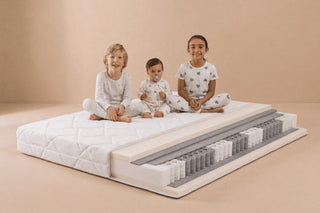
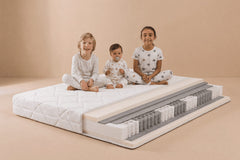
Some children sweat heavily at night even though the room is cool and the bedding is right. This is particularly common in the first hours after falling asleep and usually harmless, because the body releases heat during deep sleep. Breathable materials help: cotton, muslin or merino wool rather than polyester, and a mattress cover that moves moisture away instead of trapping it. If heavy sweating occurs together with snoring, pauses in breathing or noticeable daytime sleepiness, please discuss it with your paediatrician.
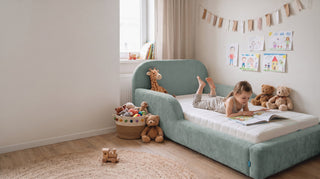
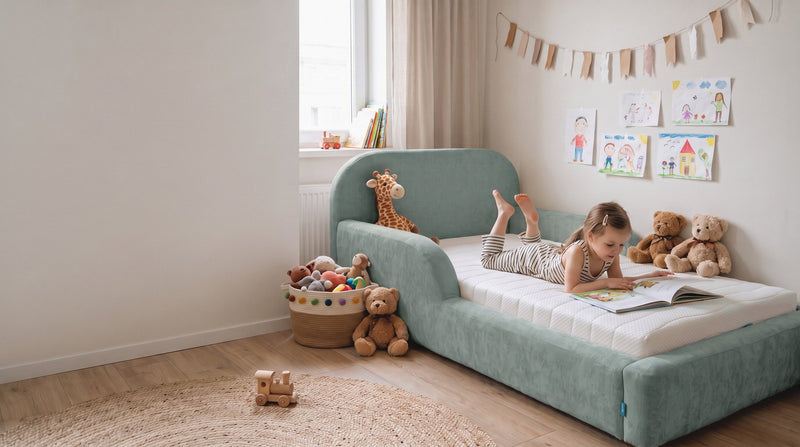
Conversely, some children wander out of the sleeping bag and then lie on the bare mattress at 17 degrees. Here a warmer duvet helps less than a bed that keeps the child in the bed at all: a low bed with soft, curved side bolsters gently holds the child towards the middle rather than letting them bump into a hard edge. If you are working on the sleep climate anyway, our overview of the sleep-friendly children's bedroom gathers the remaining levers.

Get CHF 25 off
Subscribe to the newsletter and receive a one-off CHF 25 discount. ✓ 100 nights' trial ✓ 5-year guarantee ✓ Free delivery
Frequently asked questions about room temperature in a children's room
How warm should a children's room be at night?
Around 18 degrees Celsius serves as the guide value, and a range of 16 to 20 degrees is unproblematic. More decisive than the exact number is that the temperature stays stable through the night and that the sleeping bag or duvet matches it.
How can I tell if my child is too warm?
Feel the back of the neck or between the shoulder blades. Warm and dry means correctly dressed; damp or hot means one layer less. Cold hands and feet are normal in children and say nothing about body temperature.
Can the window stay tilted open at night?
Better not permanently. A tilted window cools the walls, creates draughts and still exchanges little air. Vigorous ventilation directly before bedtime, with the window closed afterwards, is far more effective.
How high should humidity be?
Between 40 and 60 per cent is comfortable. In winter the heating often pushes the value below 30 per cent, which dries out mucous membranes. Regular bursts of ventilation, a bowl of water or a humidifier cleaned daily all help.
What if the room will not drop below 25 degrees in summer?
Black out consistently during the day, cross-ventilate only late in the evening, cover lightly and dress your child in a bodysuit rather than pyjamas. A fan is fine as long as it does not point directly at the child and stays out of reach.
Should I turn the heating off in the children's room at night?
Turning it off completely rarely makes sense, because the room then cools sharply towards morning – exactly when your child has kicked off the covers. A slight reduction of one to two degrees is usually enough.
This article is for general information and does not replace paediatric advice. If problems persist, please speak to your paediatrician.


