








It is 2.40 a.m., and for the third time this week that call comes from your child's room, the one that drags you out of deep sleep. When your child wakes up at night, you find yourself asking the same questions in the half-dark: hungry? Cold? A bad dream? Or do they simply want to come to us? The answer depends a great deal on when in the night the child wakes and how they behave. In this guide we show you the five most common causes, how to tell them apart by time and behaviour, and how to respond at night so that everyone gets back to sleep as quickly as possible.
The short answer: children wake at night because they briefly surface between two sleep cycles and then cannot go back to sleep on their own. The five most common reasons are a sleep association, hunger or thirst, disturbances such as heat, noise and light, developmental leaps and teething, and separation anxiety. Waking in the first half of the night tends to point to overtiredness or a night terror, in the second half more to dreams or fears. Responding calmly, briefly and in the same way every night is the most important tip.
- Brief waking between sleep cycles is normal in children; the question is why the child doesn't go back to sleep on their own.
- Time and behaviour reveal a lot: screaming after 1 to 3 hours, crying after midnight or calling out in the early morning have different causes.
- At night the rule is: little light, few words, no programme, always the same response.
- Keep the room at around 18 °C, dark and quiet; adjust the blanket to the season.
- With snoring, pauses in breathing, fever, pain or fear that persists during the day, see your paediatrician.
Why a child wakes at night – time and behaviour as clues
Sleep consists of cycles, which are shorter in young children than in adults. At the end of each cycle comes a brief phase in which the child is almost awake. In the first half of the night, deep sleep predominates; in the second, light sleep and dream sleep. That is why the time often says more about the cause than the crying itself: a child sitting up screaming in bed at 9.30 p.m. is experiencing something different from one quietly calling for Mum at 4 a.m.
| When and how the child wakes | Likely cause | First step |
|---|---|---|
| 1–3 hours after falling asleep, screams, unresponsive, doesn't remember | Night terror, often with overtiredness | Do not wake, keep safe, earlier bedtime |
| Several times a night, calls for you, goes straight back to sleep with your help | Sleep association | Phase out the sleep aid in the evening |
| Sweaty, kicks off the blanket, tosses and turns | Too warm, disturbances | Cool the room, lighter blanket |
| Cries, complains of pain, red cheek, fever | Teething, infection, growing pains | Comfort; with fever or if it persists, paediatrician |
| Second half of the night, awake, frightened, wants to come to you | Nightmare, separation anxiety | Comfort briefly, settle in their own bed |
| Awake and lively from 5 a.m. | Sleep need met, bedtime too early, light | Check bedtime, darken the room |
Cause 1: the sleep association
In children from one year, this is the most common reason for waking at night. If your child only falls asleep in the evening at the breast, with a bottle, in your arms or with your hand on their back, they link falling asleep with exactly that condition. When they wake briefly at night between two cycles, the condition is missing, and they call for it. Typically, they go straight back to sleep as soon as you provide the familiar help, and wake again one to two hours later. They are not "spoilt"; they have simply never practised falling asleep without that help.
So the place to start is the evening, not the night. Put your child to bed drowsy but still awake and reduce the sleep aid in small steps: from your arms into bed with a hand on their tummy, then only your voice, then a chair beside the bed, then the door. A reliable ritual makes this process considerably easier; you will find ideas in our article on bedtime rituals for toddlers. Allow one to two weeks for the new pattern to settle in.
Cause 2: hunger and thirst
For babies, night feeds are normal and necessary; discuss with your paediatrician or the parent counselling service when they can be phased out. In the second year of life, healthy children can usually manage without a night feed. If a toddler still wakes up hungry, it is worth looking at dinner: a bowl of soup alone won't last until morning. Carbohydrates with some protein and fat – bread with cheese, rice with vegetables, a yoghurt – keep them full for longer. For children who eat poorly in the evening, a piece of banana before brushing teeth is a good bridge.
Thirst is an underestimated issue in winter. Dry heated air in the flat makes children sleep with their mouths open, their throats get dry, and they wake up. A glass of water within reach, a damp cloth over the radiator or a brief airing before bedtime help. A sweet bottle for getting back to sleep, on the other hand, damages the teeth and becomes a sleep association in itself.

Cause 3: disturbances – heat, noise and light
In the light sleep phases, children register more than adults. The first tram at 5.10 a.m., the neighbour in the stairwell, the street lamp through the gap in the curtain, a room at 23 °C: any of these can turn half-sleep into real waking. The guideline for a child's room is around 18 °C. Check with your hand on the back of their neck whether the child is sweaty; cold hands, on the other hand, are no reason to wrap them up more warmly.
On light: in summer it gets light in Switzerland before 6 a.m. A blackout curtain or blind stops the early morning acting as an alarm clock. A night light, if needed, should be dim and warm-white and not shine directly onto the bed. Against noise, a rug, a closed curtain and, with siblings in the same room, a quiet, steady white noise help. You can read whether a room of their own already makes sense in our article From what age does a child sleep in their own room?
Get CHF 25 off
Subscribe to the newsletter and receive a one-time CHF 25 discount. ✓ 100-night trial ✓ 5-year warranty ✓ Free delivery
Cause 4: developmental leaps, teething and illness
When a child has slept well for weeks and suddenly wakes every night, a phase is often behind it. During developmental leaps – learning to walk, the language explosion, toilet training, starting playgroup or kindergarten – the brain processes huge amounts of new input at night. Such phases usually last one to three weeks and pass on their own. During this time, don't introduce new habits that you will have to undo afterwards, such as the parents' bed as a permanent solution.
Teething can cause restless nights again and again in the first two to three years of life, the molars often especially so. Red cheeks, dribbling, chewing on everything: a chilled teething ring in the evening and plenty of closeness help. Colds with a blocked nose make breathing difficult when lying down; a slightly raised head end and a saline nasal rinse before sleep bring relief. With earache, fever or night-time pain in the legs that disappears during the day, talk to your paediatrician. You can see how much sleep your child needs in our age-by-age guide to sleep needs.
Cause 5: separation anxiety and night-time fears
Between around 18 months and 3 years, separation anxiety is at its strongest. By now the child knows that you are gone when they wake up, but they cannot yet be sure that you will come back. Calling out at night is then the question: "Are you still there?" The answer should be reliable and always the same: go in briefly, speak calmly, rest a hand on them, leave again. This is how the child learns that you will come, but that the night is for sleeping.
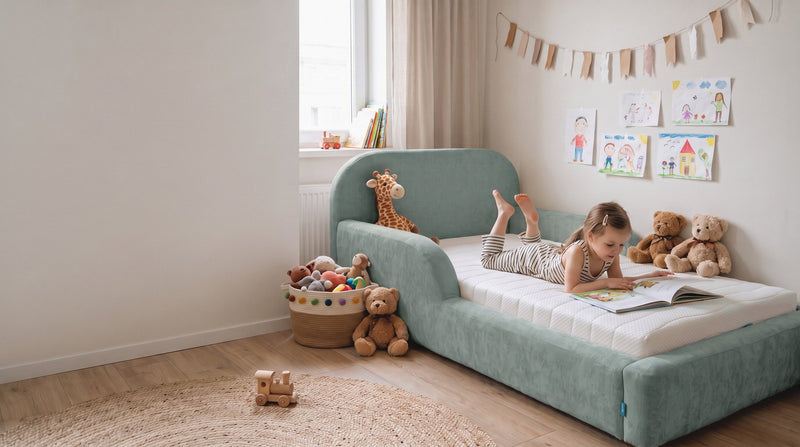
From around three years, imagination and dreams come into play. The shadow of the jacket on the hook becomes an animal, the creak of the wooden floor a monster. Take the fear seriously without confirming it: instead of "chasing away" the monster, look under the bed together and find that only yesterday's sock is lying there. A "guardian" cuddly toy, an open door and a dim night light provide security. The bed plays a part too: a softly padded rim feels more protected in the dark than an open bed with hard edges. There is more on this in our article on fall-out protection without bars.

How to respond correctly at night – step by step
How you respond in the first two minutes often decides whether the child is asleep again in five minutes or in an hour:
- Wait briefly. Count to 60 before you get up. Many children mumble, turn over and go back to sleep if nobody comes.
- Go in quietly and in the dark. No ceiling light, no phone screen. A dim night light in the hallway is enough.
- Check briefly. Feel the neck (sweaty?), the nappy (wet?), the forehead (hot?), the blanket (kicked off?). Fix only what is really necessary.
- Soothe without waking. A hand on the back, a quiet sentence like "It's night-time, I'm here, go back to sleep". No conversation, no play, no drink unless they are genuinely thirsty.
- Leave them in bed. Settle the child in their own bed where possible rather than picking them up; that way they link comfort with their bed.
- Leave as soon as they are calm. Don't wait until the child is deeply asleep; otherwise your staying becomes the new condition.
- The same every night. Agree between you as parents so that the response doesn't depend on who gets up.
Night terrors are the exception: don't soothe, don't wake, just make sure the child doesn't hurt themselves and wait until the episode is over.
Common mistakes with night waking
Rushing in immediately. If you are in the room at the first sound, you take away the child's chance to go back to sleep on their own. Waiting a minute is not neglect.
Waking the child up properly. Light on, nappy change, fetching a bottle, singing a song: every action signals "it's time to be awake".
Only working on the night. If you are consistent at night but still carry the child to sleep in the evening, you are fighting against your own sleep aid. The lever is at bedtime.
Giving up after three nights. A change often gets worse before it gets better, because the child is testing the new pattern. Give every change at least a week.
When you should talk to your paediatrician
Night waking is usually harmless. Have it checked if your child snores loudly, has pauses in breathing or constantly breathes through their mouth, complains of pain at night, has a fever, sweats heavily or wakes with a fear that stays with them during the day too. Likewise if they are constantly tired and irritable during the day despite enough time in bed, or if the frequent waking does not improve after four weeks of consistent implementation. In Switzerland, your paediatrician, the parent counselling service (Mütter- und Väterberatung) and the sleep clinics at the children's hospitals are the right places to turn to. A sleep log with times and behaviour helps the professional enormously. Sleep medication without a doctor's prescription is not a solution.

Frequently asked questions about waking at night
How often is waking at night normal?
Brief waking between sleep cycles is normal at any age. For babies, several waking phases a night are usual; for toddlers, occasional waking. If a child wakes more than two to three times a night over weeks and needs help every time, it is worth looking at the causes.
Should I bring my child into our bed at night?
If it suits all of you, there is nothing against it. If it becomes a strain, it is better to settle the child in their own bed and take them back calmly and always in the same way. During phases of illness or fear there can be exceptions, as long as you name them as such.
My child wakes up at the same time every night – why?
A fixed pattern suggests a cycle change at which the child regularly becomes almost awake, often combined with a sleep association or a disturbance at that time, such as the first tram or the heating. Check the environment at that time and phase out the sleep aid in the evening.
Is my child waking because of teething?
Teething can cause restless nights again and again in the first two to three years of life, usually for a few days. Red cheeks, dribbling and chewing are typical signs. If the waking lasts considerably longer than a week, something else is probably behind it.
What can I do if my child is afraid at night?
Take the fear seriously, but stay calm and matter-of-fact. Look together at what the noise or the shadow really was, give them a guardian cuddly toy and leave a dim, warm-white night light on. Avoid exciting stories and screens in the evening.
When should I talk to my paediatrician?
With snoring, pauses in breathing, fever, pain, heavy sweating or fears that persist during the day. Likewise if the waking does not improve after four weeks of consistent implementation. A sleep log makes the conversation easier.
This article is for general information only and does not replace paediatric advice. If problems persist, please consult your paediatrician.


