








The first call at 11 p.m., the second at 2 a.m., and at 4.30 a.m. your child is standing next to your bed: when a child won't sleep through the night, neither do the parents. After a few weeks, energy, patience and nerves run out. Yet occasional waking is part of childhood; the problem starts where the child cannot get back to sleep without your help. In this guide you will learn how much night waking is normal at what age, which seven causes are behind it and which two-week plan teaches your child to fall back asleep on their own. We also cover the mistakes that unintentionally stop children sleeping through.
The short answer: everyone wakes briefly at night between two sleep cycles. A child who won't sleep through has usually not learned to fall back asleep at that moment without help, because in the evening they only fall asleep while breastfeeding, with a bottle, being carried or holding a hand. Other reasons are too much daytime sleep, an unsuitable bedtime, hunger in younger children, physical complaints and disturbances in the room. If you gradually phase out the sleep aid in the evening and adjust sleep times and the environment, you will usually see calmer nights within one to two weeks.
- Brief waking between sleep cycles is normal – what matters is whether the child goes back to sleep on their own.
- The most common cause is a sleep association: at night the child needs the same help as when falling asleep.
- Limit the nap, align bedtime with the need for sleep, keep the room cool and dark.
- At night, respond calmly, briefly and always in the same way; phase out help step by step over two weeks.
- With snoring, pauses in breathing, pain or waking in fear, the issue belongs at the paediatrician's.
Is it normal that my child doesn't sleep through the night?
Yes, to a certain extent. Sleep runs in cycles of light sleep, deep sleep and dream sleep, and at the end of each cycle we wake briefly. Adults turn over and go back to sleep without noticing. In young children the cycles are shorter, the waking moments more frequent, and the ability to self-soothe first has to mature. A toddler who briefly opens their eyes, mumbles and goes back to sleep is "sleeping through". A child who calls out at every cycle change is not sleeping through, even though they wake just as often.
| Age | What is usual at night | What you can pay attention to |
|---|---|---|
| 0–6 months | Waking several times; night feeds are normal and necessary | On the back, own bed in the parents' room, no loose blankets or pillows |
| 6–12 months | Waking once or twice is common; longer sleep stretches become possible | Regular daily rhythm, discuss night feeds with your paediatrician |
| 1–3 years | Occasional waking is normal; falling back asleep without help is being learned | Phase out sleep associations, limit the nap |
| 3–6 years | Sleeping through is the rule; exceptions during illness, dreams, upheaval | Take fears seriously, keep up bedtime rituals |
A rule of thumb used by many paediatricians: if a child wakes more than two to three times a night over several weeks and needs your help every time, it is worth taking a closer look at the causes.
Cause 1: the sleep association – the most common reason
Imagine you fall asleep in your bed and wake up at 2 a.m. on the kitchen floor – you would be wide awake. That is exactly how a child feels who falls asleep in the evening at the breast, with a bottle, in your arms or while being stroked, and wakes up at 2 a.m. alone in a dark bed. The conditions for falling asleep are gone, and they have never practised going back to sleep without them. They call out, you restore the conditions – and the pattern repeats every night.
The solution therefore lies not in the night but in the evening: the child should learn to go to bed drowsy but still awake and take the last step themselves. The bedtime ritual then ends with a sentence like "Good night, I'm next door" instead of falling asleep on your shoulder. We show what such a ritual can look like in our bedtime routine from age 2. Importantly, the transition works step by step; you phase out the help over about two weeks, one stage at a time.
Causes 2 to 4: daytime sleep, bedtime and hunger
Too much or too late daytime sleep
A child who is still sleeping for two hours at 3.30 p.m. has hardly any sleep pressure at 7 p.m. They do fall asleep eventually, but more lightly, and wake more often during the night. For two- to three-year-olds, a nap of around 60 to 90 minutes, finished by 3 p.m. at the latest, has proven itself. You can read when your child is ready to give up the nap entirely in our article on dropping the nap.
Bedtime too early or too late
Too early means: lying awake for a long time, restless sleep. Too late means: overtiredness, stress hormones, light sleep and frequent waking in the first half of the night. A guideline: the child should fall asleep within 15 to 20 minutes. If it takes longer, bedtime is more likely too early; if they fall asleep immediately and wake up screaming after an hour, more likely too late.
Hunger
For babies, night feeds are normal and necessary. In the second year of life, healthy children can usually manage without a night feed. A filling dinner with carbohydrates and some protein – bread, rice, potatoes, yoghurt – helps; a sweet bottle just before falling asleep, on the other hand, is often a sleep association in itself.

Causes 5 to 7: complaints, night terrors and disturbances
Physical complaints
Teething, a blocked nose, earache, itching from dry skin or growing pains in the legs in three- to five-year-olds disturb deep sleep in particular. A sudden onset is typical: the child has slept through for weeks and now wakes up crying every night. For growing pains, gently massaging the calves and warmth help; for anything that lasts longer than a few nights or comes with fever, ask your paediatrician.
Night terror or nightmare
If your child screams one to three hours after falling asleep with wide-open eyes, cannot be calmed and remembers nothing in the morning, it is probably a night terror: do not wake them, just keep them safe. A nightmare tends to come in the second half of the night; the child is awake and looking for comfort. There is more on this in our article on night terrors in children.
Disturbances in the room
Children react more sensitively to stimuli than we do. A room that is too warm, street noise, light from the hallway under the door or a winter duvet still on the bed at the end of March: any of these can lead to full waking during the light sleep phase. The guidelines are around 18 °C, darkness and a light sleeping bag or a blanket that suits the season.
Get CHF 25 off
Subscribe to the newsletter and receive a one-time CHF 25 discount. ✓ 100-night trial ✓ 5-year warranty ✓ Free delivery
Common mistakes that prevent sleeping through
Reacting differently every night. One night bringing the child into your bed, one night firmly taking them back, one night singing for half an hour: the child has no idea what the rules are at night, so they try everything each time. Agree on one response as parents and stick with it for at least two weeks, even if Mum and Dad take turns.
"Waking the child up" at night. Switching on the light, talking loudly, changing the nappy even though it is dry, fetching a drink: the more action, the more awake the child becomes. At night the rule is: little light, few words, little programme.
Only tackling the night. If you are consistent at night but still carry the child to sleep in the evening, you are fighting against your own sleep association. The lever is at bedtime.
Giving up after three days. The first week is often harder than before, because the child is testing the new pattern. That is not a sign that it isn't working, but that they are learning right now.

The two-week plan for falling back asleep independently
The plan starts in the evening and accompanies your child gently, without leaving them to cry alone. It is suitable for children from about one year; for babies, discuss the approach with your paediatrician.
- Days 1–3: anchor the ritual. A fixed sequence of 20 to 30 minutes, always ending in the child's bed. You still stay with them, but the child lies in their own bed, not in your arms.
- Days 4–6: reduce contact. Instead of stroking, rest your hand calmly on the child; instead of singing, hum. At night you respond in exactly the same way: hand on, few words, no picking up.
- Days 7–9: increase the distance. You sit on a chair next to the bed without physical contact. If the child calls at night, you sit briefly on the chair and leave as soon as they are calm.
- Days 10–12: towards the door. The chair moves towards the door. At night your voice from the door is now often enough: "I'm here, go back to sleep."
- Days 13–14: independent. You leave the room after the ritual. At night you wait one to two minutes to see whether the child settles on their own.
| Cause | Measure | First effect usually after |
|---|---|---|
| Sleep association | Two-week plan, child into bed awake | 1–2 weeks |
| Too much daytime sleep | Shorten the nap, finish before 3 p.m. | 3–5 days |
| Wrong bedtime | Adjust in 15-minute steps | 1 week |
| Hunger | Filling dinner | Immediately |
| Disturbances | 18 °C, dark, quiet, suitable blanket | Immediately |
| Physical complaints | Paediatrician | Depends on the cause |
The sleep environment as an underestimated factor
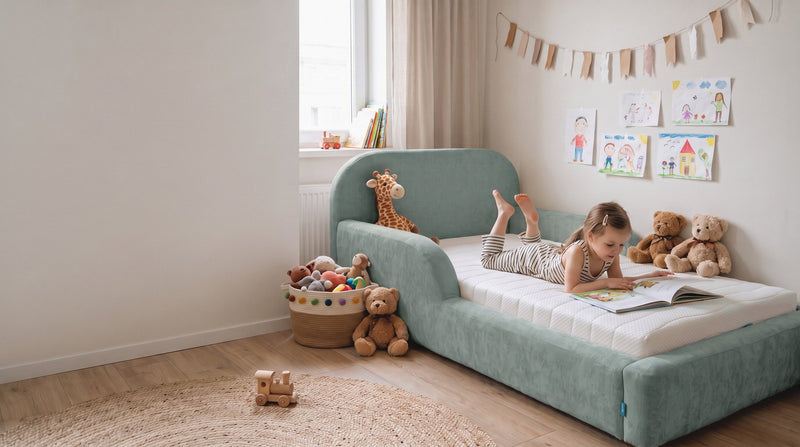
Whether a child goes back to sleep or calls out after briefly waking is decided in seconds. What counts then is what they perceive: are they sweaty? Is it bright? Does the bed feel familiar and protected? Children who have just moved from the cot to a big bed often wake more frequently in the first weeks because the familiar boundary is missing. A soft, padded rim that they can lean against when half asleep gives that feeling back without them bumping into hard edges. You can read how to support the move well in our article on the transition from the cot.
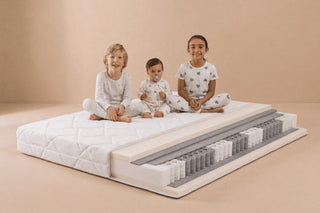
The mattress plays a part too. A mattress that is too soft or worn out leads to frequent turning; a mattress that traps heat leads to sweating and waking. For children from toddler age, a medium-firm, breathable mattress with a stable edge is suitable, so that the child lies safely even at the edge of the bed. A removable cover washable at 40 °C is worth its weight in gold for night-time accidents and for families with allergies. And a cuddly toy or comforter that is there every night is, for many children, the bridge back to sleep.
When you should talk to your paediatrician
Night waking is usually a matter of habit and rhythm, but not always. Have it checked if your child snores loudly, has pauses in breathing or sleeps with their mouth open; enlarged tonsils or adenoids can be behind this. Likewise if they complain of pain at night, sweat very heavily, are constantly tired during the day despite enough time in bed, or if the waking is linked to great fear that also persists during the day. If you see no improvement after four weeks of consistent implementation, sleep counselling makes sense; in Switzerland, the parent counselling service (Mütter- und Väterberatung) and the sleep clinics at the children's hospitals offer support. Take a sleep log of the last two weeks with you. We advise against sleep medication or dietary supplements without a doctor's prescription.

Frequently asked questions about sleeping through
From what age should a child sleep through the night?
That varies from child to child. Many children regularly sleep longer stretches at a time in their second year, others need until their third year. What matters is less the age than the question of whether the child falls back asleep without help after briefly waking.
Should I breastfeed my child or give a bottle at night when they wake?
For babies in the first months, night feeds are normal and important. Later it depends on whether the child is drinking out of hunger or because drinking has become a sleep aid. Discuss the timing of night weaning with your paediatrician or lactation consultant and reduce gradually.
Is it okay to let my child cry at night?
We recommend not leaving a child to cry alone. Gentle methods in which you stay present and reduce your help step by step work well for most children. Waiting one to two minutes to see whether the child settles on their own is something different from leaving them to cry.
Is it a problem if my child comes into our bed at night?
No, if it suits all of you and everyone gets enough sleep. If it becomes a strain, you can take the child back calmly and always in the same way, and make it easier for them to fall back asleep on their own with the two-week plan. A secure bed of their own makes this step easier.
How long does it take until my child sleeps through?
With consistent implementation, most families see calmer nights after one to two weeks. Setbacks during teething, illness or holidays are normal and usually pass quickly once you return to the familiar routine.
What if nothing helps at all?
If you have been consistent for four weeks and see no improvement, get support. The parent counselling service, your paediatrician or a sleep clinic at the children's hospital help to find hidden causes.
This article is for general information only and does not replace paediatric advice. If problems persist, please consult your paediatrician.


