



Somewhere between the second and the fourth birthday it happens in almost every family: the child who used to fall asleep in the dark without a murmur suddenly wants light. And you are left with a question to which the internet gives two opposite answers. One says: any light at night disturbs sleep. The other says: a night light takes the fear away and helps children fall asleep. Both are true – just under different conditions. What matters is brightness, colour, position and age. A night light for children can be a small, quiet anchor of light near the floor, or a colourful lamp glowing in the field of view that keeps a child occupied for hours. We show you exactly where the line runs and how to get rid of the light again once it is no longer needed.
The short answer: a night light makes sense if it is very dim and warm, sits outside the direct line of sight and helps your child fall asleep alone or find the toilet at night. It becomes a sleep wrecker when it is bright enough to look at a picture book by, when it glows bluish-white, when it cycles through colours, or when it sits directly in your child's line of sight. As a rule of thumb: as dark as possible, as bright as necessary – and near the floor rather than on the bedside table. From around six years, most children no longer need a permanent light, though many want to keep it for a while longer, and that is fine.
- The question is not "light or no light", but how bright, which colour and where.
- Warm, reddish-yellow light stimulates the eye far less than cool white or bluish light.
- Near the floor behind or beside the bed beats the bedside table in the line of sight.
- Colour changes, projections and music belong to the falling-asleep phase, not to the whole night.
- Take fear of the dark seriously: a night light is a tool, not a solution – security comes from your presence.
How light at night affects children's sleep
The eye contains light-sensitive cells that tell the internal clock whether it is day or night. When light reaches them, the body throttles melatonin release and sleepiness declines. These cells do not respond equally to all wavelengths: short-wavelength, bluish light has the strongest effect, long-wavelength, reddish light the weakest. That is why the colour of a night light matters at least as much as its brightness.
Then there is the amount. A night light that makes the floor in front of the bed just visible sits well below one lux at the child's eye – less than moonlight. A lamp bright enough to read by quickly reaches fifty to a hundred times that. That is exactly where the range begins in which light can measurably influence sleep. In practice: if you can make out the letters on a book cover in the glow, it is too bright for a children's room. How blackout and a night light work together is described in our article on blacking out a children's bedroom.

When a night light really helps
There are four situations in which a night light does more good than harm. First, fear of the dark, which typically appears between three and six years, when imagination grows faster than the ability to separate fantasy from reality. Second, the night-time trip to the toilet, especially during potty training: a child who cannot find the way holds on instead and wakes fully. Third, waking after a nightmare, when a child has to reorient themselves in their familiar room. And fourth, moving into their own room or a new bed, where the light provides security for a few weeks.
In all of these cases the night light is a temporary tool, not a permanent fixture. That distinction matters: introducing it from the start as a transitional aid, and saying openly that it will go again later, makes weaning off it far easier. More on the fear phase is in our article on a child who is afraid of the dark.
When the night light becomes a sleep wrecker
Problems rarely come from the light as such, but from how it is implemented. Too bright is the most common mistake: many devices are designed for the changing table and give off far more light than needed. Too cool is the second: white and bluish LEDs stimulate the eye more strongly. Badly placed is the third: a light on the bedside table or on the opposite wall sits in the direct line of sight and is therefore the strongest light source in the room as soon as your child opens their eyes.
Devices with changing colours, star projections or built-in sound are particularly tricky. They are fascinating – and that is precisely the problem. A child watching the colours change is occupied, not sleepy. If you have such a device, use it deliberately during the ten minutes of the routine and then switch it off with a timer, rather than letting it run all night. The same applies to devices that keep a standby LED lit after switch-off: tape it over.
| Age | Recommendation | Brightness | Position |
|---|---|---|---|
| 0–12 months | Not needed, only for feeding or changing | Very dim, on briefly only | Dimmed lamp in the parents' bedroom |
| 1–2 years | Usually unnecessary, darkness is normal | Only if the child asks for it | Hallway or open door rather than the room |
| 3–4 years | The most common phase for a night light | Very dim, warm white or amber | Near the floor, behind or beside the bed |
| 5–6 years | Often still wanted, exit can be planned | Dim, reduce step by step | Near the floor or hallway light |
| From 7 years | Usually no longer needed | A torch within reach is enough | On the bedside table, switched off |
Colour, brightness and position: the three adjustments
On colour: warm beats cool. What you want are light sources with a very low colour temperature – amber, warm orange or muted red. Many LEDs sold as "warm white" sit at 2700 kelvin, which is considerably warmer than daylight lamps but still brighter than necessary. Colour-changing modes are unsuitable for staying asleep, whereas a calm, constant light stops being noticed at all after a few nights.
On brightness the rule is: you should just about be able to find the door handle but not distinguish colours. Devices with a stepless dimmer are therefore more practical than ones with two fixed settings. And on position: the light illuminates the floor, not the bed. Ideal is a socket below bed height, behind the head end or on the door side of the room – that way it marks the path without shining into your child's face.

Safety: what to check when buying
A night light is an electrical device in a children's room, and that deserves two minutes of attention. Plug-in models should sit firmly and not tilt; a device hanging crookedly in the socket should be replaced. Corded lamps must not be arranged so that the cable reaches the bed or becomes a trip hazard. Battery-powered models with a silicone shell are practical for small children because they can come into bed – provided the battery compartment is screwed shut and cannot be opened without a tool.
Also check whether the device becomes noticeably warm in use. Modern LEDs stay cool; if a night light gets hot, it belongs away from the bed and away from fabric. And one point that is easily forgotten: night lights with a remote control or app often flash briefly at night when reconnecting – which reliably wakes a child. Simple devices are the better choice here.
Step by step: phasing out the night light in three weeks
Week 1 – change the position. Move the light further from the bed, towards the door. Same brightness, just more distance. Three to four nights are enough to adjust.
Week 2 – reduce the brightness. Go to the lowest setting, or tape a piece of baking paper over the light surface. Talk about it beforehand so it is not a surprise.
Week 3 – limit the time. The light stays on only until your child falls asleep, then a timer switches it off. Explain that they may switch it back on themselves at any time – that control matters more than the darkness.
Afterwards. Replace the permanent light with a torch or a push light beside the bed. Many children use it two or three times and then forget about it.
Important: take only one step at a time, and put the plan in a calm stretch with no nursery change, house move or new sibling. If you hit a setback, go back one step rather than starting again from scratch.
Myths fact-checked
"A night light causes short-sightedness." This claim goes back to an older study that later research did not confirm. On current evidence the connection is regarded as unproven.
"A child who needs light is not independent enough." Fear of the dark is a normal developmental phase, not a parenting problem. It shows that imagination is growing.
"Red light is harmless at any brightness." Colour matters, but quantity remains decisive. Red light can also disturb sleep if it is bright enough.
"A night light helps a child sleep through." It helps them get back to sleep after waking. It does not change how often they wake – that depends on sleep quantity, rhythm and environment, as we describe in our article on children who do not sleep through.
When your child is still afraid despite the night light
Light alone does not dissolve fear. What helps is the combination of predictability, closeness and a room in which nothing unexpected happens. Concretely: the same routine in the same order, a short walk around the room together before bed, a clear statement of when and how often you will look in, and a transitional object such as a soft toy. Take the fear seriously without magnifying it – so do not search under the bed for monsters, but show that the room is safe.
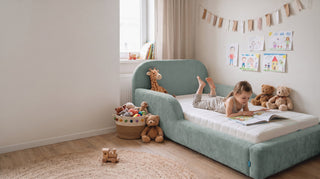
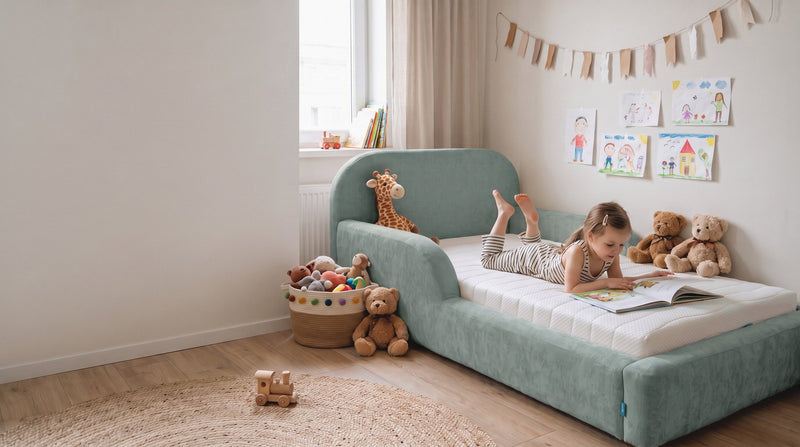
A second, often overlooked point is the bed itself. A high bed with hard edges and an open side feels exposed at night. A low bed with soft, curved side bolsters gives a perceptible boundary without confining – exactly in the phase when a child has come out of the cot and misses the familiar walls. If you combine the two, a calm warm light and a bed with a nest-like feel, the discussion about light usually lasts only a few months.

Get CHF 25 off
Subscribe to the newsletter and receive a one-off CHF 25 discount. ✓ 100 nights' trial ✓ 5-year guarantee ✓ Free delivery
Frequently asked questions about night lights for children
From what age does a night light make sense?
Usually from around three years, when fear of the dark can appear. Before that children rarely ask for one, and in the first year of life no permanent light is needed in the room – for night feeds or changing, a briefly switched-on dimmed lamp is enough.
Which light colour is best?
Warm tones such as amber, warm orange or muted red. They stimulate the light-sensitive cells in the eye less than cool white or bluish light. Changing colours are unsuitable for the night because they hold attention.
How bright may a night light be?
Dim enough that you can just about find the door handle, but cannot distinguish colours or read text. If you can make out a book title in its glow, it is too bright.
Does a night light cause short-sightedness?
On current evidence, no. An older study had suggested such a link, but later research could not confirm it. Today's discussion about short-sightedness centres mainly on too little daylight outdoors.
Is an open door better than a night light in the room?
Often yes, because the hallway light arrives indirectly and is not in the line of sight. What matters is that the hallway lamp is warm and dim and that nobody switches on the ceiling light at night.
How do I wean my child off the night light?
In three steps over about three weeks: first move the light further from the bed, then reduce the brightness, finally use a timer that switches it off after your child falls asleep. Leave your child in control of being able to switch it back on themselves.
This article is for general information and does not replace paediatric advice. If problems persist, please speak to your paediatrician.

