


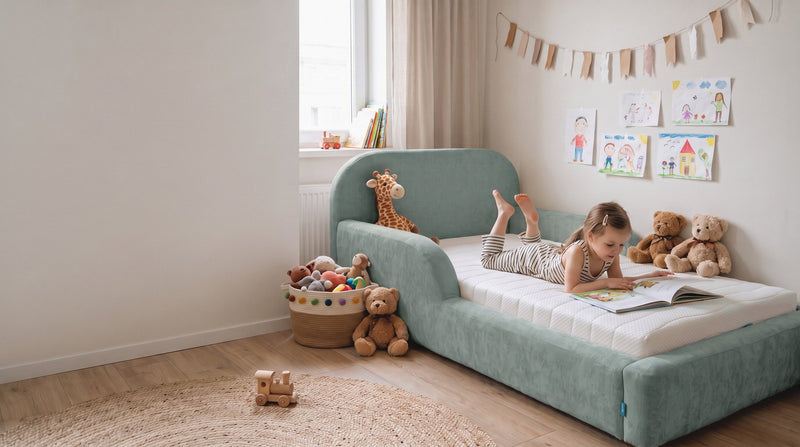

The cot is getting too small, and suddenly you are facing a decision that will stay with you for the next eight to ten years: which children's bed size is the right one – 90 or 120 cm? Many parents in Switzerland know the situation: the children's room in the city flat measures perhaps ten square metres, your child still wants to cuddle up and be read to in the evening, and in a few years a sibling may come along. Alongside the two main formats, there are also the in-between sizes 70×140 and 80×160 cm, often marketed as a "junior bed". This guide compares all four sizes objectively, shows you how to work out the space needed in the room, and gives you a clear decision aid. That way you will find the bed that suits your child, your room and your budget.
The short answer: for most children, 90×200 cm is the most sensible children's bed size: it fits into almost any room, lasts into the teenage years, and mattresses and bedding are available everywhere. 120×200 cm is worth it if you regularly get into bed with your child to read or comfort them, if your child is a very restless sleeper, or if the room is big enough. The in-between sizes 70×140 and 80×160 cm are cheap, but they have to be replaced again after just a few years. If you only want to buy once, choose 200 cm in length.
- 90×200 cm is the classic single-bed size: space-saving, inexpensive to equip and usable into the teenage years.
- 120×200 cm offers room for cuddling, reading aloud and restless sleepers, but needs around 30 cm more room width.
- 70×140 and 80×160 cm are transitional sizes that are usually replaced before school age.
- Work with the bed's outer dimensions, not the sleeping surface – upholstered beds add 12 to 15 cm.
- The deciding factors are room size, your child's temperament, shared rituals in bed, and whether a sibling will use it too.
The common children's bed sizes at a glance
Four sizes are widespread in Swiss children's rooms. Two of them are genuine transitional formats, two accompany your child well into school age. The table shows what you can expect from each size.
| Size (sleeping surface) | Typical age | Period of use | Mattresses and bedding | Space required |
|---|---|---|---|---|
| 70×140 cm | approx. 2 to 5 years | short, new purchase needed afterwards | cot format, readily available | very little |
| 80×160 cm | approx. 2 to 7 years | medium, until about Year 1 | special size, smaller selection | little |
| 90×200 cm | from approx. 2 years until the teens | long, 10 years and more | standard, widest selection, inexpensive | medium |
| 120×200 cm | from approx. 2 years until the teens | long, 10 years and more | readily available, slightly more expensive | high |
The in-between sizes are mainly of interest if the room is really tiny or if you can take over a second-hand bed for a short time. If you are buying new, 200 cm in length is the better choice in the vast majority of cases: a child grows to around 115 to 125 cm by the time they start school, and in bed they need considerably more length than their height, because they stretch out, lie sideways and need space for a duvet and pillow. A 140 cm long bed is therefore often already too short at four or five.
Children's bed size 90 cm: the practical choice
The 90×200 cm bed is the classic, and for good reason. It fits even into narrow rooms, leaves space for a play rug or a small table, and is the cheapest to equip: mattresses, fitted sheets, mattress protectors and bedding in this size can be found in every department store and in every price range. Moving house is also easier, because the bed fits through almost any door and stairwell.
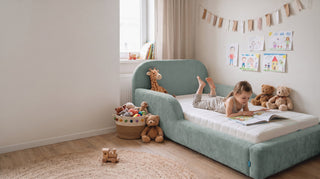
For children coming straight from the cot, 90 cm has another advantage: the bed feels manageable. Many two- and three-year-olds initially feel lost on a very wide sleeping surface, because they miss the familiar boundary of the cot. A narrower bed, ideally with a fall-out guard without bars, creates a nest feeling more quickly. The limits of the format show when two of you regularly lie in the bed: it is enough for reading aloud, but for falling asleep together it gets tight for an adult. And if a second child crawls in at night, the space is definitely used up. For calm sleepers and families where the bed is mainly there for sleeping, however, 90 cm remains the most sensible choice.
Children's bed size 120 cm: the comfortable choice
A 120×200 cm bed is often called a "small double", and that is exactly where its appeal lies. If your evening routine consists of reading aloud, cuddling and sometimes falling asleep together, the extra width makes a noticeable difference: a parent lies comfortably next to the child without balancing on the edge with one hip. Restless sleepers who lie sideways at night and turn over several times bump into the edge less often. And when siblings or friends stay over, two small children fit side by side without any problem.
The price for this is space. A 120 cm bed needs around 30 cm more room width than a 90 cm bed, and correspondingly more for upholstered models with their outer dimensions. In a room of ten square metres that is a noticeable difference; in one of fourteen, hardly at all. Mattresses in 120×200 cm are readily available in Switzerland, but the selection is smaller and prices are slightly higher than for the standard size. Bedding, on the other hand, is no problem: a normal Swiss duvet of 160×210 cm covers a 120 cm wide bed well too. Those who have the space and see the bed as a place for shared rituals rarely regret the larger version.

Room size: how to work out the space needed
The most common mistake when buying a bed: parents calculate with the sleeping surface instead of the outer dimensions. A wooden bed with a 90×200 cm sleeping surface is quickly 100×210 cm on the outside, and an upholstered bed with soft edges is around 12 to 15 cm wider and longer than its sleeping surface. Add to that the space you need around the bed: at least 60 to 70 cm along the long side, so that you can make the bed and your child can get in and out comfortably. Less is needed at the foot end if there is a wall there.
A worked example: your child's room measures 2.6 by 3.8 m, so just under ten square metres. A 120 cm bed with an upholstered edge takes up around 135×215 cm on the outside. If you place it lengthways against the short wall, 125 cm of room width remains next to the bed for the wardrobe, play area and the path to the door. That is doable, but tight. A 90 cm bed in the same spot leaves around 155 cm free, enough for a 60 cm deep wardrobe and a proper play corner. The best approach is to draw the floor plan with the window, door and radiator on squared paper, or to mark out the outer dimensions on the floor with masking tape. You will find more ideas for tight spaces in the article Furnishing a small children's room.
Get CHF 25 off
Subscribe to the newsletter and receive a one-time CHF 25 discount. ✓ 100-night trial ✓ 5-year warranty ✓ Free delivery
Decision aid: which size suits your child?
Room size is the first limit, but not the only criterion. Go through the following questions one by one – usually a direction emerges quickly.
- How does your child sleep? Calm sleepers who are still lying more or less as they were the night before are perfectly served with 90 cm. Restless sleepers who lie sideways and turn a lot benefit from 120 cm.
- Who else lies in the bed? If you regularly get in to read aloud or comfort your child, 120 cm is considerably more comfortable. For a quick goodnight kiss, 90 cm is enough.
- Is a sibling on the way? A 120 cm bed can be used by two small children for a while, for example when the younger one moves out of the cot and the room is shared.
- How old is your child at the changeover? For very young children around two, the nest feeling speaks more for 90 cm or for an upholstered bed, which offers a noticeable boundary even at 120 cm. To find out whether your child is ready at all, read the article When is my child ready for a big bed?
- How long should the bed last? If you do not want to buy again before the teenage years, choose 200 cm in length, regardless of the width.
If both options still fit after these questions, space decides. A bed that overwhelms the room is no fun, even if it is comfortable.

Common mistakes when choosing a children's bed size
Buying too small because the child is still small. A 70×140 cm bed looks right next to a two-year-old, but is too short at five. Then the next purchase is due, often right when school starts, when the child already has plenty of new things to cope with.
Forgetting the outer dimensions. Especially with upholstered beds, several centimetres are added. Anyone who only calculates with 90 or 120 cm will be surprised during assembly that the wardrobe door no longer opens.
Not checking doors and the stairwell. A bed is usually delivered disassembled, but the headboard can be a large piece. Measure door widths and tight landings, especially in older buildings.
Planning the mattress separately. Some beds are delivered without a slatted base or in a special size. Clarify before buying whether the slatted base is included and which mattress height suits the fall-out guard.
Changing the bed too early. Size alone does not solve sleep problems. When the move out of the cot is coming up, good preparation helps more than the biggest possible bed. You can read how to make the move a success in the guide to the transition from the cot.
Mattress, bedding and follow-up costs
The bed is not the end of it. Factor in the accessories from the start, because this is where the sizes differ more clearly than with the bed itself. A good children's mattress in 90×200 cm is available across a wide price range, because it is the best-selling size of all. In 120×200 cm the selection is smaller and the price is usually a little higher. 80×160 cm is a special size that not every retailer stocks.
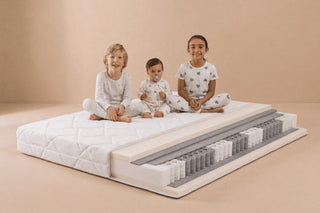
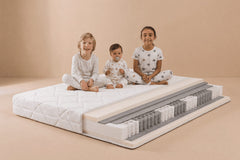
When it comes to bedding, Switzerland has an advantage: the usual duvet format of 160×210 cm fits both a 90 cm and a 120 cm bed. For smaller children, a children's duvet of 100×135 cm is more comfortable, because it is lighter and does not wrap around the child so easily. Fitted sheets and mattress protectors, on the other hand, must match the mattress size exactly, and here 90×200 cm is the cheapest and available everywhere. For the mattress, look for a stable edge so that your child does not sink in even at the side, a removable, washable cover, and sufficient load capacity in case you get into bed in the evening. A reversible mattress can also be turned regularly and lasts longer.

Frequently asked questions about children's bed sizes
Is a 90 cm wide bed enough until the teenage years?
Yes, 90×200 cm is the standard size for single beds and is used by adults too. With children, width is rarely the problem, it is more the length – and at 200 cm that is sufficient well beyond school age. Only tall teenagers sometimes wish for more space.
Is a 120 cm wide bed too big for a two-year-old?
Not as a rule. Some children enjoy the space, others initially feel lost on a large sleeping surface. An upholstered edge that gives the bed a noticeable boundary helps to create a nest feeling even at 120 cm. What matters more is that the child is ready for the change.
Is a junior bed of 70×140 or 80×160 cm worth it?
Only in exceptional cases, for example with very little space or if you can take over a second-hand bed for a short time. A 140 cm long bed is often already too short at four or five, and you have to buy a second time. If you only want to buy once, choose 200 cm in length.
How much space does a children's bed need in the room?
Allow for the bed's outer dimensions plus 60 to 70 cm of free space along at least one long side. With upholstered beds, the outer dimensions are around 12 to 15 cm larger than the sleeping surface. A floor plan on squared paper or masking tape on the floor quickly shows what is realistic.
Does standard Swiss bedding fit a 120 cm wide bed?
Yes, the usual duvet format of 160×210 cm covers a 120 cm wide bed well. Fitted sheets and mattress protectors, however, must be exactly 120×200 cm. For small children, a lighter children's duvet of 100×135 cm is often more comfortable.
Can I switch from 90 to 120 cm later?
Yes, that is possible at any time, provided the room has the space. Many families start with 90 cm and switch when a sibling comes along or the room gets bigger. If you know that from the start and have the space, though, choosing 120 cm saves you a second purchase.


