

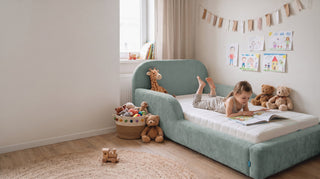

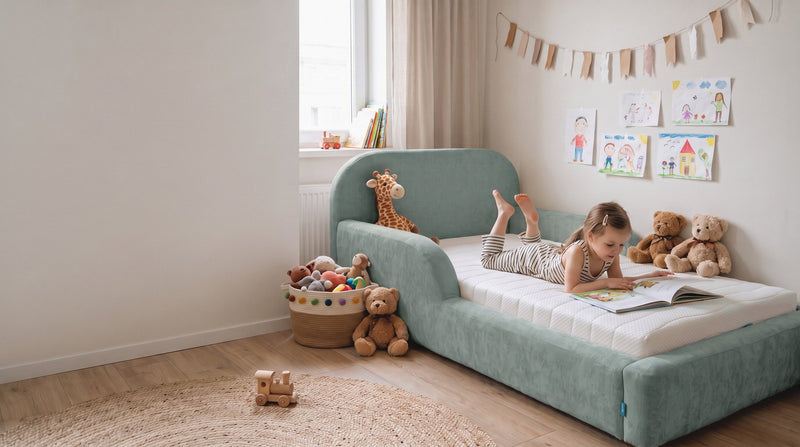

At around two, your child begins to see their room as their own little kingdom: this is where they want to pull the books off the shelf themselves, spread the building blocks across the floor and climb into bed in the evening without any help. Setting up a bedroom for 2 to 5-year-olds is therefore not about designing a beautiful room for adults, but a room built for someone 90 to 110 centimetres tall. Many parents in Switzerland face the same question: what does the room really need, and what just looks pretty on Instagram? The answer is surprisingly practical: clear zones, low furniture, storage at child height, three layers of light and a bed that safely accompanies the move from the cot. This guide shows you step by step what matters, with concrete measurements, an overview by age and a checklist to tick off.
The short answer: A good bedroom for 2 to 5-year-olds is divided into three zones (sleeping, playing, reading), has furniture the child can use independently and leaves as much floor space free as possible. The bed should have a low entry height of around 30 to 40 centimetres and soft fall protection. Storage belongs within the child's reach, and hazards such as tip-prone shelves and open sockets are consistently secured. A few calm colours and warm light in the evening round the room off.
- Think from the child's perspective: everything your child needs every day should be within reach at 90 to 110 centimetres.
- Three zones (sleeping, playing, reading) give the room structure, even in 10 square metres.
- The bed needs a low entry, soft edges and fall protection that does not feel confining.
- Anti-tip fixings, socket covers, window locks and cord-free curtains are a must, not a nice-to-have.
- Fewer toys, but open boxes and baskets that your child can tidy into themselves.
Thinking from the child's perspective: eye level and independence
The best furnishing tip costs nothing: crouch down and look at the room from about a metre off the ground. Suddenly the picture on the wall hangs somewhere in the void, the light switch is out of reach and the wardrobe looks like a wall. That is exactly how your child experiences their room. Between two and five, children want to do things themselves: take their trousers out of the drawer, fetch their favourite book, throw the building blocks back in the box. A room that makes this independence possible saves you dozens of "Can you pass me that?" moments a day.
In practice, that means: the bottom two shelves belong to the child, the upper ones to you. Coat hooks go at 80 to 100 centimetres, a small mirror at child height, pictures at 100 to 120 centimetres rather than at adult eye level. The drawer with tomorrow's daycare clothes is the bottom one. Anything dangerous or not meant for little hands moves up high or into a cupboard with a child lock. The result is a room in which your child is not a guest, but the host.
Three zones: sleeping, playing, reading
A child's bedroom has three very different jobs to do, and they work better when they are spatially separated. That works in a small room too; our article on the small child's bedroom shows how to manage it in 10 to 12 square metres.
Sleeping zone
Ideally, the bed stands with its headboard against a wall, not directly under the window (draughts, morning light) and not next to the radiator. This area should be calm and subdued: soft textiles, a small night light, no toys in sight. If the bed doubles as a cuddle den and story-time spot, it becomes the most familiar place in the room for your child.
Play zone
The play zone needs one thing above all: free floor. Two by two metres is enough for a wooden train set, a puzzle or a building-block city. A washable rug defines the area and dampens noise for the neighbours below you. Storage sits right next to it, so the journey is short when it is time to tidy up.
Reading zone
A beanbag or a low sofa, a shelf with the book covers facing forward, a warm lamp: that is all it takes. This corner is also your spot for the evening ritual and a retreat when everything got too much after kindergarten.
Safety in the child's bedroom: what really counts
Two- to five-year-olds climb, pull, lever and experiment. The Swiss Council for Accident Prevention (BFU) has been pointing out for years that most childhood accidents happen at home, and the child's bedroom is a classic. The good news: the most important measures are inexpensive and done in an afternoon.
- Anti-tip fixings: Every shelf, chest of drawers and wardrobe is fixed to the wall with brackets. Children use open drawers as a staircase.
- Sockets and cables: Safety covers in all unused sockets, cables run behind furniture or hidden in trunking. No floor lamp with a loose cable in the play zone.
- Windows: Lockable window handles or child locks, no furniture as a climbing aid directly beneath the window.
- Curtains and blinds: No loose-hanging cords or strings; screw curtain poles on firmly.
- Edges and small parts: Pad hard corners at head height, store toys with small parts for siblings separately.
For the bed: no hard edges at head height, no gaps between mattress and frame where an arm could get trapped, and fall protection that is soft. You can read why rounded, upholstered shapes have advantages here in the article on fall protection without bars.

Furniture heights by age: measurements that really fit
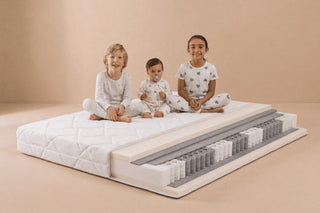
Children grow around 20 to 25 centimetres between the ages of two and five. So it is worth asking of every piece of furniture: does it fit now, and will it still fit in three years? A bed that grows with them in 90×200 or 120×200 centimetres, for example, accompanies your child from the cot into their school years; our guide to children's bed size 90 or 120 cm explains which width makes sense. The table below gives you guide values to adapt to your child's height.
| Age | Height approx. | Bed entry (top of mattress) | Table / seat height | Easily reachable shelf height |
|---|---|---|---|---|
| 2 years | 85–92 cm | 25–35 cm | 40–44 cm / 22–24 cm | up to approx. 90 cm |
| 3 years | 92–100 cm | 30–40 cm | 44–48 cm / 24–27 cm | up to approx. 100 cm |
| 4 years | 100–108 cm | 30–40 cm | 46–50 cm / 26–29 cm | up to approx. 110 cm |
| 5 years | 106–115 cm | 35–45 cm | 50–54 cm / 28–31 cm | up to approx. 120 cm |
Rule of thumb for the table: when your child is sitting, their feet should rest flat on the floor and their elbows should rest loosely on the tabletop. Height-adjustable children's tables and chairs are therefore one of the few purchases that pay off across the whole phase.
Get CHF 25 off
Subscribe to the newsletter and receive a one-time CHF 25 discount. ✓ 100-night trial ✓ 5-year warranty ✓ Free delivery
Storage that lets children tidy up themselves
The most common tidiness problem in a child's bedroom is not too little storage, but the wrong kind. A tall cupboard with lots of small compartments overwhelms a three-year-old; they do not know where things go and leave everything lying around. What works is coarse and visible: a few big categories instead of many small ones. A box for building blocks, a basket for cuddly toys, a crate for cars, a shelf section for puzzles. A photo or pictogram on the box helps, even before your child can read.
Tried and tested: low, open shelves (60 to 80 centimetres high) with pull-out baskets or fabric boxes, bed drawers or flat boxes on castors under the bed for seasonal items, and a coat rail with hooks at 90 centimetres for jacket, rucksack and snack bag. Clothes belong in a low chest of drawers whose top drawer is reserved for things you choose.
And then the most important trick: rotation. A third of the toys are in the room, two thirds are in the cellar or attic. Every four to six weeks, swap them round. The room stays clear, tidying takes five minutes instead of twenty, and your child plays more intensely with what is there.

Light in the child's bedroom: three layers instead of one ceiling light
A single bright ceiling light is the worst of all solutions in a child's bedroom: too glaring for story time, too dark in the play corner, and in the evening there is no way to bring the light down gently. Plan three layers instead.
- Base light: A ceiling light or several spots, dimmable if possible, with warm white light (2700 to 3000 kelvin). Cool white light above 4000 kelvin belongs in the workshop, not in a child's bedroom.
- Zone light: A wall light or clip-on lamp in the reading corner, a small table lamp on the craft table. Both without exposed cables within reach.
- Night light: A dim, warm night light with motion or timer control takes away the fear of the dark without disturbing sleep. Reddish or amber tones are gentler than white or blue light.
Think about daylight too. In the Swiss winter it is dark at 5 pm; in June it is still light at 9 pm. A blackout blind or a dense curtain helps with falling asleep and with the nap in summer. You can find out how wall colours and light interact and which tones support calm in the room in the article on colours in the child's bedroom.
Common mistakes when setting up a child's bedroom
Most mistakes come not from carelessness but from enthusiasm: parents want the room to be beautiful and complete, and forget that a two-year-old has different needs from an adult.
- Too many stimuli: Colourful wallpaper, mobile, wall stickers, fairy lights, bunting. The room looks cheerful, but the child struggles to settle in the evening. Better: walls in a muted tone, colour through textiles and a few consciously chosen elements.
- Furniture bought for later: A school desk at age three is too high and takes away play space. Buy what fits now or grows with them.
- Bed changed too early or too high: A tall teenager's bed without fall protection is not suitable for a two-year-old. The article When is my child ready for a big bed? shows how to tell that your child is ready.
- Storage on the floor: Large chests and baskets in the middle of the room eat up play space. Storage belongs against the walls and under the bed.
- Everything childproofed, nothing allowed: If nothing may be touched, the child learns nothing. Secure the real dangers, allow the rest.
Step by step: how to set up the child's bedroom
It is best to plan the room over a weekend before you buy anything. This order helps you avoid bad purchases.
- Measure and sketch: Room, windows, doors, radiators and sockets on paper or in an app. For the bed, think of the external dimensions, not just the sleeping surface.
- Define the zones: First the bed (against a wall, not under the window), then the play area (at least two by two metres free), then the reading corner in what is left.
- Choose a base colour: One calm colour for walls and large furniture, accents through cushions, rug and pictures.
- Prioritise furniture: Bed, low shelf, chest of drawers, somewhere to sit. Everything else is optional.
- Secure: Anti-tip fixings, sockets, windows, cables. Only then do the toys move in.
- Install lighting: Dimmable base light, reading lamp, night light.
- Tidy in with your child: Let your child help decide which box goes where. What they have put away themselves, they will find again.
- Review after four weeks: What is always lying around? What is never used? Then adjust.
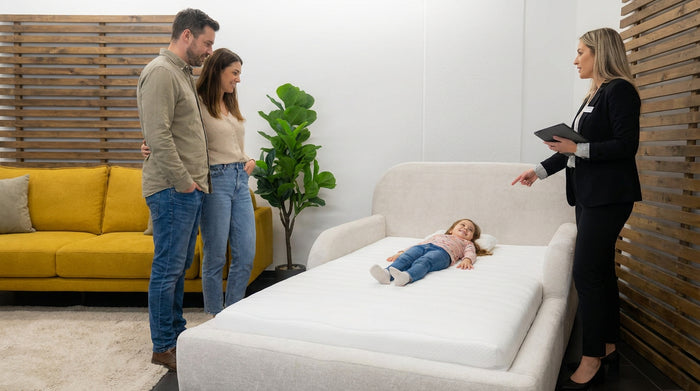
If the move from the cot to a big bed is part of the project, plan it as a separate step and not on the same day as the makeover.

Frequently asked questions about setting up a child's bedroom
How big should the free play area in a child's bedroom be?
As a guide, allow at least three to four square metres of free floor space, i.e. an area of roughly two by two metres. That is enough for building blocks, puzzles or a wooden train set. In small rooms you gain this space by moving storage to the walls and under the bed.
How high can the bed be for a two- or three-year-old?
The top of the mattress should be around 30 to 40 centimetres above the floor so that your child can get in and out independently. Loft beds are not suitable for children under six. Soft fall protection makes sense until around the fourth birthday.
How many toys belong in a child's bedroom?
Far fewer than most parents think. A third in the room, the rest in the cellar or attic, rotated every few weeks. Children play with more focus when the selection is manageable, and tidying up takes only a few minutes.
What lighting is right for a child's bedroom?
Three layers: a dimmable, warm white base light of 2700 to 3000 kelvin, a reading lamp in the cosy corner and a dim, warm night light. Avoid cool white light and glaring lamps directly above the bed.
Do I have to childproof the bedroom completely?
Real hazards must be removed: tip-prone furniture, open sockets, unsecured windows, cords and hard edges at head height. Everything else your child may and should explore. A room where nothing is allowed holds development back.
Which colours are suitable for a toddler's room?
Muted, warm tones such as sand beige, sage green, powder pink or light grey feel calm and stay usable for a long time. Bold colours are better used as accents through cushions, rug or pictures, not on large surfaces.


