


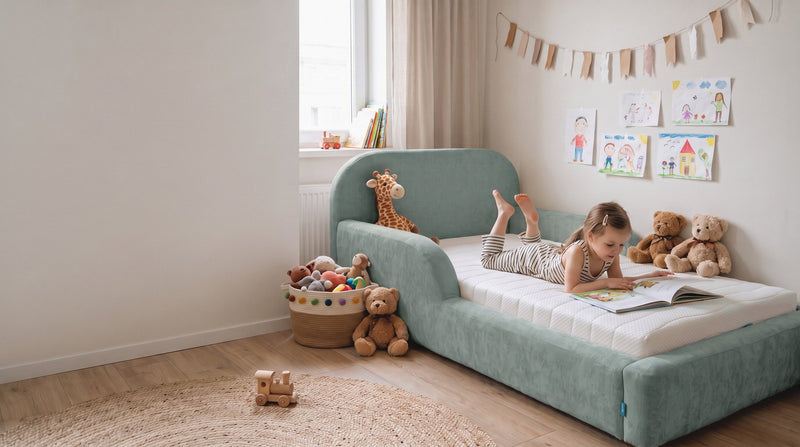

In many Swiss rented flats the child's bedroom measures 10 to 12 square metres, and in older buildings in Zurich, Basel or Bern sometimes only 8 or 9. That space has to hold a bed, storage for clothes and toys, a play area and, at some point, a table, and still the room should not feel like a box room. Anyone setting up a small child's bedroom is therefore fighting less with taste than with centimetres. The good news: small rooms are no disadvantage for children, as long as the floor stays free and the furniture respects their height and their measurements. In this guide you will find seven tried-and-tested tricks, a table showing the real footprint of typical children's furniture, and an example of how an 11-square-metre room can be divided up.
The short answer: A small child's bedroom becomes big when the bed stands lengthways along the wall, storage moves upwards and at least two by two metres of floor stay free. For the bed, always work with the outer dimensions (for a 90×200 sleeping surface usually around 100 to 105 by 210 to 215 centimetres) and allow 60 to 70 centimetres of access on the open side. Multifunctional furniture, open shelves, calm colours and toy rotation do the rest. Anything not needed daily leaves the room.
- Measure first: draw the floor plan with the door swing, windows, radiators and sockets.
- Bed lengthways against the wall, work with outer dimensions rather than the sleeping surface, plan in the access area.
- Storage upwards: wall shelves and tall, anti-tip-secured cupboards instead of chests on the floor.
- Every piece of furniture does two jobs: bed with drawers, stool with storage, fold-down table.
- At least four square metres of free play space; rotate toys every few weeks.
Before furnishing: measure and know the real space requirements
Before you order so much as a shelf, you need three numbers: the room dimensions, the door opening and the space each piece of furniture takes up including access. A piece of furniture never needs only its footprint. Drawers have to open in front of a chest of drawers (around 50 centimetres), doors in front of a wardrobe (60 centimetres), and next to a bed a child has to be able to get in and out. The bedroom door also swings across roughly 80 by 80 centimetres that you must not block.
| Furniture | Typical outer dimensions | Access / movement area | Total space approx. |
|---|---|---|---|
| Children's bed 90×200 (sleeping surface) | approx. 100–105 × 210–215 cm | 60–70 cm along the long side | 3.4–3.7 m² |
| Children's bed 120×200 (sleeping surface) | approx. 130–135 × 210–215 cm | 60–70 cm along the long side | 4.0–4.4 m² |
| Chest of drawers, 3 drawers | 80 × 40 cm | 50 cm in front | 0.7 m² |
| Wardrobe, 2 doors | 100 × 60 cm | 60 cm in front | 1.2 m² |
| Low shelf with boxes | 80 × 35 cm | 40 cm in front | 0.6 m² |
| Children's table with chair | 60 × 60 cm | 50 cm for the chair | 0.7 m² |
| Free play area | 200 × 200 cm | – | 4.0 m² |
If you add up the table, you land at around 10 to 11 square metres. That is why access areas should overlap: the access to the bed is also play space, the space in front of the chest of drawers is also the route to the door.
Trick 1: the bed lengthways against the wall, planned with its outer dimensions
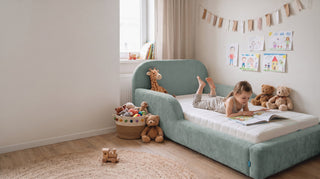
The bed is the largest piece of furniture in the room and decides everything else. If it stands lengthways along a wall, it only needs access on one side, and the middle of the room stays free. Ideal is a wall without a window and without a radiator, with the head end in a corner so that the child lies protected on two sides.
The outer dimensions are decisive. Many parents plan with 90 by 200 centimetres and then discover that the bed, with frame, headboard and fall protection, is 12 to 15 centimetres wider and longer. In a room 2.6 metres wide, that makes the difference between whether a chest of drawers still fits next to it or not. So always ask for the outer dimensions when buying and draw those in, not the sleeping surface. Whether 90 or 120 centimetres of width makes sense depends on the room and on whether you want to climb in at bedtime to read stories; you will find the trade-offs in the guide Children's bed size: 90 or 120 cm. In very small rooms under 9 square metres, 90 centimetres is almost always the right choice.
Trick 2: use the walls and think vertically
A 10-square-metre room with a 2.4-metre ceiling has around 30 square metres of wall space, and most of it is empty. Whoever moves storage upwards gains floor. In concrete terms: a narrow, tall shelf unit (40 centimetres wide, up to 200 centimetres high) instead of a wide sideboard, wall shelves above the chest of drawers, a row of hooks at 90 centimetres for jacket and daycare rucksack, and a second shelf at 180 centimetres for things only you need: winter clothes, photo books, the toys currently on a break.
The bottom 100 centimetres belong to the child; above that, the parents' zone begins. This two-way split makes the room both child-friendly and tidy. Important in rented flats: tall furniture is always fixed to the wall with anti-tip fixings. Two drill holes are filled in five minutes when you move out; a toppled shelf unit is a real accident. Above the bed, the walls stay free apart from light pictures, so that nothing can fall down. You can read how to check safety throughout the room in the article Setting up a bedroom for 2 to 5-year-olds.

Trick 3: choose multifunctional furniture
In a small room, no piece of furniture may have only one job. The bed is a place to sleep and storage: flat boxes on castors or a drawer under the slatted base take bedding, seasonal clothes or the toys on a break. A stool with a lid is a seat and a toy box. A fold-down table on the wall is a craft table and disappears again after the afternoon snack. A bench under the window is reading spot, storage and lookout platform in one.
The chest of drawers can do more too: with a changing mat it serves as a changing station in the first years, then as a clothes chest, and the top remains a surface for night light and books. When buying, it is worth asking: will my child use this piece of furniture at two and at six? A bed in 90 or 120 by 200 centimetres that fits from the move out of the cot right through to school not only saves money, but also saves a rearrangement of the room. Every piece of furniture you do not buy is the best space gain of all.
Get CHF 25 off
Subscribe to the newsletter and receive a one-time CHF 25 discount. ✓ 100-night trial ✓ 5-year warranty ✓ Free delivery
Tricks 4 and 5: open shelves and calm colours
Two tricks work not on the square metres but on perception. The first: open shelves instead of closed cupboard fronts. A wall of cupboard doors makes the room look smaller; an open shelf unit with boxes in matching colours looks lighter and shows the child where their things are. The rule for open shelves: no more than two thirds full, otherwise the impression tips from airy to chaotic.
The second trick is colour. Lots of different colours and patterns make a small room look even smaller. A light, muted base colour for walls and large furniture (sand beige, warm white, mist grey or a delicate sage green) lets the room breathe. If the bed picks up the same colour range, the largest piece of furniture merges with the wall and the room looks wider. Accents come through cushions, rug and pictures, which you can swap at any time. You can read which tones also help with falling asleep in the article on colours in the child's bedroom. Then there is light: pale curtains that leave the window clear, a mirror opposite the window at a safe height and wall lights instead of floor lamps bring a sense of space into the room without costing a centimetre of floor.

Tricks 6 and 7: keep the floor free and rotate toys
For a child between two and six, the floor is the most important piece of furniture. This is where they build, do puzzles, jump about and play with their friend from daycare. Four square metres of free space, roughly two by two metres, should be the goal. Everything standing on the floor that is not bed, shelf or chest of drawers comes under scrutiny: big chests, rocking horses, tents and play kitchens are lovely, but they block exactly the space the child needs.
The seventh trick solves the toy problem at the root. Not everything has to be in the room at the same time. Divide the toys into three boxes: one in the room, two in the cellar, the attic or the parents' wardrobe. Every four to six weeks, swap them round. Your child is delighted with the "new" toys, plays with more focus, and tidying up takes minutes instead of half an hour. It has also proved worthwhile to sort things out together after birthdays and Christmas: what is broken goes, what is too small is given away, and for every new toy an old one leaves the room.
Common mistakes in the small child's bedroom
Most space problems come from three wrong decisions that can be avoided.
- Planning with the sleeping surface instead of the outer dimensions: The bed fits on paper, but in the room it no longer fits next to the chest of drawers. Always use the manufacturer's outer dimensions and add the access area.
- Placing the bed across the room: Free-standing beds need access on both sides and divide the room into two unusable halves.
- Buying a loft bed too early: Loft beds are not suitable for children under six, and mid-sleepers only make sense from around four. Before that, a low bed with soft fall protection is the safer choice; the article on fall protection without bars shows why padding beats bars here.
- Furniture bought in advance: The desk for the first year of school stands in the way for three years. Buy what is needed now or grows with them.
- Storage on the floor: Chests and baskets in the middle of the room eat up the play space that actually makes the room feel big.
Example: 11 square metres in Zurich, step by step
Let us take a typical room in a Zurich housing-cooperative flat: 2.8 by 3.9 metres, door in the short wall, window opposite, radiator under the window. This is what the layout could look like.
- Bed: Lengthways along the long wall on the right, head end in the corner by the door, outer dimensions 104 by 214 centimetres. That leaves around 1.7 metres of wall up to the window.
- Storage: On the opposite long wall, a tall, narrow shelf unit (40 × 200 centimetres) next to the door and a chest of drawers (80 × 40 centimetres) beside it. Two wall shelves above.
- Play area: Between bed and chest of drawers, around 1.6 by 2.5 metres stay free, about 4 square metres. A round rug 160 centimetres in diameter marks it out.
- Reading corner: At the foot of the bed, on the window wall, a beanbag and a clip-on lamp on the shelf.
- Table: A fold-down table on the wall next to the window, only folded down for drawing.
- Under the bed: Two flat boxes on castors for bedding and the toy box on a break.
Test the layout before buying with masking tape on the floor: tape out the outer dimensions of the furniture and walk through the room with your child. Whatever feels cramped gets moved before anything is delivered.

Frequently asked questions about the small child's bedroom
How much free play space does a toddler need at a minimum?
As a guide, three to four square metres of free floor space, i.e. an area of roughly two by two metres. In a 10-square-metre room that is achievable if the bed stands against the wall and storage moves upwards.
Which bed fits in a room of 9 or 10 square metres?
A bed with a 90×200 cm sleeping surface and outer dimensions of around 100 to 105 by 210 to 215 centimetres, placed lengthways along the wall. Add 60 to 70 centimetres of access on the open side. A width of 120 centimetres only pays off from around 11 to 12 square metres.
Is a loft bed worthwhile in a small child's bedroom?
Loft beds are not recommended for children under six. A mid-sleeper can make sense from around four, because it creates a play or storage area underneath. For two- to three-year-olds, a low bed with soft fall protection is the safer solution.
How do I measure the room correctly?
Measure length, width and ceiling height, draw in the door with its swing area, windows, radiators and sockets. For each piece of furniture, note the outer dimensions plus the area needed to open it or get in. With masking tape on the floor you can test the layout before buying.
How do I prevent chaos in a small child's bedroom?
With a few big categories in open boxes at child height, toy rotation every four to six weeks and regular sorting out after birthdays and Christmas. Involve your child in tidying up early on; what they have put away themselves, they will find again.
Can two children sleep in a small room?
Yes, in 12 square metres it works with two beds lengthways along opposite walls, or with a bunk bed once the child on top is of school age. Shared storage moves to the walls, the play area stays in the middle.


