








At some point the question comes up: when do we put the cot away? Moving on from the cot to the first open bed is often the first major change a child experiences consciously. Some children move proudly, others want their bars back for three nights running. Whether it goes smoothly is decided less on the evening itself than by three things beforehand: the timing, an environment in which a child wandering about at night is safe, and whether you know the typical pitfalls. That is exactly what this article focuses on. If you are looking for the complete process in stages, you will find it in our guide From cot to children's bed in 5 steps; here it is all about the context.
The short answer: moving on from the cot goes smoothly if you schedule it in a calm period, childproof the room beforehand from your child's perspective and give your child a familiar nest feeling in the open bed. Avoid weeks with the start of daycare, the birth of a sibling, a house move or saying goodbye to nappies, and plan the switch for a free weekend. A low bed with a soft fall-out guard takes away the fear of falling out; the rest of the safety lies in the room: sockets, shelves, windows and stairs. Most children have settled in after one to two weeks.
- Timing beats technique: a calm period without other changes running in parallel is the most important stress factor you can influence.
- A child in an open bed is a child who walks around at night. The room and the route to the parents' bedroom must be safe for that.
- The nest feeling comes from a soft boundary, a sleeping bag or blanket, a cuddly toy and a protected spot against the wall.
- The most common pitfalls are time pressure, exceptions in the first week and a bed at adult height.
- Resistance does not mean your child is not ready; a "guardian" cuddly toy and a mattress on the floor help through the first few nights.
Why "stress-free" is above all a question of timing
Toddlers have a limited budget for change. Every transition, whether a new daycare group, saying goodbye to the dummy or a new sibling, costs adaptation energy, and that energy is only available once. If you schedule the bed switch in a week when something else is already new, two transitions compete for the same budget.
Then there is the parent factor. A switch in the middle of a stressful working week, when you have to be up at six, almost automatically leads to exceptions: "Fine, come into our bed tonight." It is precisely these exceptions that extend the transition by weeks. So stress-free also means: you yourselves have enough reserves in the first three to four nights to stay calm.
And finally, the child. If your child is not yet developmentally ready, the best timing will not help. Our article When is my child ready for a big bed? describes which signals count. If, on the other hand, your child is already climbing out of the cot, the balance tips: then waiting for the perfect week is riskier than a slightly bumpy start.
The right time: favourable and unfavourable periods
A firm rule: there should be at least three to four weeks between the bed switch and any other change, in both directions. If daycare starts in August, switch the bed in June or October, not during the summer holidays in between. The following overview helps with planning:
| Situation | Assessment | Recommendation |
|---|---|---|
| Calm weeks without appointments, free weekend | Ideal | Switch on Saturday so that two nights of buffer follow |
| Start of daycare, playgroup or kindergarten | Unfavourable | Keep a gap of at least four weeks |
| Birth of a sibling | Unfavourable | Switch two to three months before the due date or well after |
| House move or new bedroom | Unfavourable | Switch in the old room first, or only after settling in |
| Potty training in progress | Unfavourable | Finish one transition, then start the next |
| Wave of winter colds, teething | Wait | Postpone to a healthy week |
| Child climbs out of the cot | Urgent | Stop waiting for the perfect period |
The season plays a smaller role than many people think. In the Swiss winter it gets dark early in the evening, which makes falling asleep easier, but infections pile up. In summer it stays light for a long time and attic flats get warm, both of which make the first nights in an open bed harder. Spring and autumn are a good compromise, when the room reaches a comfortable 18 to 20 °C without any effort.
Make the room safe before your child can get up at night
In the cot, your child's radius at night was limited to 70 by 140 centimetres. In an open bed it is the whole room, often the hallway and the stairs too. So go round the room once on your knees, at the eye level of a two-year-old, and check these points:
- Sockets and cables: fit all reachable sockets with childproof covers, run lamp and charging cables behind furniture.
- Shelves and chests of drawers: fix them to the wall with anti-tip fittings. Children climb on furniture at night to reach something.
- Windows: lockable handles or child locks, no climbing aids such as chairs or chests under the window.
- Cords and strings: blind and curtain pull cords out of reach, no strings on the bed.
- Stairs and front door: a stair gate at the top, front door locked at night with the key out of reach.
- Small items on the floor: put away Lego, beads and batteries before bedtime, and install a motion-sensor night light in the hallway.
- Radiators and edges: do not place the bed directly against a hot radiator, pad sharp furniture edges near the bed.
Our article on the bedroom for 2 to 5-year-olds shows how to sensibly furnish a room for this age overall.

Nest feeling instead of emptiness: how to make the big bed feel familiar
Children fresh out of the cot are used to the feeling of a boundary around them. An open bed without that boundary does not feel like freedom at first, but like emptiness. The goal is therefore not to leave out the boundary, but to make it softer.
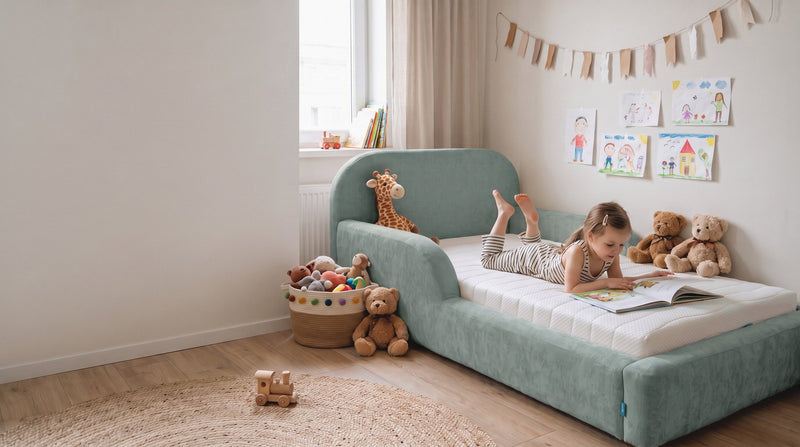
Four things create the nest feeling. First, the position: the bed stands with its long side against the wall and the headboard in a corner, not free-standing in the room. Second, a soft, continuous boundary along the open side that your child can lean against; our article on fall-out protection without bars explains why this form is safer than clip-on rails. Third, the familiar sleep system: if your child has been sleeping in a sleeping bag, keep it, because it provides security and stops them kicking themselves free at night. Switching to a blanket is a separate transition that can come a few weeks later. Fourth, smell and texture: the existing pillow or comfort cloth, the usual bedding and the cuddly toy move along too.
But do not stuff the bed full of pillows and soft toys to make it look smaller: one cuddly toy and a flat pillow are enough.
Get CHF 25 off
Subscribe to the newsletter and receive a one-time CHF 25 discount. ✓ 100-night trial ✓ 5-year warranty ✓ Free delivery
Myths fact-checked: what makes moving on from the cot unnecessarily stressful
Plenty of advice circulates around the bed switch that persists stubbornly but tends to make the transition harder. Five of these deserve a closer look:
- "The earlier, the better." Wrong. An 18-month-old cannot yet understand rules like "stay lying down"; an open bed overwhelms them. Without the pressure of climbing, there is no reason to switch before the second birthday.
- "A fall-out guard makes the child dependent." No. The soft boundary replaces the familiar bars and simply stops being needed over time. No child learns to stay in bed faster because they woke up on the floor.
- "The child has to be dry at night first." Not necessary. Both are separate developmental steps; all that is needed is a gap in time between the two transitions.
- "If they cry, they weren't ready." Protest in the first few nights is normal and shows that your child notices the change. Not being ready looks different: your child does not understand the rule after two weeks, or seems overtired and anxious during the day.
- "A mattress on the floor is always the safest solution." A floor bed has no drop height, but also no boundary and no clear "bed area". Many children roll out in their sleep and wake up shivering on the parquet. A low bed with a soft edge combines both advantages.

If your child simply will not stay in the new bed
Some children move without any problem, others get up ten times on the first night. Before you doubt the bed, check the basics: was the day full enough, was the bedtime routine as long as usual, is the room dark and cool? Then these strategies, tried and tested in many families, can help:
- The guardian: a particular cuddly toy is given the job of "looking after the bed".
- The chair beside the bed: for the first three nights, you sit on a chair beside the bed while your child falls asleep, then every second evening a little closer to the door.
- The safety net: a mattress or thick blanket next to the bed takes away your worry about falling out and your child's fear of it.
- The return formula: an always identical sentence when bringing them back ("It's night-time, your bed is here, I'm next door"), no discussion, no lights on.
- The morning anchor: a sleep-wake light or a fixed signal ("when the sun is on the blind") makes clear when getting up is allowed.
If there is no progress at all after two to three weeks, a break is legitimate, provided your child is not climbing and is not yet three years old. You can then make a second attempt in four to six weeks, this time with more lead time.
Special cases: siblings, the parents' bedroom and small flats
If the cot is needed for a new baby, talk about it openly, but do not switch in the week of the birth. The older child should already experience the new bed as their own before the baby moves in, otherwise they will link the loss of their bars to the baby's arrival. A gap of two to three months is ideal, and the big child can then ceremonially "give" the cot to the baby.
If your child still sleeps in your bedroom, the question arises whether the bed switch and the room switch should coincide. In most cases it is easier to switch the bed first in the familiar parents' bedroom and to tackle the move to their own room a few weeks later. You can read when children are ready for that in our article From what age does a child sleep in their own room?.
In small city flats in Zurich, Basel or Bern, space is often the problem: a 90×200 bed takes up around 105 by 215 centimetres including the frame, and the cot is supposed to stay next to it for another week. In this case, put the new bed against the wall where the cot used to be, and move the cot temporarily into your bedroom. With twins, switch both at the same time, otherwise one child's cot becomes a bone of contention.

Frequently asked questions about a stress-free move from the cot
Which day of the week is best for the switch?
A Saturday when you have no early appointments on Sunday and, ideally, Monday too. That gives you two to three nights of buffer in which you can stay calm without being under pressure in the morning. Avoid weekends with visitors or outings.
Can I switch the bed if a new baby is on the way?
Yes, but with a gap: ideally two to three months before the due date. That way the older child already experiences the new bed as their own before the baby moves into the cot. Straight after the birth, the switch is unfavourable because two changes then coincide.
Does the bedroom door have to be closed at night?
No, many children sleep more peacefully with the door open because they can hear you. What matters then is that the hallway, the stairs and the front door are secured. A stair gate and a motion-sensor night light in the hallway are usually enough.
Sleeping bag or blanket in the new bed?
For now, keep whatever your child is used to, usually the sleeping bag. It provides security and stops your child kicking themselves free at night. Switching to a blanket is a separate transition that you can tackle a few weeks later.
How do I recognise that my child really is not ready yet?
Not by the crying in the first few nights, that is normal. These signs are clearer: your child does not understand the rule "stay in bed" after two weeks, seems overtired and more anxious than before during the day, or is well under two years old. Then a break of four to six weeks makes sense, provided they are not climbing.
Is a floor bed the less stressful alternative?
Not necessarily. A floor bed has no drop height, but no boundary either; many children roll out in their sleep and wake up on the floor. A low bed with a soft, continuous edge combines the low entry with the familiar nest feeling.


