


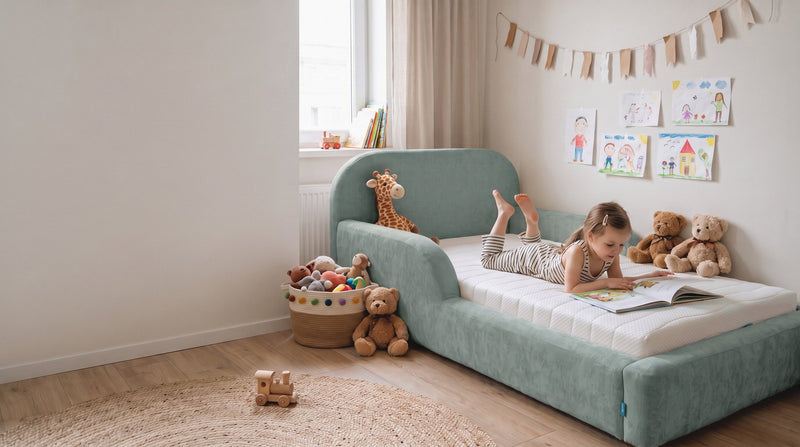

At what age does a child sleep in their own room? Hardly any question gets such different answers among Swiss parents, at playgroup or at the paediatrician's. On top of that comes the reality of many flats: in a 3.5-room flat in Zurich or Lausanne, the "own room" is often a shared siblings' room or half an office. For the first year of life there is a clear, official recommendation; after that, development, family situation and living space decide. In this guide you will find the recommendation of the medical associations, an overview by age, signs that your child is ready and a week-by-week plan for a transition without tears.
The short answer: In the first year of life, your baby should sleep in the parents' room, in their own bed and not in the parents' bed; that is the unanimous recommendation of paediatricians for preventing sudden infant death. After the first birthday there is no longer any medical requirement. Most Swiss families make the move at some point between 12 months and 3 years, many around the second birthday. What matters is not the age, but whether your child is ready and whether the transition is calm and gradual.
- First year of life: own bed in the parents' room, on the back, no loose blankets or pillows, room temperature around 18 °C.
- From 12 months the move is possible, but there is no "too late": at three or four it works well too.
- Do not move during a phase with other big changes (starting daycare, a new sibling, moving house).
- Go step by step: first the nap, then individual nights, then every night.
- The evening ritual stays the same; only the place changes.
The official recommendation for the first year of life
For babies the position is clear. Paediatric associations, including paediatrics Switzerland (pädiatrie schweiz), recommend that infants sleep in the parents' bedroom during the first year of life, but in their own bed: in a cot, a bedside crib or a cradle right next to the parents' bed. This recommendation is one of the measures proven to reduce the risk of sudden infant death. The closeness also lets you respond quickly at night, breastfeed or give a bottle without walking through the flat.
A safe sleep environment includes further points that you will also hear at the parent and child counselling service or from your paediatrician: the baby sleeps on their back, on a firm mattress, in a sleeping bag rather than under a blanket, without pillows, cot bumpers or cuddly toys in the bed. The room temperature is ideally around 18 °C, and the room is smoke-free. If you regularly take the baby into your bed, you should discuss this openly with your paediatrician, because bed-sharing in the first year carries risks, especially with very soft mattresses, heavy blankets or if a parent has smoked or drunk alcohol.
Important for the question of the own room: this recommendation applies to the first year of life. Some experts consider the first six months to be the decisive period; most Swiss recommendations say twelve months. If in doubt, talk to your paediatrician.
After the first birthday: what the experts say
From the first birthday, the question changes fundamentally. There is no longer any medical recommendation for or against an own room. Many paediatricians and sleep consultants therefore say: move when it feels right for you as a family, and not because the neighbour did it that way. Children who still sleep in their parents' room at two or three develop just as well as children who moved early.
What does influence development is separation anxiety. It often begins around the eighth month, peaks between roughly 12 and 18 months and then slowly tails off, differently for every child. A move in the middle of this phase is not forbidden, but needs more support: more time at the bedside, a familiar cuddly toy, a night light. From around two, your child understands simple explanations ("This is your room now, we're next door") and can help shape it, which often makes the transition easier. If your child wakes frequently at night during this time, that is normal, by the way, and not a sign that the own room was a mistake; the article My child wakes up at night explains the typical causes.
An own room at what age? Overview by age
The table summarises what is usual and recommended at which age. It is a guide, not a timetable.
| Age | Recommendation / usual | Sleeping place | What to watch out for |
|---|---|---|---|
| 0–12 months | Parents' room (official recommendation) | Own cot or bedside crib next to the parents' bed | On the back, sleeping bag, no loose blankets, approx. 18 °C |
| 12–18 months | Move possible, many still wait | Cot in own room | Separation anxiety high; move gently and with plenty of support |
| 18 months – 3 years | Most common window | Cot, later the first big bed | Not the room move and the bed move in the same week |
| 3–5 years | Move works well, child can have a say | Children's bed 90×200 or 120×200 cm with fall protection | Fear of the dark common; night light, clear rituals |
| From 6 years | Own retreat becomes important | Children's bed, shared siblings' room possible | Starting school brings new tiredness; protect sleep times |
One pattern stands out: the move to an own room and the move from the cot to a big bed often fall in the same phase. Deliberately plan both as two separate steps a few weeks apart.

Signs that your child is ready (and signs that they are still waiting)
Instead of looking at the calendar, it is worth looking at the child. These signals suggest the move fits well now:
- They sleep most nights without long wakeful periods or settle themselves again after a brief waking.
- They show interest in their own room, enjoy playing there and call it "my room".
- They understand simple explanations and can stay alone briefly, for instance while you are in the bathroom.
- Separation anxiety has clearly eased during the day, and the goodbye at daycare mostly goes well.
And these signals suggest waiting a few more weeks:
- Your child wakes several times a night and takes a long time to settle.
- They are in the middle of another big change: starting daycare or kindergarten, a new sibling, moving house, saying goodbye to the dummy.
- They are ill, teething heavily or going through a developmental leap with restless nights.
- They are showing new, strong fears, for example of the dark or of noises.
Get CHF 25 off
Subscribe to the newsletter and receive a one-time CHF 25 discount. ✓ 100-night trial ✓ 5-year warranty ✓ Free delivery
Swiss family reality: flats, siblings, the family bed
Guides often assume a free child's bedroom. The reality in Swiss cities looks different: families often live in 3.5- or 4.5-room flats, the second child arrives, and the home office has to go somewhere too. The own room is then often a shared siblings' room, a partitioned-off corner or a room that only exists after the next move. That is no disadvantage for your child. For many children, a shared room actually works particularly well, because the closeness of a big brother or sister makes the night less lonely. Just make sure that each child has their own, clearly recognisable sleeping place.
The family bed is also everyday life in many Swiss households, whether planned or simply because it is practical at night. From the first birthday there is nothing medically against it, as long as everyone sleeps well. But if the family bed leads to you as parents being chronically overtired, that is a legitimate reason for the move, with no justification needed. A good room does not have to be big, either: the article on the small child's bedroom shows how to fit a sleeping place, storage and play space into 10 square metres.

Step by step: the transition to their own room
A gentle transition takes two to four weeks, depending on the child. This plan has proved itself:
- Week 1, get familiar with the room: Play in the new room during the day, look at books, let the cuddly toy "move in". Your child may choose bedding or a picture. Talk about the move positively, but without pressure.
- Week 2, nap in their own room: The nap is shorter and less anxiety-laden than the night. Stay at first until your child has fallen asleep.
- Week 3, first nights: Start on a weekend when you are well rested. The evening ritual runs exactly as before, just in the new room; you can read how to build it in the article on the bedtime routine from age 2. Sit by the bed for the first few evenings and increase the distance over several days: first by the bed, then on a chair by the door, then outside the door.
- Week 4, reliability: Every night in their own room. If your child comes in at night, take them back calmly and kindly, without discussion and without turning on the light.
If the move out of the cot is due at the same time, do the room move first in the familiar cot and only the bed move some weeks later; the guide to moving on from the cot explains how to make it work.
Common mistakes when moving to their own room
- Too much at once: New room, new bed, dummy gone and starting daycare in the same week overwhelm any child. One step after the other, at least two to three weeks apart.
- The big cut: "From today you sleep in there" without preparation often leads to weeks of protest. Step by step is almost always faster.
- The room as punishment or reward: "If you don't listen, you'll have to go to your room" links the sleeping place with coercion. The room should be a place your child likes.
- Inconsistency out of tiredness: Once into the parents' bed, then three nights not, then yes again. Decide beforehand as parents what applies, and stick to it together.
- Ignoring fear: Fear of the dark is very common between three and five. A night light, an open door and the assurance that you are next door work better than "There's nothing there".
When it does not work: putting setbacks in perspective
Almost every family experiences phases when the own room suddenly stops working. After a cold, after the summer holidays in a shared hotel room or after the birth of a sibling, your child is standing at your bed every night again. That is not failure, but a normal reaction to change. Simply go back a few steps in the plan: sit by the bed for a few evenings again, slowly increase the distance, keep the ritual reliable. Usually the old sense of security is back after one to two weeks.
You should distinguish between normal night waking and unusual signs that deserve a check-up. If your child suddenly screams in panic at night, cannot be reached and remembers nothing in the morning, a night terror may be behind it; you can read what that is and how to respond in the article on night terrors in children. If your child snores loudly, breathes irregularly or is exhausted during the day despite enough sleep, talk to your paediatrician. Relaxed parents matter more for a child's sleep than the perfect room.

Frequently asked questions about a child's own room
From what age may a baby sleep in their own room?
Paediatric associations recommend that babies sleep in the parents' room during the first year of life, in their own bed right next to the parents' bed. Some experts name at least six months as the lower limit; most Swiss recommendations say twelve months. Discuss the timing with your paediatrician.
Is it harmful if my child still sleeps in the parents' room at three?
No. There is no evidence that sleeping in the parents' room up to preschool age harms development. What matters is that everyone in the family gets enough sleep. If that is no longer the case, a gentle move makes sense.
My child does not want to go to their own room, what should I do?
Pressure does not help, steps do. Start with playing and napping in the new room, then with individual nights, and stay by the bed at first until your child has fallen asleep. Increase the distance over several days. Also choose a time without other big changes.
What should I do if my child comes into the parents' bed at night?
That is very common and normal. Decide beforehand as parents whether you want to allow it. If not, take your child back calmly and without discussion, the same way every time. After a few weeks the behaviour usually fades.
Should the room move and the move out of the cot happen at the same time?
Better not. Do the room move first in the familiar cot and wait a few weeks until the new place feels natural. Only then comes the first big bed. That way only one thing changes at a time.
Does my child need a night light in their own room?
Not necessarily, but many children between two and five sleep more peacefully with a dim, warm night light, especially when fear of the dark appears. Choose a reddish or amber light with low brightness and do not place it right next to the head.
This article is for general information only and does not replace paediatric advice. If problems persist, please consult your paediatrician.


