



At some point in the night you hear that dull thud from the child's bedroom – and you know immediately what has happened. Toddlers roll and turn far more in their sleep than adults, and as soon as the cot has served its purpose, fall-out protection on the children's bed becomes the first question on parents' minds. Fall-out protection without bars sounds like a compromise to many at first: how is a soft edge supposed to keep a child in? In fact, organically shaped, upholstered edges are today a serious alternative to fixed bars and clip-on bed rails. In this guide we compare the four common types of fall-out protection objectively and explain why soft shapes work so well, especially during the move out of the cot. By the end, you will know which solution suits your child, your room and your family.
The short answer: good fall-out protection keeps a child in bed without confining them or becoming a source of injury itself. Fixed bars and clip-on rails hold reliably, but bring hard edges and pinch points with them. A floor bed does without protection altogether and relies on a low drop height. An organically shaped upholstered edge combines both: a noticeable but soft boundary that cushions any impact and at the same time allows your child to get in and out independently. For children from around two years who are moving from the cot to their first big bed, it is in many cases the most coherent solution.
- After the cot, toddlers generally need a boundary in bed until around the age of four or five.
- Four types are common: built-in bars, retrofittable clip-on rails, a floor bed without protection, and an upholstered, organically shaped edge.
- Hard bars protect against falling, but are themselves hard edges with potential pinch points.
- An upholstered edge cushions contact, creates a nest feeling and lets your child get in and out independently.
- Decisive when buying: the height of the edge, a stable connection to the bed, certified materials and a washable cover.
Why fall-out protection matters so much on a children's bed
In the cot, things were clear: four high sides, done. But as soon as a child moves to their first big bed, usually between their second and third birthday, that boundary is suddenly missing. It is precisely at this age that sleep is still very active. Children turn over several times a night, slide across the bed and often lie in a completely different position in the morning than when they fell asleep. Fortunately, a fall out of bed usually ends with nothing more than a fright, but depending on the bed height and the floor, bruises or cuts can also occur.
Accident prevention bodies therefore advise securing the sides of a toddler's bed or keeping the drop height as low as possible. That is one reason. The second is less obvious: children who feel safe in bed sleep more peacefully. A noticeable boundary provides orientation in the dark and has a calming effect, similar to the nest feeling of the cot, which many children initially miss when moving on from the cot. Fall-out protection is therefore not just a safety element but also a piece of security. So the question is rarely whether you need it, but which type suits your child.
The four types of fall-out protection at a glance
In Swiss children's bedrooms you will essentially find four solutions. Each has its justification, and none is wrong per se. The following table shows the most important differences at a glance.
| Type | How it works | Strengths | Limitations |
|---|---|---|---|
| Built-in bars | Wooden or metal bars as part of the bed frame, often with an exit opening | Very stable, clear boundary, tried and tested | Hard edges, pinch points between bars, quickly feels like a cage, conversion needed later |
| Retrofittable clip-on rail | Frame made of metal and fabric or wood, slid under the mattress or fixed to the frame | Inexpensive, fits almost any bed, removable | Can slip, gap between rail and mattress, hard bars, often wobbly |
| Floor bed | Mattress directly on the floor or on a very flat frame, no protection | Minimal drop height, full freedom of movement, inexpensive | Child still rolls out, draughts and cold at floor level, moisture under the mattress, no boundary for a sense of security |
| Upholstered, organic edge | All-round upholstered, curved edges as part of the bed, lowered entry | Soft contact, no pinch points, nest feeling, independent entry and exit | Higher purchase price, more space needed due to the padding, cover must be easy to care for |
Which option fits depends on your child's age and temperament and on the room: a restless-sleeping two-year-old needs something different from a calm four-year-old who will soon manage without protection.
Fall-out protection without bars: how an organic upholstered edge works
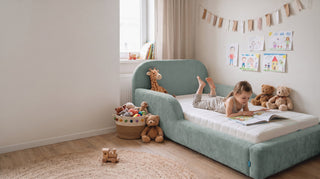
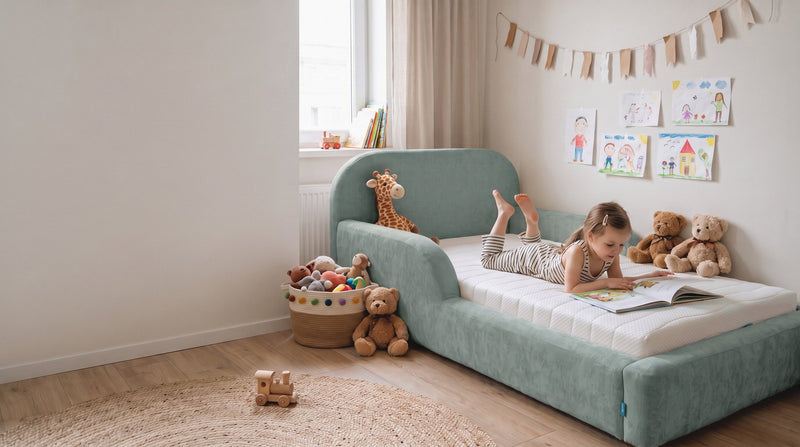
Fall-out protection without bars works on a different principle from a rail. Instead of a rigid barrier that stops the child, an upholstered edge forms a soft hollow. The edges are padded and curved all the way round: they are higher at the sides, and at the foot end or in the middle of the long side they dip down to form a low, child-friendly entry. If your child rolls to the edge at night, they first feel the soft raised section and usually turn back by themselves without waking up. At the same time, there are no bars for an arm or leg to get caught between, and no edge to bump their head on.
The second effect is psychological. Many children initially feel lost in a 90 or 120 cm wide bed because the familiar boundary of the cot is missing. An all-round upholstered edge recreates a nest feeling: the bed feels enclosed and secure without locking the child in. They can get up by themselves at any time, for example to go to the potty at night, and find their own way back. It is precisely this combination of support and freedom that makes organic shapes so well suited to the transition. What matters is that the edge is a fixed part of the bed and the cover is certified and easy to care for.

Where bars and clip-on rails reach their limits
Classic bars are not bad; they have brought generations of children safely through the night. Their weaknesses lie in the detail. Wooden or metal bars are hard: anyone who has ever bumped into a rail at night knows that it not only hurts but also wakes you up. Children who roll against bars in their sleep are therefore more likely to wake up than those who meet a soft surface. Then there is the risk of trapping: if the spacing between two bars is unfavourable, an arm or leg can get stuck, leading to fright and tears. For a child who often wakes at night, it is therefore worth considering whether the bed itself could be a trigger.
Retrofittable clip-on rails solve the problem of drop height but bring their own pitfalls. They are slid under the mattress and are held in place only by its weight. With light children's mattresses, they can tip or slip, and a gap quickly forms between the rail and the mattress that a child can slide into. As a stopgap for the first few weeks in the big bed or for the holiday flat, clip-on rails are usable. As a permanent solution for two or three years, they are usually less convincing than protection that is part of the bed from the start.
Get CHF 25 off
Subscribe to the newsletter and receive a one-time CHF 25 discount. ✓ 100-night trial ✓ 5-year warranty ✓ Free delivery
Myths fact-checked
"A soft edge won't hold a child." An upholstered edge is not a pillow that gets pushed aside. It is firmly attached to the bed and clearly higher than the mattress. Toddlers do not roll against the edge with a run-up; they slide slowly to the side. A soft but stable raised edge is enough for that. With children who deliberately climb, however, even bars will not hold them.
"Without bars, my child will constantly get up at night." A low entry makes getting up possible, but not more attractive. Whether a child leaves the bed at night depends far more on the bedtime routine and their sleep needs than on the bed.
"The higher the protection, the better." An edge that is too high prevents your child from getting in and out by themselves and turns the bed back into a cot. Ideal is an edge that rises clearly above the mattress but has a lowered entry.
"Padding is unhygienic." That depends on the cover. A robust, certified cover can be wiped down or cleaned. What matters is certification to OEKO-TEX Standard 100 and a fabric with high abrasion resistance so that it does not pill even after years.

Checklist: What to look for when buying fall-out protection
Whether bars, clip-on rail or upholstered edge: a few criteria apply to all of them. It is best to go through the list point by point in the shop or when buying online.
- Height above the mattress: the protection must still rise clearly above the mattress you have chosen. Otherwise a 16 cm high mattress "eats up" a large part of the edge.
- No gaps: no gap may form between the protection and the mattress that a child could slide into. With clip-on rails, check the fit with your mattress.
- Firm connection: the protection belongs to the bed and does not wobble. Loose parts are a hazard, not a protection.
- Edges and corners: everything your child can touch in their sleep should be rounded or padded.
- Material testing: for textiles look for OEKO-TEX Standard 100, for padding look for a flame-retardant finish.
- Care: with toddlers, a cover that can be cleaned is not a luxury but a must.
- Entry: can your child get into bed and out again independently? That is decisive for independence and for night-time trips to the toilet.
- Growing with your child: a bed with a 90×200 or 120×200 cm sleeping surface accompanies your child into school age. You can read which width suits in our guide to children's bed size: 90 or 120 cm.
From what age does a child no longer need fall-out protection?
Most children develop enough body control during sleep between the ages of four and five to stop rolling out of bed. Some get there earlier, others need the boundary right into kindergarten. There is no fixed cut-off date. It is better to observe your child: if for weeks they wake up in the morning roughly where they fell asleep and no longer roll to the edge at night, they are probably ready. You will find signs that a child is generally ready for more freedom in bed in our article When is my child ready for a big bed?
With a clip-on rail, you can reduce the protection step by step: first on one side only, then remove it entirely and put a folded blanket or a mat on the floor for a while instead. With a bed with an upholstered edge, the question does not even arise. The edge does not bother a six-year-old; it is simply part of the bed, which by now is used for reading, cuddling and playing. And when a parent gets into bed in the evening for story time, the soft edge is far more comfortable than bars in the back. The safety element thus becomes a comfort element, without you having to dismantle anything.

Frequently asked questions about fall-out protection without bars
From what age does fall-out protection without bars make sense?
An upholstered edge is intended for children moving from the cot to their first big bed, so usually from around two to three years. For babies and children under around 18 months, the crib or cot remains the right choice. An upholstered edge does not replace a cot in the first year of life.
Does a soft upholstered edge really keep a child in bed?
Yes, provided it is firmly attached to the bed and rises clearly above the mattress. Toddlers slide slowly to the side and usually turn back by themselves on contact with the edge. A child who deliberately wants to climb, however, will not be held back by any fall-out protection in the world, not even bars.
Is a clip-on rail a good permanent solution?
As a stopgap for the first few weeks in the new bed or for holidays, a clip-on rail is practical. For several years it is less ideal, because it can slip, gaps form next to the mattress and the bars are hard. In any case, check the fit with your mattress.
Does a floor bed need fall-out protection?
With a mattress directly on the floor, the drop height is so low that protection is not strictly necessary. However, your child still rolls out and then lies on the floor, which can be cold in winter. From a bed height of around 20 cm, a side boundary is recommended.
My child climbs over the fall-out protection – what should I do?
That is usually a sign that your child wants more independence or that the protection does not suit them. Check whether there is a safe entry so that they do not have to climb. If they get in and out safely, you can reduce a retrofitted protection step by step.
How do I care for upholstered fall-out protection?
Stains on the cover can usually be removed with a damp cloth and a mild cleaning agent. When buying, look for a robust cover with high abrasion resistance and certification to OEKO-TEX Standard 100. A mattress protector additionally guards against night-time mishaps.


