






"Just one more story!" Anyone who hears this sentence in the evening has actually already won. Your child does not want to leave you; they want to stay, in your voice, in your closeness, in the warm light of their room. That is exactly where the opportunity lies: reading aloud as an evening ritual turns bedtime from a chore into a moment that parents and child look forward to in equal measure. It strengthens the bond, it builds language, and it gives the day an ending that feels safe. At the same time, every family knows the other side: one story becomes four, the lights go out at 8:30 instead of 7:30 pm, and the loveliest moment turns into a drawn-out battle. This article shows why reading aloud in the evening is so valuable, how to shape the ritual, and how to set a loving limit on "just one more" without the ritual losing its magic.
The short answer: rituals like reading aloud in the evening make bedtime the loveliest moment of the day because they give your child two things at once: undivided closeness and predictability. Your child knows that this time comes every evening, and they know how it ends. That is precisely why "just one more story" can also be limited: with a clear announcement before reading, a fixed closing sentence and a goodbye that is just as loving as the story itself. The limit is not the opposite of closeness; it is part of it.
- 10 to 15 minutes of reading aloud in the evening are more valuable for bonding and language development than any other activity of the day.
- With "just one more", your child usually does not want the story but the closeness. You can respond to that without giving up the limit.
- The limit is set before reading, not afterwards: "One book, then lights out."
- A fixed closing sentence, a goodbye ritual and a bed that feels safe make the ending easier.
- The choice of books grows with your child: from picture books with repetition to read-aloud stories with several chapters.
Why reading aloud as an evening ritual achieves so much
Children spend their days on the move: playgroup, daycare, playground, siblings, shopping at Coop. The evening is often the only time when a parent does nothing else for ten or fifteen minutes than be with their child. No phone, no kitchen, no appointments. Your child senses this undivided attention very precisely, and it fills up something that experts often call the "attachment tank". A child whose tank is full in the evening can let go more easily and fall asleep alone.
Then there is language. When being read to, a child hears words that hardly ever come up in everyday life: "badger", "lantern", "shimmer", "hesitate". They hear whole sentences, sentence melodies and questions. Language researchers and paediatricians agree that regular reading aloud is one of the most effective things parents can do for language development, especially in multilingual families, of which there are many in Switzerland. Whether you tell stories in Swiss German, read aloud in standard German or in your family language is secondary. What matters is that it happens regularly.
And finally, predictability. Reading aloud comes at the same point every evening: after brushing teeth and pyjamas, before lights out. Your child learns that the story is the transition into the night. You will find an overview of what experts say about bedtime rituals in general in the article Bedtime rituals for toddlers.
What is really behind "just one more story"
Before you set the limit, it is worth taking a closer look. When a child wants a fourth story after the third, it is rarely about the book. Usually one of four needs lies behind it.
Prolonging closeness. Your child knows that after the story comes the goodbye. Another story pushes it back. That is not manipulation, but the honest wish to still be with you.
Keeping control. Two- to four-year-olds are in the middle of the autonomy phase. "One more" is a test: who decides here? These children need small choices within the limit, not negotiations about the limit.
Getting rid of excitement. A child who is still wound up after a day at kindergarten cannot switch off and looks for something to do. Here, more quiet time before reading helps, not more reading.
Fear of being alone. Around 18 months, at two years and during changes such as a switch of daycare, many children cling more. Then "one more" actually means "don't go".
If you know which need lies behind it, you can respond to that instead of just refusing the story: with two minutes of cuddling after the book, with a choice between two books, with a longer goodbye ritual. The limit stays, but your child feels seen.
How to shape the reading ritual: place, light, voice
Reading aloud works best when the surroundings play along. Three things make the difference.
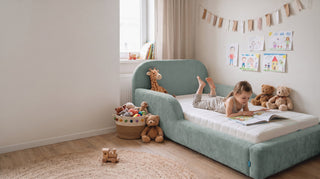
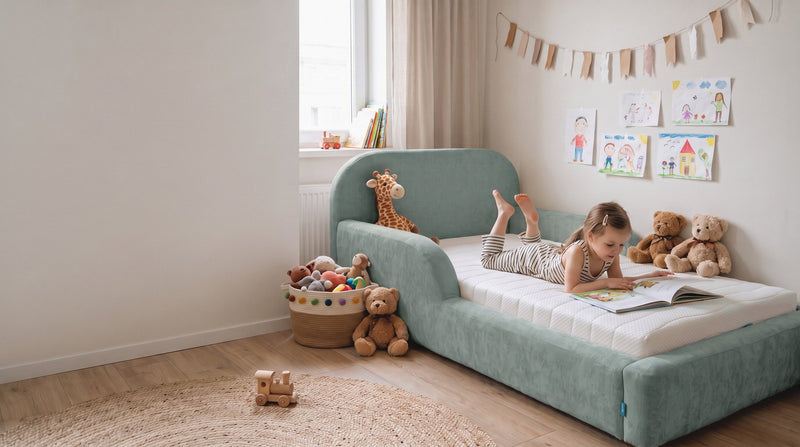
The place. Read in your child's bed, not on the sofa. That way your child associates the bed with the loveliest part of the evening and not only with being alone afterwards. Sit or lie down next to them. A bed that is sturdy enough for you to lean against makes this more comfortable for parents and turns it into a real nest for your child. Especially after the move from the cot, when the new big bed is still unfamiliar, reading together in it helps enormously. You can read how to make this move a success in the article From cot to children's bed in 5 steps.
The light. Ceiling light off, a small reading lamp or a warm night light on. Dimmed, warm light signals evening to the body. After the story, only the small lamp needs to go off.
The voice. At the start of the story it may be lively, with voices for the characters. Towards the end it becomes slower and quieter. Your child calms down with your voice. A look back after the book ("What was nice today?") is a good bridge to the goodbye, because it closes the day.

Setting a loving limit on "just one more": step by step
The limit works when it is set before the story, not afterwards. A child who gets a refusal in the middle of the loveliest moment resists. A child who knows the framework can accept it.
- Announcement before reading. "We're reading one book. After that we turn the light off."
- Your child chooses. Between two books, not from the whole shelf. The choice gives control without shifting the limit.
- Reading with a clear ending. The last page is read slowly, the book deliberately closed.
- Two minutes of closeness after the book. Cuddling, a look back at the day, a song. That is the answer to the need behind "one more", without needing another story.
- The goodbye phrase. Always the same: "Good night, I love you, see you in the morning." Then lights out and leave.
- If they protest: repeat kindly. "I know, you'd like one more. Tomorrow we'll read again. Now it's time to sleep." No discussion, no exception, no threat.
Allow about a week for your child to accept the new limit. Anyone who gives in on evening three starts again from scratch on evening four. What matters is that the limit never feels like a punishment: the story ends because the day ends, not because your child has done something wrong.
Get CHF 25 off
Subscribe to the newsletter and receive a one-time CHF 25 discount. ✓ 100-night trial ✓ 5-year warranty ✓ Free delivery
Which books suit which age?
Specific titles change, the categories stay. This overview helps with choosing at the library or bookshop. As a rule of thumb: books with a calm ending are suited to the evening ritual. Wild adventures belong in the afternoon.
| Age | Suitable book categories | Reading time | What your child gets from it |
|---|---|---|---|
| 12–24 months | Sturdy board books, books for naming things (animals, everyday objects), goodnight books with few words per page | 5–10 minutes | First words, pointing and naming, closeness |
| 2–3 years | Picture books with recurring phrases and rhymes, everyday stories (daycare, brushing teeth, sleeping), books about feelings | 10–15 minutes | Joining in, understanding sentences, processing everyday life |
| 3–4 years | Longer picture-book stories with a simple plot, animal stories, gentle reassuring stories (darkness, being alone) | 10–15 minutes | Retelling, asking questions, talking about fears |
| 4–6 years | Read-aloud books with short chapters, story collections, non-fiction picture books on favourite topics, first children's classics | 15–20 minutes | Coping with suspense, vocabulary, looking forward to tomorrow |
A tip for chapter books from age four: they are the most elegant solution to "just one more". One chapter per evening, and your child looks forward to the continuation instead of fighting the ending. Municipal libraries in Switzerland generally have well-stocked children's sections; a monthly visit with your child becomes a ritual in itself.

Common mistakes when reading aloud in the evening
- The limit is set after the story. Anyone who only says "that was the last one" after closing the book reaps protest. The announcement belongs before the first book.
- Reading aloud as a reward or punishment. "If you don't tidy up, there's no story" turns the ritual into a means of pressure. Reading aloud should take place every evening, regardless of how the day went.
- Books that are too exciting or too long. An adventure with an open ending or a 40-page book at 7:45 pm wakes your child up instead of making them tired.
- Screen instead of book. An audio story can complement a ritual; a video does not replace reading aloud. The bright display and rapid changes of image work against falling asleep.
- Your child is not allowed to join in. Questions, pointing and commenting are part of it, especially with two- and three-year-olds. Reading aloud is a conversation, not a lecture.
- Reading in the parents' bed or on the sofa. Your child falls asleep there and wakes up in their own bed, which tends to cause restlessness at night. If your child wakes frequently at night, you will find possible causes in the article Child doesn't sleep through the night.
When the goodbye is still hard
Some children accept the limit on reading without any problem and still cry when you leave the room. The problem then is not the story, but being alone afterwards. Three things help.
A guardian. The favourite cuddly toy is given a job: it keeps watch until you come back in the morning. For two- to four-year-olds this is not an empty phrase, but a real sense of security.
A gradual withdrawal. If you have been staying until your child falls asleep, shorten the time after the goodbye phrase by a few minutes each evening. Sit quietly on a chair without talking, and move the chair closer to the door from evening to evening.
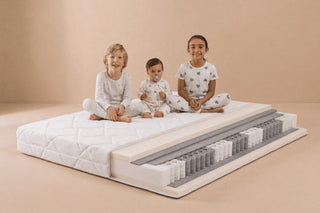
A bed that gives a sense of security. Children who feel safe in their bed are more likely to stay lying down. Soft edges, no hard corners, a feeling of being enveloped: this is especially important after the move from the cot, when the familiar bars are gone and the big bed still seems unusually wide. If you are currently wondering whether your child is ready for the big bed, the article When is my child ready for a big bed? will help.

Frequently asked questions about reading aloud as an evening ritual
From what age is reading aloud in the evening worthwhile?
From the first year of life, as soon as your child looks at pictures and responds to your voice. At first it is about closeness and sound, not the plot. From around 12 months, the book becomes a fixed building block of the evening ritual.
How long should reading aloud last?
For one- to two-year-olds, 5 to 10 minutes are enough; for three- to six-year-olds, 10 to 20 minutes is a good framework. If your child becomes more restless rather than calmer towards the end, it is too long or the book is too exciting.
Is it bad if I sometimes read a second story after all?
No, as long as it remains the exception and you announce it beforehand, for example at the weekend or during illness. It becomes difficult when the exception is granted in response to protest. Then your child learns that crying shifts the limit.
My child wants the same book every evening. Is that okay?
Yes, that is actually typical and valuable. Children learn through repetition; they soon join in and enjoy the predictability. Now and then, offer a second book as a choice alongside it, without pushing the favourite book aside.
Can audio stories replace reading aloud?
As a supplement, yes, for example for quiet time at midday or when a parent is ill. They do not replace reading aloud in the evening, because the undivided closeness and the conversation about the book are missing. Screens do not belong in the evening ritual.
What should I do if my child still can't fall asleep after reading?
Check bedtime, the daytime nap and the quiet time before the ritual. Often your child lies awake because they are not yet tired, not because the ritual was wrong. Stick to the sequence and shift bedtime in steps of 15 minutes.


