








Moving from the cot to a children's bed is one of those milestones that delights and unsettles parents in equal measure. Your child gains freedom, can suddenly get up on their own and feels "big". You, on the other hand, are wondering: when is the right time, which bed is the right one, and what do you do when your child is standing in the hallway five times a night? The good news is that the transition can be planned like a small project: with some lead time, clear stages and a plan for setbacks. This guide takes you through five steps, from the first conversation and the bed purchase to the first night when everyone sleeps through.
The short answer: the move from cot to children's bed works best in five stages: around two weeks of preparation with conversations and shared decisions, choosing a low bed with a soft fall-out guard, setting it up together as a small celebration, a first night with an unchanged bedtime routine, and two weeks of calm, consistent support. Most children need five to fourteen nights before the new bed feels normal. Setbacks are to be expected and are no reason to bring the cot back.
- Most children make the move between their 2nd and 3rd birthday; what matters are signals such as climbing, not the date.
- Allow around two weeks of lead time and pick a calm period without a house move, the start of daycare or the birth of a sibling.
- A low bed with a soft, continuous fall-out guard makes the transition easier and turns the floor beside it into a non-issue.
- The bedtime routine stays identical in sequence, timing and length – only the place your child sleeps changes.
- Expect five to fourteen nights of settling in and plan for setbacks from the very start.
Why the move is more than just a new piece of furniture
To you, the cot is a piece of furniture that has served its purpose. To your child, it is the only sleeping place they have ever known: the same smell, the same boundary, the same view on waking. Toddlers rely heavily on repetition, and it is precisely this predictability that disappears along with the cot. The new bed is more open, bigger and has no bars for your child to hold on to.
There is a second, often underestimated point: in the cot, the night was regulated from the outside. Your child could not get up, so the question never arose. In an open bed, they have to decide for themselves, for the very first time, to stay lying down. This self-regulation is a developmental task that takes time.
Well-prepared children experience the move as an honour ("I'm big now"); unprepared children experience it as a loss. The difference rarely lies in the bed itself, but in the two weeks before and after.
Step 1: Set the date and prepare for two weeks
Before you pick a date, check whether your child is ready. If your child is already climbing over the bars, the timing is no longer negotiable, because a cot is then less safe than an open bed. Our article on when a child is ready for a big bed explains which other signs count. If climbing is not an issue, the rule is: choose a calm period. No move in the week daycare starts, straight after the birth of a sibling or during a house move. Holiday time with sleepovers at the grandparents' is also unfavourable.
Once you have picked a weekend, preparation begins around 14 days beforehand:
- Day 14 to 10: talk casually about the big bed. Show pictures, mention that their cousin or their friend from kindergarten also sleeps in a big bed.
- Day 10 to 5: let your child have a say: the bedding, the colour, the night light. Two options are enough, otherwise the choice becomes overwhelming.
- Day 5 to 1: read a picture book about growing up, play "going to the big bed" with dolls or soft toys. This makes the topic familiar before it becomes real.
Step 2: Choose the right children's bed
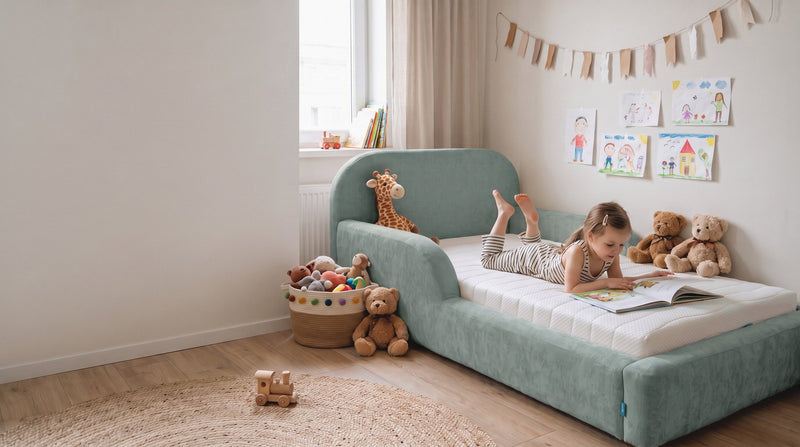
The first big bed needs to do three things: it must be low enough for your child to get in and out on their own, it needs a fall-out guard that provides security without feeling restrictive, and it should grow with your child for a few years. The entry height matters more than any question of design.
| Type of bed | Sleeping surface | Years of use | For the transition |
|---|---|---|---|
| Junior bed | 70×140 cm | usually until around age 5 | Low and reassuringly small, but a second bed purchase is soon needed |
| Children's bed 90×200 cm with soft fall-out guard | 90×200 cm | into school age and beyond | Good balance of nest feeling, space and longevity |
| Children's bed 120×200 cm with soft fall-out guard | 120×200 cm | into school age and beyond | Room for reading together; needs a larger bedroom |
| Standard bed without fall-out guard | 90×200 cm | unlimited | Open and often high; needs retrofitting or a mattress on the floor |
Whether 90 or 120 cm width makes sense depends on the room and on your reading habits; you will find the pros and cons in our article on children's bed size: 90 or 120 cm. The fall-out guard deserves a close look: clip-on rails made of wood or metal bring back the hard edges your child was just about to leave behind. Soft, continuous edges provide the same support but feel like a boundary to lean against. Our article on fall-out protection without bars explains why that is safer.

Step 3: Set up the new bed together
Assembly is not a logistics job to get done during nap time; it is the emotional heart of the transition. Set up the bed on the morning of the chosen day, when your child is well rested, and give them real tasks: passing the screws, helping to lift the mattress, smoothing the cover, placing the cuddly toy inside.
Then comes the inauguration, with no pressure to sleep: read a story in the new bed at midday, do a "test-lie" round with all the soft toys. This way the bed is first experienced as a place to play and cuddle, and only then as a place to sleep. An afternoon nap in the new bed is a gentle intermediate step if your child still sleeps during the day.
The cot stays in the room for now. It acts as visible reassurance: it is still there, but it is no longer needed. After about a week, once the new bed has been accepted, you remove it without any big announcement. If it is needed for a younger sibling, say so openly; most children are proud to "hand something down".
Get CHF 25 off
Subscribe to the newsletter and receive a one-time CHF 25 discount. ✓ 100-night trial ✓ 5-year warranty ✓ Free delivery
Step 4: The first night in the big bed
In the evening, a single principle applies: everything stays the same except the place. The same time, the same sequence of teeth brushing, pyjamas, story and song, the same length. If you have been reading two books so far, do not read three now to make up for the excitement. Extended rituals quickly become the new expectation. Our article on the bedtime routine from age 2 shows how a stable evening ritual is built at this age.
What is new is a short, clear rule that you say once before lights out: "You stay in your bed until it gets light. If you need something, you call, and I'll come." This wording takes away your child's fear of being alone while still setting a boundary. A dimmable, warm-white night light helps during the first few nights, because the room looks different from the new perspective.
If your child gets up, bring them back calmly, using the same few words, without discussion, without annoyance and without extra cuddles in the parents' bed. This may happen three to eight times on the first night. That is not a defeat; your child is testing whether the new rule holds. If the sequence is identical every time, the testing usually ends within a few nights.

Step 5: Support for two weeks and catch the setbacks
The second night is often calmer than the first, while the fourth or fifth is unsettled again. That is typical: the novelty has worn off, the habit is not yet there. So plan for two weeks in which you have nothing big on in the evenings and a little buffer in the mornings. Praise specifically ("You slept in your bed all night") rather than generally. A calendar with one sticker per night makes progress visible; a small reward after five stickers is enough, nothing more is needed.
Typical setbacks and suitable responses:
- Your child wants to go back to the cot: acknowledge it calmly ("You miss your little bed"), but stick with the new bed. If the cot is still in the room, now is the time to remove it.
- Nightly wandering into the parents' bed: bring them back every time, even at three in the morning. Two exceptions in the first week often cost you a month.
- Waking early at six: a simple sleep-wake light or the rule "get up when the light is green" helps from around two and a half.
- Illness or teething in the second week: support, comfort, stay in the child's room, but do not switch back to the cot.
If every night is still a battle after four weeks, check the circumstances: is your child overtired, not getting enough activity, or are there new fears? Our article Moving on from the cot: how to make the transition stress-free looks at timing and pitfalls in more detail.
Common mistakes when moving on from the cot
Most difficulties are not caused by the child but by well-meant shortcuts taken by parents. These five are the ones we see most often:
- The surprise switch: your child comes home from daycare and the cot is gone. What was meant as a treat feels like a loss. At least one week of lead time is a must.
- Two changes at once: a new bed and, at the same time, giving up the dummy, the nappies or moving rooms. Each change takes energy on its own; together they are overwhelming.
- The "reward bed": if your child is allowed into the parents' bed at the first protest, that is exactly what they learn. Comfort yes, change of location no.
- A bed that is too high: a children's bed at adult height forces your child to drop down to get out. The bed should be low enough that their feet touch or almost touch the floor when sitting on the edge.
- Giving up too soon: three bad nights are no proof that your child is not ready. Only after two to three weeks without any improvement is it worth questioning the timing.
Checklist: Is everything ready for the move to the children's bed?
This overview sums up the five steps in an order you can stick on the fridge. The "room" item is often forgotten: a child who can get up alone at night suddenly reaches sockets, cables, shelves and the stairs in the hallway. So before the first night, go round the room once on your knees and look at what lies within reach.
| Area | Task | When |
|---|---|---|
| Timing | Calm period chosen, with no other changes | 2–3 weeks before |
| Preparation | Conversations, picture book, bedding chosen together | 14 days before |
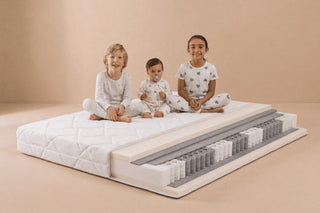
| Bed | Low entry, soft fall-out guard, suitable mattress | Allow for delivery time |
| Room | Sockets, cables, anti-tip fixings on shelves, night light, door/stairs secured | Before the first night |
| Evening | Routine unchanged, rule stated clearly once | First night |
| Support | Sticker calendar, calm returns to bed, cot removed after 1 week | Day 1 to 14 |

Frequently asked questions about moving from the cot to a children's bed
How long does it take to settle into the new children's bed?
Most children need five to fourteen nights before the new bed feels normal. Children who had two weeks of lead time and helped with the assembly are often quicker. Still, expect an unsettled dip around the fourth or fifth night.
Should the cot leave the room straight away?
No, leave it in place for about a week. It acts as visible reassurance without your child having to sleep in it. As soon as the new bed has been accepted, or your child actively wants to go back to the cot, remove it without any big announcement.
What if my child comes into our bed every night?
Bring them back calmly every time, using the same few words, even in the middle of the night. Consistency in the first week decides whether the wandering becomes a habit. A night light and the promise "I'll come if you call" take away the fear of being alone.
Junior bed or straight to 90×200 cm?
A 70×140 cm junior bed often becomes too short by the age of five, and then a second bed purchase is due. A low 90×200 cm bed with a soft fall-out guard lasts into school age and beyond. More important than the sleeping surface is the low entry height.
My child falls out of the new bed at night – what helps?
A continuous, soft fall-out guard along the open sides prevents rolling out during sleep. In the first few nights, you can also place a thick blanket or mattress next to the bed. With a low bed, the drop height stays small anyway.
What if the transition still isn't working after four weeks?
First check for overtiredness, new fears or simultaneous changes such as starting daycare. If every night remains a battle, you can raise the issue with your parent and child counselling service or your paediatric practice. Going back to the cot only makes sense if your child is still well under two and does not climb.


