







Bye-bye cot: for many parents this moment comes sooner than expected, namely on the morning when their child is suddenly standing in the hallway even though they fell asleep behind bars. The move to the first big bed is a milestone that triggers pride, but also questions: is it too early? Will my child fall out at night? And how do I bridge the time until the new bed is delivered? This article is the compact version for parents who want clarity fast. It shows you the five signs that your child is ready, focuses on the most important of them, climbing, and explains what you can do about safety and preparation before the first night in the big bed begins.
The short answer: your child is ready for their first big bed if they climb out of the cot or try to, if space is noticeably getting tight, if they want to do things "all by myself", if they reject the cot as "babyish" or if they want to go to the potty by themselves at night. Climbing is not a sign like the others but a safety issue: from the first leg over the top rail, a low, open bed with a soft boundary is safer than the cot. You bridge the time until delivery with the slatted base at its lowest setting or the cot mattress on the floor.
- Five signs show readiness: climbing, lack of space, the drive for independence, rejection of the "baby bed" and going to the potty.
- Climbing is the most urgent sign: a fall over the top rail means a drop of 80 to 90 cm, usually head first.
- The first big bed must above all be low and have a soft boundary; edges and drop height decide, not the design.
- Until delivery, immediate measures help: slatted base all the way down, climbing aids out, and if necessary the mattress on the floor.
- Preparation does not take weeks: childproofing the room, involving your child and keeping the routine the same is enough for a good start.
Sign 1: The little explorer becomes a climbing artist
As soon as your child gets a leg over the top rail, the function of the cot reverses: what used to protect is now a climbing wall with a hard floor behind it. Depending on the model and the position of the slatted base, the top rail of a cot sits 80 to 90 centimetres above the floor. Toddlers have a heavy head relative to their body and still little strength in their arms, which is why they almost always fall head first when climbing over. On parquet or laminate, that is a serious risk of injury, and it exists at a time when you are asleep and cannot watch.
So watch out for the early stages: your child pulls themselves up on the bars and looks over the edge, puts a foot between the bars, pushes cuddly toys or the pillow into a corner to get higher. If you see this, the switch is no longer a question of "whether" but of "how soon". Many paediatricians advise giving up the cot at the latest when the child can climb or the top rail only reaches their chest, regardless of how old they are. If your child is only 18 or 20 months old, a very low bed with a soft boundary is still safer than a cot they climb out of.
Signs 2 and 3: Space is getting tight, "all by myself!" becomes the motto
The second sign shows itself less dramatically, but every night. If your child stretches out their arms in their sleep and bumps against the bars, lies diagonally in the morning or has their feet through the bars, then the 70 by 140 centimetre sleeping surface has become too small for their nightly urge to move. Toddlers turn over many times in their sleep; every collision with the bars can trigger a brief waking. If the nights are becoming more restless without any sign of teething, infection or a developmental leap, it is worth looking at the space.
You hear the third sign during the day: "All by myself!" when getting dressed, climbing the stairs, pouring a drink. This phase between around two and three years is a surge of autonomy, and it does not stop at the sleeping place. A child who wants to do everything themselves but has to be lifted into a bed in the evening that they cannot get out of on their own increasingly experiences this as a contradiction. A bed with a low entry that they can climb into themselves and get out of by themselves in the morning fits this developmental step and often makes the bedtime routine more relaxed, because your child has a say in when they lie down.

Signs 4 and 5: The "baby bed" is annoying, the potty is calling
Many children say it directly: they look at their big sister's or their friend's bed and declare that they are not a baby any more. When the cot is no longer perceived as a cosy nest but as a restriction, the mental switch has already happened, and the furniture is lagging behind. This sign is the most pleasant, because your child wants the transition themselves and actively carries it. All that matters is that the wish comes up several times over a few days and not just once when visiting friends.
The fifth sign is linked to becoming dry. If your child is gradually becoming dry in the morning or at night and wants to go to the potty or the toilet by themselves, bars are literally in the way: they have to call and wait instead of going themselves. An open, low bed supports this step. Dryness is not a prerequisite for a big bed, however, just an indication of growing body awareness. If you want to understand the signs and their developmental background in more detail, including a sixth sign about understanding rules, you will find the full version in our article When is my child ready for a big bed? 6 clear signs.
Get CHF 25 off
Subscribe to the newsletter and receive a one-time CHF 25 discount. ✓ 100-night trial ✓ 5-year warranty ✓ Free delivery
Safety check: What the first big bed needs to do
With the cot, the furniture took care of safety. With the first big bed, it is shared between the bed, the room and the child. For the switch to improve the situation rather than just shift it, the new bed should outperform the old one on four points:
| Criterion | Cot when the child climbs | Good first big bed |
|---|---|---|
| Drop height | 80–90 cm over the rail, head first | Low sleeping surface, feet reach the floor when sitting |
| Boundary | Rigid bars that invite climbing | Soft, continuous edges without footholds |
| Edges | Hard wood or metal at head height | Upholstered, with no hard corners |
| Getting up independently | Only possible by climbing | Safe at any time, even half asleep at night |
| Years of use | Ends with climbing | 90×200 or 120×200 cm into school age |
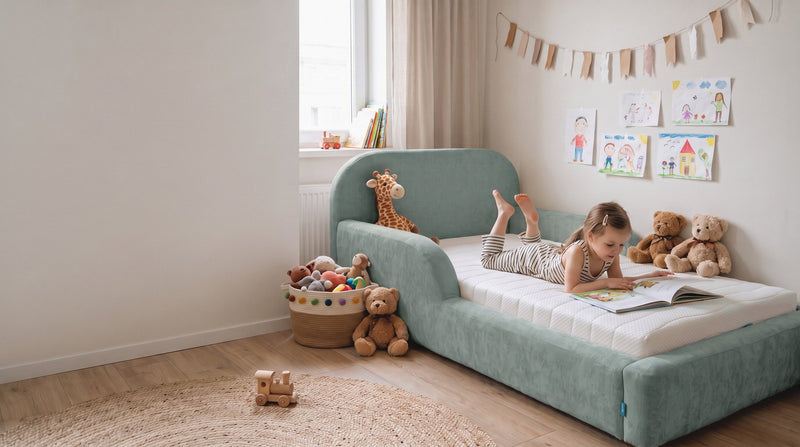
One point is often overlooked: clip-on bed rails made of wood or metal bring back exactly the hard edges and footholds that your child is just leaving behind. Soft, curved edges keep your child in bed just as well during sleep, but they can neither be climbed nor do they hurt when a head rolls against them at night. You can find the background in our article Fall-out protection without bars: why organic shapes are safer.

Preparation: Three things before the first night in the big bed
When climbing speeds up the switch, there is no time for weeks of lead-up. These three points are the minimum that should be done before the first night:
- Bridge the time until delivery. A new bed delivered by carrier usually takes two to four weeks to arrive. Set the cot's slatted base to its lowest position straight away, remove pillows and large cuddly toys that serve as a step, and put your child in a sleeping bag that makes climbing harder. If your child still climbs, take the cot mattress out and lay it on the floor against the wall. That is uncomfortable, but safer than a fall over the rail.
- Childproof the room from a child's height. A child who can get up at night reaches sockets, cables, shelves and windows. Anti-tip fixings, socket covers, window handle locks and a stair gate belong before the first night, not after. You will find a detailed list in our article Moving on from the cot: how to make the transition stress-free.
- Involve your child, even if it has to happen fast. Let your child choose the bedding or the colour of the bed, pass the screws during assembly and do a test-lie in the afternoon with all their cuddly toys. Even two days of lead time make a difference, because the bed is then not unfamiliar when the light goes out.
On the evening itself, the routine stays as it was: same time, same sequence, same length. The only new thing is the sentence before lights out: "You stay in your bed until it gets light. If you need something, you call."
Common mistakes when your child climbs out of the cot
Out of an understandable wish to keep the familiar cot a little longer, parents reach for solutions that tend to increase the risk:
- Raising the bars or stretching a net over the cot. Home-made extensions and nets are not tested for children's beds, offer new climbing aids and can become a strangulation hazard. Bed tents and covers do not belong on a cot either.
- Telling your child off for climbing. Climbing is a normal motor milestone, not disobedience. Telling them off at most ensures that they climb in secret.
- Waiting until it "really" happens. Anyone who has seen the leg over the rail should not wait for the first successful exit. The first fall is usually the first success.
- Buying a bed at adult height. A high bed with a sleeping surface at 50 or 60 centimetres swaps the climbing wall for a cliff. Your child has to jump to get out, and half asleep that goes wrong.
- The mattress on the floor as a permanent solution. As a stopgap it makes sense; as a permanent state it lacks a boundary: children roll out in their sleep and end up lying on the cold parquet. A low bed with a soft edge combines both.
Once the bed has arrived, it is worth looking at the complete process, with preparation, the first night and dealing with setbacks, in our guide From cot to children's bed in 5 steps.

Frequently asked questions about saying goodbye to the cot
My child is only 18 months old and climbing – do they still have to move to a big bed?
Yes, for safety reasons. A fall over the top rail is more dangerous than a night in an open bed. Choose a very low bed with a soft boundary, keep the sleeping bag and expect that a child this young does not yet understand the rule "stay in bed". The room must therefore be completely childproofed.
How do I bridge the weeks until the new bed is delivered?
Slatted base to the lowest position, pillows and large cuddly toys out of the cot, sleeping bag on. If your child still climbs, lay the cot mattress on the floor against the wall. That is a stopgap for two to four weeks, not a permanent solution.
Is a clip-on bed rail on a normal bed enough?
It keeps your child in bed, but brings back hard edges and footholds and, on most models, is only designed for part of the bed's length. For children who have just made the switch, soft, continuous edges with no way to climb are the safer option.
Does my child have to show all five signs?
No. Climbing alone is enough to make the switch. Without climbing, two to three signs that are visible over several days are a good indication. A single sentence like "I want a big bed" when visiting friends is not enough on its own.
How low should the first big bed be?
Low enough that your child's feet reach or almost reach the floor when sitting on the edge of the bed. Then they can get out safely even when half asleep, and the drop height during sleep stays small. Beds at adult height are unsuitable for two- to three-year-olds.
Is climbing a sign of a particularly wild child?
No, it is a normal motor milestone between around 18 and 30 months. Some children never climb, others very early; both are within the normal range. All that matters is that you recognise the early stages and switch the bed before the first fall happens.
This article is for general information only and does not replace paediatric advice. If problems persist, please consult your paediatrician.


