



Anyone who wants to buy a kids’ bed quickly realises how huge the choice is: house beds, loft beds, toddler beds, upholstered beds, extendable models and countless listings on Tutti or Ricardo. On top of that come questions that nobody in the shop answers clearly: is 90 cm wide enough? How high should the edge be for a two-and-a-half-year-old? And how can you tell whether the varnish and fabric are really safe? Ideally, the first big bed will stay with your child for six, eight or even ten years, far longer than a changing table or cot. A bad purchase is therefore not only annoying but also expensive and a hassle, especially when the bed has to be carried up to the fourth floor of an old apartment building. In this guide, we go through all the important criteria one by one, with concrete measurements, price ranges in CHF and a checklist for your purchase.
The short answer: First check whether your child is ready, then choose the mattress size to suit the room and your everyday life, usually 90×200 or 120×200 cm. The key safety factors are a low entry height, effective fall protection and rounded or padded edges. When it comes to materials, recognised labels such as OEKO-TEX or FSC help you find your way. Also include the slatted base and mattress in your budget, and check the warranty, returns and delivery before you order.
- The move to a big bed usually happens between 18 months and 3 years, once your child shows the signs.
- 90×200 cm saves space, while 120×200 cm leaves room for cuddles and bedtime stories.
- An entry height of around 20 to 35 cm and continuous fall protection make the first nights more relaxed.
- Labels such as OEKO-TEX Standard 100 (textiles) and FSC (wood) offer guidance on harmful substances and origin.
- Realistically, plan CHF 400 to 2,000 for the bed, slatted base and mattress together, depending on quality.
The right time: is your child ready?
Before you think about dimensions and materials, it is worth taking an honest look at your child. A kids’ bed without bars is a step towards independence, and that step should match your child’s development, not just the calendar. Many children move between roughly 18 months and 3 years. Typical signs include: your child climbs over the cot rails, keeps bumping into the bars while asleep, seems cramped in the cot or asks for a “big” bed themselves. You will find a detailed overview in our article When is my child ready for a big bed?.
Timing within family life is just as important. If the change coincides with starting nursery, the birth of a sibling or a house move, that can be a lot of new things at once for a toddler. If possible, plan the bed change a few weeks before or after. A practical example: if a baby is due in March and the cot is to be passed on, the big bed can move in as early as December. This gives your older child enough time to settle in, and they will not associate the new bed with feeling pushed aside. Babies under about 18 months, on the other hand, should stay in a cot or baby bed.
Mattress size: 90×200 or 120×200 cm?
The size of the sleeping surface is the most far-reaching decision you will make. Toddler beds measuring 70×140 cm used to be common. They are cheap and compact, but many children have already outgrown them by the age of four or five, and then it is time to buy again. If you are thinking long term, you will usually opt for standard sizes, for which mattresses and bedding are available in every price range.
90×200 cm: the space saver
A 90 cm wide bed also fits into small rooms of 8 to 10 m², as found in many city flats. It will last a child into their teens and leaves room for a play mat and a desk.
120×200 cm: a family bed in miniature
At 120 cm wide, mum or dad can lie down comfortably while reading aloud, and after a nightmare there is room for two. Many parents value exactly this flexibility. In return, the bed needs around 30 cm more room width, and the mattress and bedding cost a little more. You will find a detailed decision guide in the article Kids’ bed size: 90 or 120 cm.
Buying a kids’ bed: safety from entry to edges
For a toddler, what matters most is being able to climb in and out safely. An entry height of around 20 to 35 cm (top of the mattress) has proven itself: your child can get up on their own at night, and if they roll out, the low height usually keeps the consequences minor. Loft beds and the top bunk of bunk beds, however, are unsuitable for toddlers; the Swiss Council for Accident Prevention (BFU) advises letting children sleep on top only from about the age of 6.
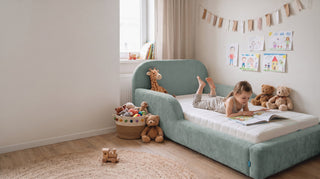
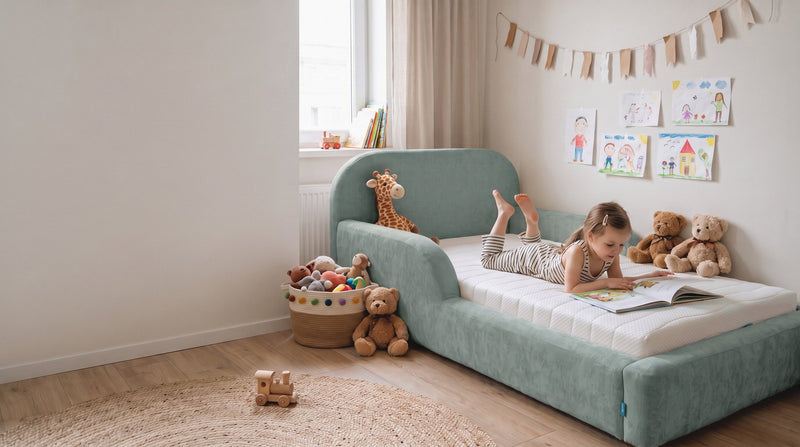
Fall protection should cover at least the upper third to half of the sleeping surface and rise a few centimetres above the mattress. Classic solutions are wooden rails or clip-on guards. An alternative is organically shaped, padded side panels that surround the child without arms or legs getting caught between bars. You can read more in Fall protection without bars.
Check the edges too: toddlers stumble, run and jump, including around the bed. Rounded corners or padding noticeably reduce the risk of bumps to the head. Look for firmly fixed screws with no protruding parts, no small pieces that can come loose, and no wide gap between the mattress and the frame.

Materials, harmful substances and labels
In their first years, a child spends around 10 to 13 hours a day in bed or close to it. That makes it all the more sensible to choose low-emission materials. For wooden beds, solid wood such as beech, birch or oak and oiled or water-based varnished surfaces are common. Chipboard is not bad in principle, but it should be processed to keep emissions low.
Labels help you assess a bed, but each one measures something different:
- OEKO-TEX Standard 100: textiles and covers have been tested against a list of harmful substances.
- FSC or PEFC: the wood comes from responsibly managed forests; the label says little about harmful substances.
- Blue Angel (Blauer Engel): an eco-label that, for furniture, takes emissions into account among other things.
A practical tip from everyday life: if a new bed smells strongly when you unpack it, set it up in a well-ventilated room for a few days if possible before your child sleeps in it. This also applies to second-hand beds from Tutti or Ricardo, where you should additionally check for cracks, loose joints and flaking varnish. Also ask the seller for the assembly instructions and any missing screws.
Slatted base and mattress: the underestimated duo
Many parents focus on the bed frame and choose the mattress on a whim. Yet your child does not sleep on the frame but on the mattress. Children are light and need a fairly firm, point-elastic surface that they do not sink into. Mattresses that are too soft can encourage an unfavourable sleeping position.
For the base, a simple roll-up slatted base or a fixed base with 20 to 28 slats is usually enough for children. The gaps between the slats should not be too wide, so that the mattress is evenly supported and well ventilated. Adjustable head sections are rarely needed for children.
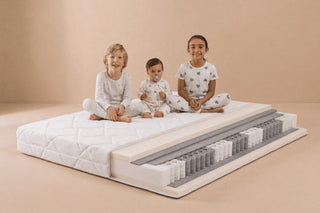
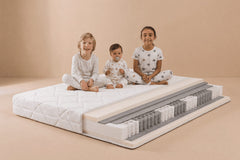
When choosing a mattress, three questions are worth asking: is the cover removable and washable at 40 to 60 °C? Is the mattress reversible so that it wears evenly? And can it also support an adult lying alongside at story time? Pocket-sprung mattresses are well ventilated, which helps children who sweat a lot at night. A bedroom temperature of about 16 to 19 °C also supports a pleasant sleeping climate. Budget roughly CHF 150 to 500 for a good children’s mattress in 90×200 cm.
Get CHF 25 off
Subscribe to our newsletter and get a one-time CHF 25 discount. ✓ 100-night trial ✓ 5-year warranty ✓ Free delivery
Room size, external dimensions and storage
The sleeping surface does not tell you how much space the bed actually takes up. Upholstered beds and house beds with a roof in particular are often 10 to 20 cm wider and longer than the mattress. A bed with a 90×200 cm sleeping surface can therefore easily take up 100×215 cm of floor space. So measure carefully before you buy, and take radiators, French windows, sloping ceilings and sockets into account.
An example from a typical old apartment in Zurich: the child’s room measures 2.9 × 3.4 m, with a door that opens inwards. Here, a 120 cm bed only fits along the long wall without blocking the wardrobe. With a 90 cm bed, on the other hand, there is room for a play corner by the window. Sketch the floor plan on squared paper or mark the external dimensions on the floor with masking tape, and you will quickly see the effect.
Drawers under the bed hold toys or bedding, but they can restrict ventilation of the mattress. Also watch out for steps and boxes next to the bed that your child could trip over at night. You will find more ideas in Furnishing a small children’s room: 7 tricks for more space.

Care, warranty, trial nights and delivery
Kids’ beds have to put up with a lot: spilt milk, felt-tip pens, feverish sweat or a leaking nappy. For upholstered beds, the cover should be removable and washable; for wooden beds, a robust, wipeable surface helps. Ask about replacement covers in case you want to change the colour later.
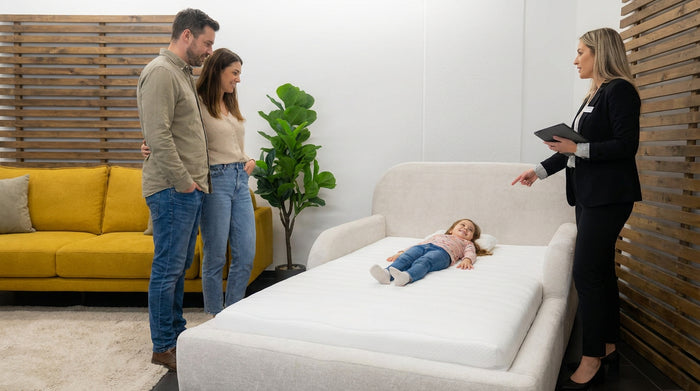
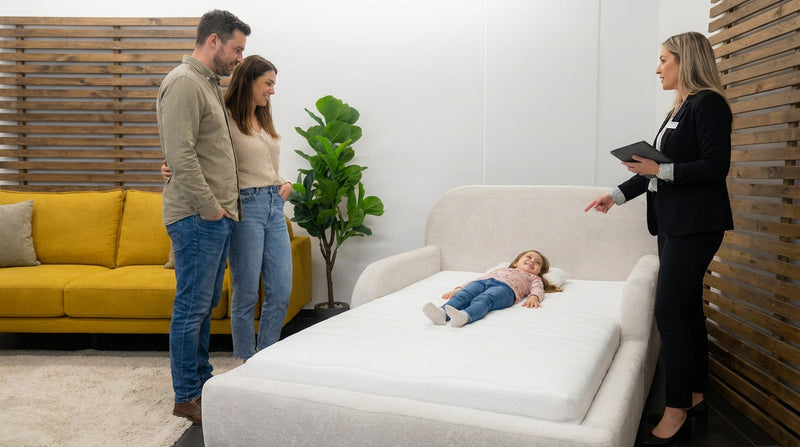
In Switzerland, consumers are entitled to a two-year statutory warranty. There is, however, no statutory right of withdrawal for online purchases. Whether you can return a bed therefore depends on the retailer’s terms. Read them carefully: how long does the return period last? Who pays for return shipping? Do you have to keep the original packaging? Offers with several weeks of trial sleeping give you time to see whether your child feels comfortable.
For delivery, it matters whether the retailer delivers throughout Switzerland, whether customs duties and VAT apply to orders from abroad, and whether the parcel is carried into your flat. A large bed ordered from abroad can end up considerably more expensive than expected because of shipping, customs clearance and return costs. Our article Children’s furniture in Switzerland: where do parents buy quality furniture? gives an overview of where to shop.
Budget and criteria at a glance
Price ranges in Switzerland vary widely. Simple wooden beds from furniture stores start at around CHF 150 to 300, while designer and upholstered beds are often between CHF 600 and 1,500 or more. Second-hand beds often cost only half as much but come without a warranty. The following table summarises the most important criteria:
| Criterion | What to look for | Guide value |
|---|---|---|
| Sleeping surface | Room size, cuddling, length of use | 90×200 or 120×200 cm |
| Entry height | Getting up independently, low fall height | approx. 20–35 cm |
| Fall protection | Coverage, height above the mattress, no trapping points | at least the upper half of the sleeping surface |
| Edges | Rounded or padded | no sharp corners |
| Materials | Smell, surfaces, labels | e.g. OEKO-TEX, FSC |
| Mattress | Firm, breathable, washable cover | approx. CHF 150–500 |
| Service | Warranty, returns, delivery | at least 2 years’ statutory warranty |
Checklist and common buying mistakes
This checklist helps you take a structured approach, whether you are in a furniture store in Dietikon or ordering online in the evening:
- Watch for signs of readiness and choose a calm moment.
- Measure the room and mark the bed’s external dimensions with masking tape.
- Decide on the sleeping surface: 90 or 120 cm wide.
- Check the entry height, fall protection and edges.
- Check the materials, smell and labels.
- Plan the slatted base and mattress at the same time.
- Clarify warranty, returns, delivery costs and assembly.
- Let your child help choose the colour.
The most common mistakes are these: a toddler bed that is too small and has to be replaced after two years; an old, sagging mattress from the cellar; a loft bed for a toddler; and underestimating the external dimensions. Many families also forget to involve their child. If your daughter can choose the bedding or help with assembly, the move to the new bed is often easier.

Frequently asked questions about buying a kids’ bed
At what age does my child need a big bed?
Many children move between roughly 18 months and 3 years. What matters are the signs, for example when your child climbs over the cot rails or asks for a big bed themselves. Babies should stay in a cot or baby bed.
Is 90×200 or 120×200 cm the better choice?
A 90 cm wide bed saves space and fits into small rooms. A 120 cm wide bed offers room for cuddling and reading aloud, but needs around 30 cm more room width.
How high should a kids’ bed for toddlers be?
An entry height of around 20 to 35 cm has proven itself. Your child can then get up independently and the fall height stays low. Loft beds are only suitable for older children.
Which labels are useful for a kids’ bed?
OEKO-TEX Standard 100 stands for textiles tested for harmful substances. FSC or PEFC indicate wood from responsible forestry. The Blue Angel takes emissions into account for furniture, among other things.
Can I return a kids’ bed bought online?
In Switzerland, there is no statutory right of withdrawal for online purchases. Whether a return is possible depends on the retailer’s terms. So check the return period, costs and trial offers before you order.
How much does a good kids’ bed cost in Switzerland?
Simple wooden beds start at around CHF 150 to 300, while high-quality upholstered or designer beds often cost CHF 600 to 1,500. Add a slatted base and a mattress for around CHF 150 to 500.


