



How well a child sleeps depends on many things: the daily rhythm, the bedtime routine, developmental leaps. One factor is often underestimated, even though it can be improved with little effort – the room itself. If you want to set up your child's bedroom for sleep, you don't need an expensive complete makeover, just a few clear adjustments. Light, temperature, humidity and noise determine how easily your child falls asleep and whether they keep sleeping in the second half of the night. Bed position, colours, mattress and tidiness help decide whether the room feels calm in the evening or more like a playground. Here are the eight factors, with target values, everyday examples and a checklist.
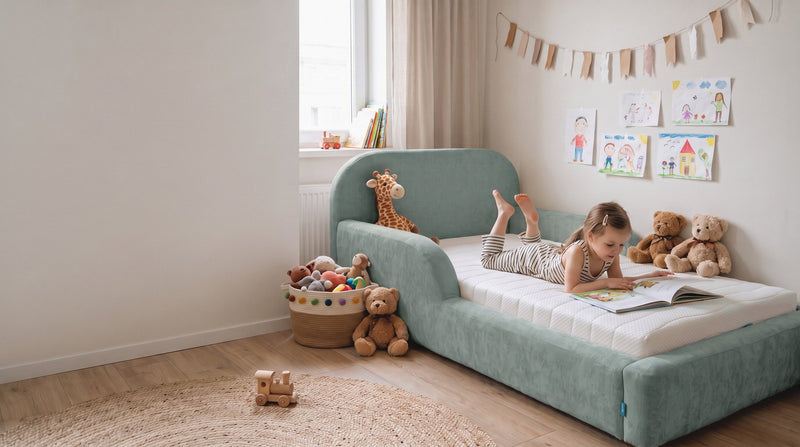
The short answer: A sleep-friendly child's bedroom is dark at night, fairly cool (around 16–19 °C), moderately humid (40–60% relative humidity) and quiet. The bed stands in a sheltered spot, not under the window and not right next to the radiator, with a view of the door. The field of vision around the bed is calm, and toys have their own area that is tidied every evening. Add to that a bed with a well-fitting, breathable mattress in which your child feels secure.
- Darkness is the strongest timekeeper: blackout plus, at most, a dim, warm night light.
- Sleep climate: around 16–19 °C and 40–60% humidity, with a short burst of airing before bedtime.
- Reduce noise rather than masking it – if you use a white noise machine, keep it quiet and away from the bed.
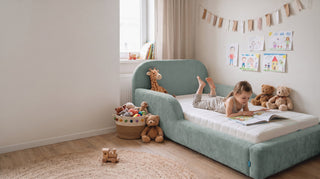
- One long side of the bed against the wall, away from the window and radiator, with a view of the door.
- Separate the sleep and play zones and keep the view from the pillow as calm as possible.
1. Light and blackout
Light is the most important timekeeper for the body clock. When it gets dark in the evening, the body releases more melatonin, the sleep hormone. Bright light, especially light with a high blue component, slows this process down. Studies suggest that children are more sensitive to it than adults, because their pupils are larger and the lenses of their eyes are clearer.
For the room, this means: at night, your child's bedroom should be so dark that you can barely make out your hand in front of your face. In many Swiss flats, roller shutters or slatted blinds do this job well. If they are missing, blackout blinds fitted directly to the window frame help, combined with floor-length curtains that close the gaps of light at the sides. This is especially important around summer time: in June, the sun doesn't set in Zurich until around 9.30 pm and rises again shortly after 5.30 am.
If your child needs a night light, choose a dim, warm light in orange or red, close to the floor and out of their direct line of sight. Screens, illuminated alarm clocks and standby LEDs don't belong in a child's bedroom. In the morning, however, it's fine for the room to get bright: daylight after getting up further stabilises the rhythm.
2 and 3. Sleep climate: temperature and humidity
To fall asleep, core body temperature drops slightly. A cool room supports this; an overheated one tends not to. As a guideline for children's bedrooms, around 16 to 19 °C is recommended. More important than an exact figure is that your child neither sweats nor feels cold: a warm neck is a good indicator, while cool hands are perfectly normal.
Relative humidity should ideally be between 40 and 60 per cent. In winter, it often drops to 30 per cent or below in heated Swiss homes, which can dry out the mucous membranes. Consistently above 60 per cent, on the other hand, the risk of mould and house dust mites rises. A simple thermo-hygrometer shows you where you stand.
| Reading | Target range | What helps |
|---|---|---|
| Temperature too high (above 20 °C) | approx. 16–19 °C | Radiator valve on setting 2, lighter duvet, shade the room during the day |
| Air too dry (below 40%) | 40–60% | Don't overheat, dry laundry in the room, use a humidifier only if it is cleaned carefully |
| Air too humid (above 60%) | 40–60% | Open windows wide for 5–10 minutes several times a day, keep furniture away from the outside wall |
4. Noise: quieter rather than louder
Children often sleep deeply in the first few hours, but more lightly in the second half of the night. That's exactly when noises are most likely to wake them: the tram at five o'clock, the neighbour in the stairwell, the coffee machine in the kitchen. The World Health Organization gives an average indoor level of around 30 decibels as a guideline for bedrooms – roughly a soft whisper.
The first lever is location: if you have the choice, a room facing the courtyard or garden is better than one facing the street. Well-sealed windows, heavy curtains, a rug and full bookshelves dampen sound further. Door seals also help if the child's bedroom is right next to the living room or kitchen.
White noise machines are not a must. If you use one, keep the volume low and place it away from the bed, not on the headboard. A steady, quiet background sound can soften disruptive noises; loud continuous sound, on the other hand, isn't sensible. Often it's enough for the adults to move noisy activities to the other end of the flat in the evening.

5. The right bed position
Where the bed stands affects light, temperature and the sense of security all at once. A position with one long side against the wall has proven effective. It gives many children a feeling of protection, and nobody can fall out on that side. The ideal spot lets your child see the door without lying directly in front of it.
Spots directly under the window are unfavourable: there are draughts, cold radiates from the glass and it gets light there first in the morning. Right next to the radiator, the air becomes dry and warm, so leave around half a metre of space. There should be no heavy shelves, picture frames or wall lamps above the bed that could come loose.
Also pay attention to what is within reach: cords from blinds and curtains should be out of reach, as should cables and sockets. A low bed has the advantage that getting up at night and climbing in independently are easier. You'll find a detailed overview of distances and checkpoints in the kids' bed safety checklist.
6. Low stimulation and colours
Toddlers take in their surroundings intensely. A room full of colourful patterns, flashing toys and wall stickers is stimulating during the day – in the evening it makes switching off harder. That doesn't mean the room has to be bare. What matters most is the view from the pillow: what your child sees as they fall asleep should be calm.
When it comes to colours, muted, warm tones such as greige, sand, off-white, sage or a soft dusty pink work well. Very bright, saturated colours such as fire-engine red or neon yellow tend to be stimulating. Research on colours and sleep is thin, however, and clear effects of individual shades have not been proven. What is certain is that a calm overall picture helps many children. Read more in Kids' room colours: which colour promotes sleep?.
A practical tip: use colour and pattern in the play zone and on interchangeable items such as cushions or pictures. The room stays lively, and the sleeping corner still feels serene.
7. Bed and mattress
The bed is the centre of the room, and your child spends up to twelve hours a day in it. After the cot, usually somewhere between around 18 months and three years, a bed measuring 90×200 or 120×200 cm is a long-term solution. A low bed makes it easier to get in and out independently. Side fall protection and soft edges provide security and the feeling of being nestled in.
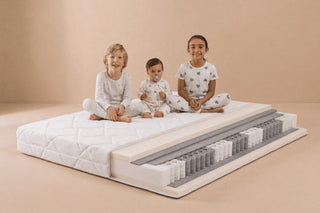
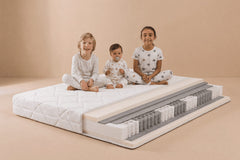
The mattress should match the bed size with no gap to the frame, and be point-elastic enough for the shoulders and hips to sink in slightly while the spine stays straight. Children sweat relatively heavily at night. A breathable construction and a slatted base that lets air circulate under the mattress therefore help the sleep climate. A removable, washable cover is worth its weight in gold when it comes to colds, snack crumbs or a night-time accident.
We've summarised which firmness and construction suit which age in our guide to kids' mattresses for 2- to 10-year-olds. One thing remains important: before around 18 months, no bed replaces the cot, and the switch depends on your child's development.
8. Tidiness: separate the play and sleep zones
Many children's bedrooms in Switzerland are between 9 and 12 square metres – bedroom, playroom and retreat all in one. That makes a clear separation all the more important. If the Lego tower stands next to the pillow, the bed quickly becomes a play surface. A visible division, on the other hand, helps your child switch from play mode to sleep mode in the evening.
The separation doesn't have to be elaborate. A low, open shelf, a rug or a different wall colour marks out the play zone. The sleep zone stays free of toys, apart from one cuddly toy and perhaps a book. Open boxes where every toy has a fixed place make tidying up manageable for two- to five-year-olds. A five-minute tidy-up then becomes a fixed part of the bedtime routine. If siblings share a room, a curtain can also mark the zones.
Where space is tight, vertical solutions and beds with a clean shape work well. You'll find ideas in Small kids' room ideas, and a basic set-up for this age group in Setting up a room for 2- to 5-year-olds.

Common mistakes
These are the pitfalls we come across most often in everyday family life:
Heating too much. For fear the child might get cold, the room is heated to 22 °C. Better: a cool room and a suitable duvet or sleeping bag.
Using the night light as a reading lamp. Bright, white night lights disturb more than they soothe. Warm, dim and close to the floor is enough.
The bed as a playground. If the bed is used for romping and building during the day, switching to sleep mode is harder.
Forgetting to air the room. Especially in winter, tilting the window instead of opening it wide cools the walls without properly exchanging the air. Better to open it wide three to four times a day for 5–10 minutes.
Leaving tech in the room. Tablet, baby monitor with a bright display or speaker with an indicator light: anything that glows or beeps is a distraction. Charge devices outside the child's bedroom.
Changing everything at once. A new bed, a new colour and a new position in the same week is too much for some children. Introduce changes gradually and involve your child, for example in choosing the bedding.
Checklist: setting up your child's bedroom for better sleep
Most of these points can be done in one weekend – for example on a Saturday when your child is at their grandparents'. Here's how to go about it:
1. Measure in the evening. Place a thermo-hygrometer next to the bed for a few days and note the temperature and humidity before bedtime and in the morning.
2. Check the darkness. Lie down on your child's bed at 9 pm with the blinds closed. Where does light get in? Close the gaps with curtains or clip-on blinds.
3. Position the bed. Long side against the wall, away from the window and radiator, with a view of the door.
4. Calm the field of vision. Lie down again and look at what you see: posters, colourful boxes, flashing devices? Move them or relocate them to the play zone.
5. Define the zones. A shelf and rug define the play zone, and every toy gets a box.
6. Add to the routine. Air the room briefly and tidy up together for five minutes before the bedtime routine begins.
7. Review after two weeks. Does your child fall asleep faster or sleep through for longer? Then keep it that way; otherwise, fine-tune individual points.
Get CHF 25 off
Subscribe to the newsletter and get a one-off CHF 25 discount. ✓ 100-night trial ✓ 5-year warranty ✓ Free delivery

Frequently asked questions about a sleep-friendly child's bedroom
What is the ideal temperature for sleeping in a child's bedroom?
As a guideline, around 16 to 19 °C. More important than the exact figure is that your child neither sweats nor feels cold. Check the back of the neck: it should be warm but not sweaty. Cool hands and feet are normal and not a sign that it's too cold.
How high should the humidity be in a child's bedroom?
Ideally between 40 and 60 per cent relative humidity. In winter, the air in heated homes is often drier, so it helps not to overheat. If the reading is consistently above 60 per cent, open the windows wide more often to prevent mould and dust mites.
Does my child need a night light?
Not necessarily. Many children sleep best in complete darkness. If your child would like a night light, choose a dim, warm light in orange or red, placed close to the floor and not pointing directly at their face.
Where should the bed go in a child's bedroom?
Ideally with one long side against the wall and a view of the door, but not directly in front of it. Avoid spots directly under the window and next to the radiator. There should be no heavy shelves or pictures above the bed, and cords and cables should be out of reach.
Which wall colour promotes sleep?
There is no miracle colour, and the research is thin. Muted, warm tones such as greige, sand, off-white, sage or a soft dusty pink have proven popular. Very bright, saturated colours tend to be stimulating and are better suited to the play zone.
Are white noise machines useful in a child's bedroom?
They can soften disruptive noises but are not a must. If you use one, keep the volume low and place it away from the bed. It's worth reducing sources of noise first, for example with curtains or a rug.


