


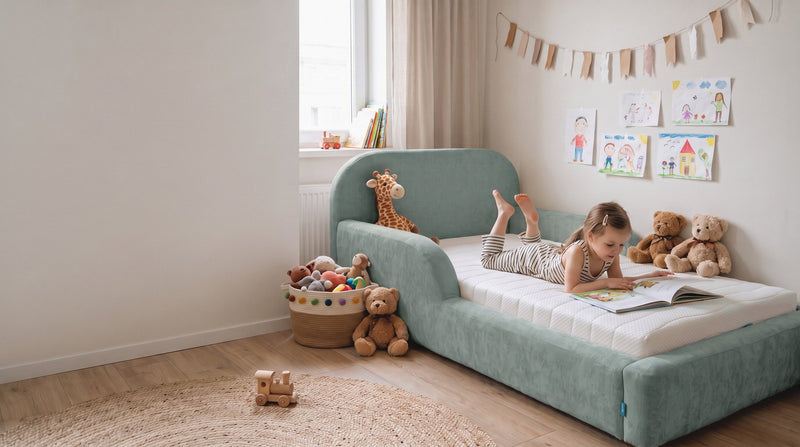

Moving into the first big bed is a lovely milestone, but it also brings plenty of new questions. Suddenly there are no bars, your child can get up alone at night, and the bedroom becomes territory to explore. This is exactly where kids bed safety is decided in everyday life: not only in the bed itself, but also in the chest of drawers next to it, the blind cord at the window and the cable of the night light. Many parents check the frame carefully when buying, yet overlook the surroundings. With our checklist, you can go through all the important points in about 20 minutes. All you need is a screwdriver, a folding ruler and the willingness to look at the room from 80 cm, your child’s eye level.
The short answer: a safe kids bed stands firmly, has no gaps in which a head, fingers or feet could get trapped, and has a mattress that fits the frame without a large gap. The location matters just as much: away from the window, with no cords or cables within reach and surrounded by furniture that is secured against tipping. A low sleeping surface and fall protection make night-time falls less serious. Check everything again every three months, because your child grows quickly and keeps discovering new possibilities.
- Most risks lie not in the bed itself but around it: windows, cords, cables and unsecured furniture.
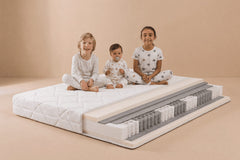
- There should be no more than about two finger widths of space between the mattress and the bed frame.
- Chests of drawers, shelves and wardrobes should be anchored to the wall, at the latest once your child starts climbing.
- A low sleeping height, fall protection and a soft rug make night-time falls far less of a worry.
- The checklist is not a one-off project: plan a short check every three months.
Why kids bed safety is about more than a sturdy frame
When parents think about safety, they usually look at the bed first: is it well made, does it wobble, are the materials tested? That is right, but it is only half the story. Accidents in the nursery often happen where two things meet: a child who has just learned to climb and a piece of furniture or object that is not meant for it. The Swiss Council for Accident Prevention (BFU) has pointed out for years that falls are among the most common causes of accidents in young children, and that a large share of them happen at home.
Between roughly 18 months and 4 years, your child’s range of movement changes enormously. At two, many children pull themselves up on drawers; at three, they push a chair to the window to look outside. At the same time, their awareness of danger is barely developed. So it is not enough to buy a good bed and put it just anywhere. If you see the bed, mattress, location and furnishings as one system, you rule out most risks with little effort. That is exactly what the following checklist is for: twelve checkpoints to go through thoroughly once and then briefly on a regular basis. For more on furnishing, see our guide setting up a toddler room.
The 12 checkpoints at a glance
The table sums up all the points. Print it out or save it on your phone and tick off what is done during your check. The following sections explain each point in more detail.
| No. | Checkpoint | What to look for |
|---|---|---|
| 1 | Sturdy frame | Nothing wobbles, all screws are tight, no fittings stick out. |
| 2 | No trapping points | No gaps in which a head, neck, fingers or feet could get stuck. |
| 3 | Well-fitting mattress | Lies flat in the frame, with no more than about two finger widths of space all round. |
| 4 | Edges and surfaces | Rounded or padded, no splinters, no peeling paint, no loose small parts. |
| 5 | Height and fall protection | Low sleeping surface, side guard, soft floor in front of the bed. |
| 6 | Distance from the window | Bed not under or right next to the window, window handles secured. |
| 7 | Cords and cables | Blind and curtain cords tied up high, cables out of reach. |
| 8 | Anti-tip furniture | Chest of drawers, shelf and wardrobe anchored to the wall. |
| 9 | Heat and power sources | Distance from the radiator, sockets covered, no fairy lights on the bed. |
| 10 | Sleep climate | Around 16 to 19 °C, air the room regularly, breathable materials. |
| 11 | Uncluttered bed | Few soft toys, no ribbons, chains or small parts in the bed. |
| 12 | Regular checks | Check again every three months and after every rearrangement. |
Bed and mattress: checkpoints 1 to 4
1. Sturdy frame. Shake all four corners firmly. Nothing should creak, shift or give way. Tighten the screws again about two weeks after assembly, as wood and joints settle. Screw heads and fittings should be recessed or covered so that neither skin nor pyjamas can catch on them.
2. No trapping points. Openings in the bed should be either so small that no finger fits in, or so large that head and body pass through easily. In-between sizes are critical, for example headboards with cut-outs or gaps between the bed and the wall. On cots, the spacing between bars is usually between 4.5 and 6.5 cm. If the bed stands against the wall, push it right up to it or deliberately leave enough space that nobody can get wedged.
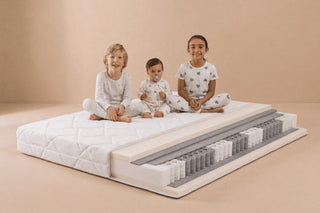
3. Well-fitting mattress. Push the mattress to one side and measure the gap on the other. It should be no more than about two finger widths, otherwise an arm or leg can slip in. The sleeping surface must lie flat and must not sag in the middle. How to find the right mattress is explained in our guide buying a kids bed: what to look for.
4. Edges and surfaces. Run your hand over all surfaces and edges. Splinters, rough patches or peeling varnish are warning signs, because toddlers put a lot in their mouths. Padded or well-rounded edges reduce the risk of injury when your child bumps into them while playing. Look for test labels on textiles and finishes, and remove stuck-on decorations that could come loose.

Location and surroundings: checkpoints 5 to 8
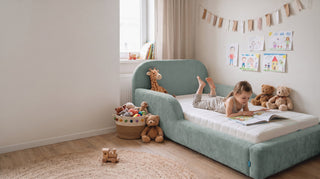
5. Height and fall protection. The lower the sleeping surface, the less serious a night-time fall. For children between two and four, a sleeping height of around 20 to 35 cm has proven itself. A side guard helps, especially in the first few weeks. Also place a non-slip rug or floor cushion in front of the bed. What to do if it happens anyway is covered in my child falls out of bed.
6. Distance from the window. Never place the bed directly under or next to a window, or it quickly becomes a step up. As a rule of thumb: at least an arm’s length away, and no furniture nearby that could serve as a step. Lockable window handles or window restrictors are a small investment with a big effect in a Swiss block of flats with tilt-and-turn windows on the third floor.
7. Cords and cables. Loops on blinds, shutters and curtains can pose a strangulation risk. Tie them up, shorten them or use cord cleats fitted more than 1.5 m high. Cables from the night light, lamp or baby monitor should be out of reach; the baby monitor should be at least about a metre away from the bed.
8. Anti-tip furniture. A full chest of drawers looks heavy, but it tips easily when a child pulls out all the drawers and climbs up them. Anchor chests of drawers, shelves and wardrobes to the wall with suitable wall plugs and anti-tip brackets. This takes about ten minutes per piece. If you rent, a quick word with the property management is worthwhile; small drill holes are usually considered normal wear and tear.
Sleep environment and daily life: checkpoints 9 to 12
9. Heat and power sources. Keep some distance between the bed and the radiator so that the bedding does not heat up and your child does not bump into the radiator. Cover sockets near the bed with safety covers. Fairy lights and decorative lamps on the bed frame look cosy, but do not belong within reach. Night lights with button batteries should have a screw-secured battery compartment. If you suspect something has been swallowed, Tox Info Suisse can be reached around the clock on 145.
10. Sleep climate. As a guide, a child’s bedroom should be around 16 to 19 °C with humidity between 40 and 60 per cent. Air the room thoroughly for five to ten minutes morning and evening. A breathable mattress and a sleeping bag or light duvet suited to the season help prevent overheating. Feel the back of your child’s neck to check for sweating; cold hands alone do not mean your child is too cold.
11. Uncluttered bed. One or two favourite cuddly toys are wonderful; ten soft toys and a pile of cushions are not. Remove dummy clips, hair bands, ribbons on soft toys and toys with small parts from the bed. For babies in their first year, the rule is anyway: sleeping bag instead of duvet, no pillow, nothing extra in the cot.
12. Regular checks. Children get bigger, stronger and more inventive. Plan a quick round every three months, for example when switching to summer or winter bedding, and always after moving furniture.

Common mistakes when moving to a big bed
Many safety gaps arise not from carelessness, but because the situation changes gradually. These are the mistakes we see most often:
Moving to the top bunk too early. Loft beds and top bunks are generally only suitable from around six years. Even a raised play bed 1.2 m high is not a good sleeping solution for a three-year-old.
The bed as a climbing frame. If the bed stands next to the shelf, it creates a staircase upwards. Plan the layout so that no chain of furniture leads to the window or high shelves.
Simply reusing the old mattress. A 70 × 140 cm cot mattress does not fit a bed with a 90 × 200 cm sleeping surface. The resulting gap is a real risk.
Removing the fall protection too early. Many children still roll a long way in deep sleep at three or four. It is better to leave the guard on for a few more months. Our article fall protection without bars shows the options.
Only checking at adult height. From 1.70 m, a room looks completely different than from 80 cm. So get down on your knees: that is the only way to spot sockets behind the bed or dangling cables.
Get CHF 25 off
Subscribe to our newsletter and get a one-time discount of CHF 25. ✓ 100-night trial ✓ 5-year guarantee ✓ Free delivery
Step by step: how to work through the checklist
Take a quiet moment, ideally when your child is at nursery, with the grandparents or napping in another room. Here is how to proceed:
Step 1: check the bed (5 minutes). Shake all the corners, tighten the screws, measure the mattress gap with your fingers, feel along the edges.
Step 2: change your perspective (3 minutes). Kneel next to the bed and look around. What can be reached from this height? Cables, sockets, cords, small parts on shelves?
Step 3: test the climbing routes (5 minutes). For each piece of furniture, ask yourself: can my child climb onto it and go higher from there? Pull out the bottom drawer as a test and press on it lightly. If the chest tips forward, it must be secured straight away.
Step 4: window and heating (3 minutes). Secure the window handles, tie up the cords, check the distance to the radiator.
Step 5: climate and bed contents (4 minutes). Put up a thermometer, choose bedding to suit the season, reduce cuddly toys to one or two. Then add a reminder in three months to the family calendar. If your child is only just moving, our guide from cot to toddler bed will also help.

Frequently asked questions about kids bed safety
From what age is a kids bed without bars safe?
Most children are ready for a bed without bars between about 18 months and 3 years. More important than the exact age are signs such as climbing out of the cot or wanting a big bed. A low bed with side fall protection makes the move safer.
How big can the gap between the mattress and the bed frame be?
As a rule of thumb, no more than about two finger widths when the mattress is pushed to one side. If the gap is larger, an arm or leg can slip in. In that case you need a mattress of the right size.
Do I really need to anchor bedroom furniture to the wall?
Yes, this is generally recommended, at the latest once your child starts climbing. Chests of drawers and shelves can tip over if a child uses the drawers as steps. An anti-tip kit with wall plugs takes just a few minutes to fit.
Where should the kids bed go in the room?
Ideally against an interior wall, away from the window, radiator and sockets. There should be no furniture next to the bed that could serve as a step up to the window or high shelves.
How warm should a child’s bedroom be at night?
As a guide, around 16 to 19 degrees with humidity of 40 to 60 per cent. The best way to tell whether your child is too warm is to feel the back of the neck, not the hands.
How often should I check the safety of the kids bed?
Plan a short check about every three months and also after every rearrangement of furniture. Tighten the screws, check the mattress gap and see which new climbing routes your child might have discovered.
This article is for general information only and does not replace advice from a paediatrician. If problems persist, please contact your paediatrician.


