






A dull thud in the middle of the night, a moment of silence and then loud crying: when a child falls out of bed, parents are usually more shaken than the child. It happens once or twice in many families, especially in the first weeks after moving from the cot to a big bed. Most of the time it ends with a brief fright and perhaps a small bump. Even so, you should know how to respond in the first few minutes and which signs mean your child needs to be seen by a doctor. In this guide you will find out why children fall out of bed, what you can do straight away and which warning signs to look out for. We also show you how to set up the children’s room so that a fall either doesn’t happen at all or ends without harm.
The short answer: If your child falls out of bed, stay calm, take a close look at them and comfort them. If they cry straight away, can be soothed and then behave as usual, a fall from a low height is generally harmless. If there are warning signs such as loss of consciousness, repeated vomiting, unusual drowsiness or changed behaviour, have your child checked by a doctor, and in an emergency call 144. Babies should always be seen by a paediatrician after a fall. The best ways to prevent falls are a low sleeping height, a bed guard and a soft surface next to the bed.
- Falling out of bed is common, especially shortly after the move to a big bed, and usually ends without harm.
- Straight away: stay calm, look at your child, comfort them and keep a close eye on them over the next few hours.
- Warning signs such as loss of consciousness, repeated vomiting, severe drowsiness, or blood or fluid from the nose or ear need medical assessment; in an emergency call 144.
- Always have a baby examined by a paediatrician after a fall.
- Prevention: low sleeping height, bed guard, bed against the wall, soft rug and enough sleeping space.
Why children fall out of bed
Toddlers sleep differently from adults. They turn over often, slide diagonally across the bed and not infrequently wake up with their feet on the pillow. As long as the cot had boundaries all round, nobody noticed. In the new bed, that boundary is suddenly gone, and the body first has to learn where the edge is. That is why most falls happen in the first weeks after the switch, which in many families takes place at some point between about two and three years of age. To find out when the right moment has come, read our article When is my child ready for a big bed?
Typical triggers
- New bed: unfamiliar surroundings, no side boundary, a different mattress height.
- Restless sleep: teething, infections, nightmares or night terrors lead to more movement.
- Sleeping surface too narrow: a 70 cm wide bed leaves little room; 90 cm or more gives noticeably more margin.
- Position of the bed: if the bed stands freely in the room, there are two open sides instead of one.
- Getting up at night: half-asleep children stumble when climbing out, for example on the way to the toilet.
The good news: most children get used to their new freedom within a few weeks.
Child falls out of bed: what to do straight away
In the first moment, it is tempting to scoop your child up and check them over in a panic. A calm, orderly approach is better. Your child takes their cue from your reaction: if you stay composed, they usually settle more quickly.
- Stay calm: take a breath, dim the light or switch on a night light so that you can see without dazzling your child.
- Look: is your child responding? Are they crying straight away? Are they lying in an unusual position or protecting an arm or leg? If they are not moving or not responding, don’t carry them around, but call 144 immediately.
- Comfort: hold your child and talk to them quietly. Strong crying straight after the fall is a good sign, as it shows that your child is awake and responsive.
- Check the head and body: gently look for bumps, grazes or bleeding. You can cool a bump for a few minutes with a cold pack wrapped in a cloth, never directly on the skin.
- Observe: if your child then behaves as usual, they can go back to sleep. Still keep an eye on them over the following hours.
It helps to make a quick mental note of the time and what happened. If you do need medical advice later, this information is valuable.
Warning signs: when you need medical advice
The vast majority of falls from a children’s bed are harmless. However, there are signs where you should not wait but have your child checked by a doctor. Some of them do not show immediately but only after a few hours. The following overview summarises generally recognised warning signs. It does not replace a medical assessment: if in doubt, it is better to call once too often.
| Warning sign | What to do |
|---|---|
| Loss of consciousness, even briefly, or a seizure | Call 144 immediately |
| Child is hard to wake or not properly responsive | Call 144 immediately |
| Blood or clear fluid from the nose or ear | Seek medical help immediately, children’s A&E or 144 |
| Repeated vomiting | Go to children’s A&E or the paediatric practice without delay |
| Unusual drowsiness, confusion, unusual behaviour, unsteady walking | Have your child checked without delay |
| Severe or worsening headache, persistent crying that cannot be soothed | Contact your paediatrician |
| A baby has fallen, even without visible effects | Always have them examined |
| An arm or leg is being protected, severe swelling | Paediatric practice or children’s A&E |
Outside surgery hours, the emergency departments of children’s hospitals or the regional out-of-hours medical services can help you.
Get CHF 25 off
Subscribe to our newsletter and get a one-time CHF 25 discount. ✓ 100-night trial ✓ 5-year warranty ✓ Free delivery

The hours after the fall: observe rather than worry
Once your child has calmed down and seems their usual self, the phase of attentive observation begins. Over the next few hours, check whether they eat and drink normally, play as usual, speak clearly (if they already talk) and walk steadily. Young children often cannot put discomfort into words. A child who is usually lively and suddenly lies listlessly in a corner therefore deserves a second look.
And what about sleep?
For a long time people said that a child must on no account fall asleep after a knock to the head. As a blanket rule, that is not correct. If your child seems normal after the fall and it is bedtime anyway, they can generally sleep. Still check on them a few times during the night: are they breathing calmly and regularly, lying relaxed, responding to touch? If you are unsure or the doctor advises it, you can briefly wake your child to check that they respond as usual. If they are difficult or impossible to wake, that is an emergency.
Trust your instincts, too. You know your child best. If something seems odd to you, even if nothing in the table matches exactly, a call to the paediatric practice is never wrong.
Myths fact-checked
“If the child doesn’t cry, everything is fine.” Not necessarily. Immediate crying is usually a reassuring sign. A child who is quiet, dazed or unusually listless after a fall, on the other hand, should be watched closely and, if in doubt, checked by a doctor.
“A big bump is more dangerous than no bump.” A bump may look dramatic, but on its own it says little about how serious the injury is. What matters is your child’s behaviour and the warning signs in the table.
“Nothing can happen from 30 centimetres.” Serious injuries from a low height are rare, but not impossible, for example if the child lands on a hard edge or a toy. That is why it is not just the height that counts, but also what lies next to the bed.
“A bed guard makes a child less independent.” A side guard that covers only part of the bed’s length leaves a gap to climb out. Your child can then get up on their own and is still protected while asleep. Find out more in the article Bed guards without bars.
“Babies don’t fall out of bed yet.” They do, as soon as they can roll over, and often earlier than expected. That is why the rule for babies is: never leave them unattended on a changing table, sofa or adult bed.

How to stop your child falling out of bed
Falls can never be ruled out completely, but you can greatly reduce both the risk and the consequences. The most effective measures:
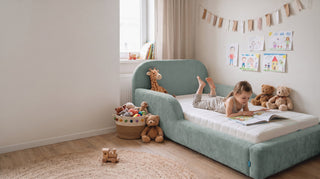
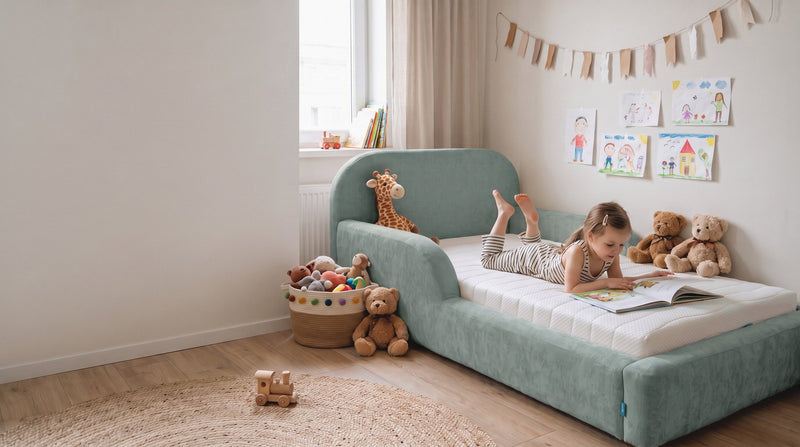
- Low sleeping height: the lower the mattress, the shorter the fall. For toddlers, many parents choose beds where the sleeping surface sits only a little above the floor.
- Bed guard: a side boundary stops your child rolling over the edge in their sleep. Make sure it is firmly attached and that there is no gap between the guard and the mattress in which arms or legs could get trapped.
- Bed against the wall: this leaves only one open side. There should be no gap between the mattress and the wall.
- Soft surface: a thick rug, a play mat or a floor cushion softens the impact. This is particularly worthwhile in period flats in Zurich or Bern with parquet or stone floors.
- Enough sleeping space: a 90 × 200 cm or 120 × 200 cm bed gives restless sleepers plenty of room. To find out which width suits you, read Kids’ bed size: 90 or 120 cm.
- Night light: a dimmed, warm light helps when getting up at night without disturbing sleep.
- A tidy floor: building blocks, toy cars and hardback books have no place in front of the bed.
You will find more ideas for a safe room in the guide Setting up a room for 2 to 5-year-olds.
Checklist: is the kids’ bed fall-safe?
Take ten minutes to go through the children’s room with this list, ideally in the evening when the light is the same as at bedtime:
- The sleeping surface is low enough for your child to climb in and out safely on their own.
- The open side has a sturdy bed guard with a free gap to get in and out.
- The bed stands against a wall, with no gap between the mattress and the wall.
- The mattress fits the frame exactly, with no gaps at the edges.
- There is a non-slip, soft rug or mat next to the bed.
- There are no hard furniture edges, radiators or shelves right next to the open side of the bed.
- In the evening, the floor in front of the bed is clear of toys.
- A night light shows the way to the door.
- The bed is not under a window, and nothing heavy hangs directly above the head end.
- You can hear your child at night, for example through open doors or a baby monitor.
If you buy second-hand on Tutti or Ricardo, also check that all the screws are there and the bed guard is firmly fixed.
Common mistakes after the move to a big bed
Many falls can be traced back to a few typical mistakes. The most common: the child moves straight into a high bed or loft bed because “it will be needed later anyway”. For toddlers, however, an upper sleeping level is not suitable. Manufacturers generally state a minimum age for loft and bunk beds, and you should stick to it.
A second mistake is making the switch during a phase that is already unsettled, for instance just before starting nursery, the birth of a sibling or a house move. Children often sleep more restlessly then, and the new bed becomes yet another change. You will find tips for a gentle transition in the article From cot to kids’ bed in 5 steps.
Third: the bed turns into a playground. If children bounce on the mattress during the day, they link the bed less with rest, and falls happen quickly during rough play. A regular bedtime routine with a story, cuddles and lights out helps to establish the bed as a place for sleeping. And finally, many parents underestimate the surroundings: a bed with a guard is of little use if there is a hard toy box right next to it.

Frequently asked questions about “child falls out of bed”
Is it normal for my child to fall out of bed?
Yes, it happens in many families, especially in the first weeks after the move to a big bed. Children first have to learn where the edge of the bed is. With a bed guard, a low sleeping height and a little patience, falls usually become rare quite quickly.
Can my child go back to sleep after falling out of bed?
If your child seems normal after the fall and can be soothed easily, they can generally go back to sleep. Check on them a few times during the night to see that they are breathing calmly and lying relaxed. If they are hard to wake or you are unsure, get medical advice.
When should I see a doctor after a fall?
If there is loss of consciousness, repeated vomiting, unusual drowsiness, changed behaviour, a severe headache, or blood or fluid from the nose or ear, have your child checked by a doctor. In an emergency, call 144. Babies should always be examined after a fall.
How do I cool a bump properly?
Wrap a cold pack or a cold flannel in a cloth and place it on the bump for a few minutes. Never put cooling packs directly on the skin, to avoid cold injuries. If the swelling becomes very large or your child is in a lot of pain, have it looked at.
At what age does my child no longer need a bed guard?
There is no fixed age. Many children sleep so calmly by kindergarten age, from around 4 years, that they no longer need a guard, while others benefit from it for longer. As long as your child moves around a lot at night or has already fallen out, a bed guard is worthwhile.
Does a mattress on the floor help prevent falls?
A mattress on the floor prevents falls from a height, but it may be less well ventilated, so moisture can build up. A low bed with a slatted base or a ventilated frame is better. A soft rug next to the bed is a sensible addition.
This article is for general information only and does not replace advice from a paediatrician. If problems persist, please contact your child’s paediatrician.


