

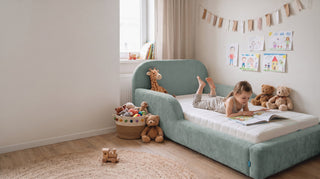
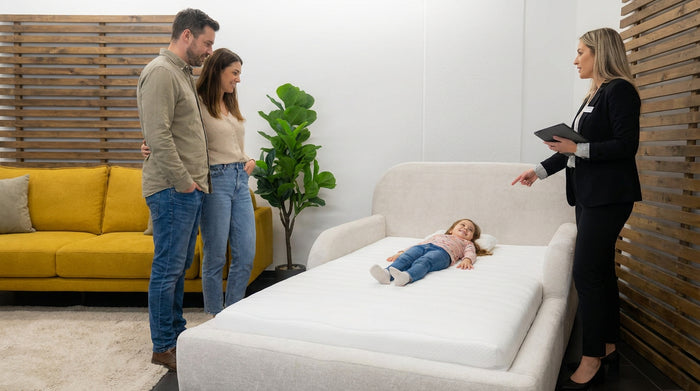

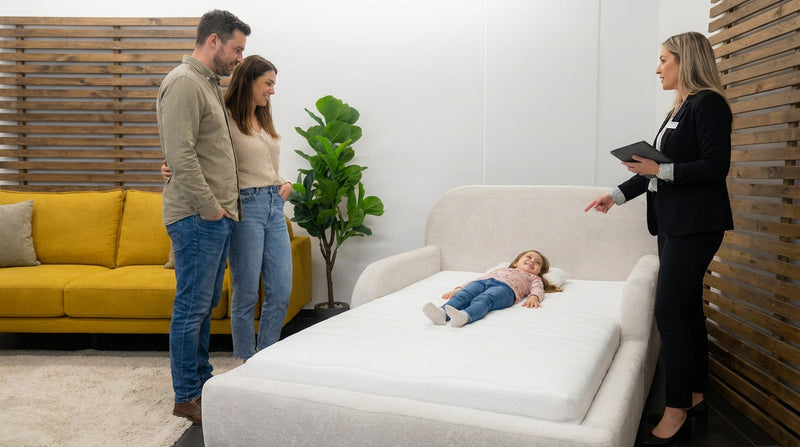
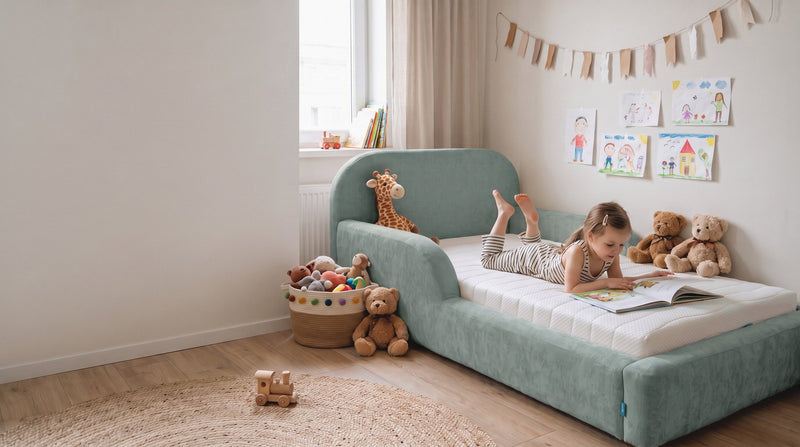

At first glance, a 120x200 kids’ bed looks like a small luxury, but in everyday family life it is often a very practical choice. If you lie down next to your child in the evening to read aloud, you quickly notice how cramped a 90 cm wide mattress becomes. Add to that children who spin round in their sleep, siblings who climb into bed at the weekend, and nights of fever or bad dreams when mum or dad lies down with them for a while. At the same time, a wide bed takes up more space, and in many Swiss flats the children’s room is on the small side. In this guide, we show you which families really benefit from a 120×200 kids’ bed, how much space you should plan for and where the drawbacks lie. At the end, a checklist helps you make your decision.
The short answer: A 120×200 kids’ bed is worth it above all if you regularly lie in bed with your child in the evening, if your child sleeps restlessly or seeks your closeness at night. It offers enough space for one parent and one child and can be used right into the teenage years. The prerequisite is a room that still has enough play space once the bed is in, as a rule of thumb from around 9 to 10 m². In very small rooms, a 90×200 bed is usually the better choice.
- A width of 120 cm gives roughly a third more sleeping surface than 90 cm, which is enough room for reading and cuddling together.
- Especially worthwhile for restless sleepers, children who need closeness and families with frequent sibling or cousin visits.
- Plan for a footprint of around 2.6 to 3 m² including the frame and about 60 cm of free space in front of the bed.
- Drawbacks: more space needed, a slightly smaller choice of bed linen and more weight when moving house.
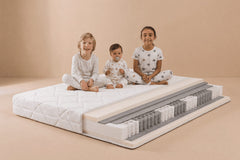
- The mattress should be sturdy enough for an adult lying alongside; the Mila Dream supports up to 150 kg.
Who a 120x200 kids’ bed is worth it for
Not every child needs a wide bed. There are, however, some typical situations in which the extra 30 cm make all the difference. If you recognise yourself in one or more of the following points, a 120×200 kids’ bed is worth considering.
Restless sleepers
Some children wake up in the morning lying crossways, with their head at the foot of the bed or half on the soft toys’ pillow. These “propeller sleepers” are not unusual among toddlers and kindergarten children. On a wider sleeping surface, they bump into the edge less often and have more room to turn over. This does not replace fall protection, but it takes a lot of pressure out of restless nights.
Settling to sleep and reading aloud
In the first few years, many parents keep their child company in the big bed while they fall asleep. Anyone squeezing onto 90 cm often ends up lying tensely on the edge of the bed. On 120 cm, an adult and a child can lie side by side without anyone having to tuck their arm in. That makes the ritual of book, song and cuddles more relaxed, as we also describe in the article “Just one more story”.
Children who seek closeness at night
If your child wakes up at night and wants someone to stay with them, a wide bed is a good alternative to moving into the parents’ bed. You lie down with them for a while instead of bringing your child into your own bedroom.
Long use: from toddler to teenager
An important argument for 120×200 is how long it can be used. A length of 200 cm is also enough for teenagers and later for adults. A width of 120 cm matches what many adults use as a single bed in a small flat or guest room. A bed of this size can therefore accompany your child from their first big bed at around two years old until they leave home, provided the frame and mattress are solid.
This has practical consequences. You do not buy a second bed after a few years; at most you replace the mattress when it is worn or needs change. Sleepovers become easier too: when a cousin from Bern visits for a weekend, two primary-school children usually find enough room on 120 cm. And when a younger sibling slips in with their big sister after a nightmare, nobody has to move to the floor.
It is important to note, however, that a big bed is only the right bed once your child is truly ready for it. For babies and toddlers under around 18 months, the cot or baby bed remains the right choice. You can read about the signs of readiness in our article When is my child ready for a big bed?.
Assessing space requirements and room size correctly
The mattress itself measures 120 × 200 cm, i.e. 2.4 m². Then there is the frame, which adds a few centimetres on each side depending on the model and padding. Realistically, you should allow for a footprint of around 2.6 to 3 m². Before buying, always measure the external dimensions of the specific model, not just the mattress size.
As a rule of thumb, at least 60 cm should remain free in front of the long side where your child gets in and out, ideally 70 to 80 cm. Add a free play area of around 1.5 to 2 m² so that building blocks, a play shop or a dolls’ house still fit. This means that a 120×200 kids’ bed works well in rooms from around 9 to 10 m². In rooms of 7 to 8 m², things get tight as soon as a wardrobe and chest of drawers are added.
Sample floor plans
- Period flat room in Zurich, 3.2 × 3.6 m (11.5 m²): the bed stands with its long side against the wall opposite the window. There is room next to it for a 100 cm wardrobe, and a play corner with a rug remains in front of the window.
- New-build room, 3 × 3.3 m (9.9 m²): the bed goes in a corner, headboard against the wall. This leaves a free strip about 1.8 m wide as play space. A narrow wardrobe stands next to the door.
- Small room, 2.6 × 3 m (7.8 m²): here a 90×200 bed would usually be wiser, so that enough room to move remains.
You will find more ideas for tight floor plans in the article Furnishing a small children’s room.
Get CHF 25 off
Subscribe to our newsletter and get a one-time CHF 25 discount. ✓ 100-night trial ✓ 5-year warranty ✓ Free delivery

An honest look at the drawbacks
A wide bed does not only have advantages. To help you decide well, here are the most important points that are often underestimated in practice.
Space in the room
The extra 30 cm of width sound like little, but they change your furnishing options. A desk, to be added later for a school child, needs around 1 m² plus room for the chair. So plan today for what the room should look like in five years.
Choice of bed linen
Fitted sheets in 90×200 are available in practically every pattern. In 120×200 the choice is smaller, especially for children’s designs. Some manufacturers offer combination sizes that cover several widths. When it comes to duvet size, on the other hand, you have a free choice: in Switzerland, 160 × 210 cm is common, and a smaller duvet is often enough for children. Plan for at least two sets per bed so that a replacement is ready straight away after a night-time accident.
Weight and moving house
A 120 cm bed is heavier and bulkier than a 90 cm model. The next time you move house or swap rooms, it will take two adults and some tools. Make sure the bed can be dismantled easily and that the parts fit through narrow stairwells, as are common in many older buildings.
Costs
Wider beds, mattresses and bed linen generally cost a little more. For bed linen, expect roughly CHF 10 to 30 extra per set, depending on quality.
Comparison: 90×200 or 120×200?
The following table summarises the main differences. You will find a detailed comparison with other sizes in our core article Kids’ bed size: 90 or 120 cm.
| Criterion | 90×200 | 120×200 |
|---|---|---|
| Sleeping surface | 1.8 m² | 2.4 m² |
| Recommended room size | from approx. 7 m² | from approx. 9–10 m² |
| Reading together | possible, but cramped | comfortable for one parent and one child |
| Restless sleepers | little leeway | much more freedom of movement |
| Choice of bed linen | very wide | smaller, especially for children’s designs |
| Weight and transport | lighter, easier to handle | heavier, more effort when moving |
| Period of use | into the teenage years | into the teenage years, also as a guest bed |
In short: 90×200 is the space-saving solution for small rooms and children who like to sleep on their own. 120×200 plays to its strengths as soon as closeness, movement or visitors come into play.

The right mattress for 120×200
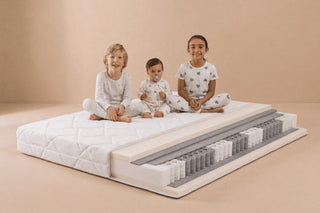
With a wide kids’ bed, the mattress is at least as important as the frame. That is because it carries not only the child, but often an adult too, who lies down to read aloud or during restless nights. A child weighing 15 to 25 kg hardly puts any strain on the mattress, whereas a parent weighing 70 or 85 kg puts on considerably more. So check the stated weight capacity and make sure the mattress does not give way at the edge when you sit on it.
Other points to look out for:
- Point elasticity: the mattress should support the light child well without sagging when an adult joins them. Zoned spring cores distribute weight more evenly.
- Washable cover: a removable cover that can be washed at 40 to 60 °C is almost essential with children.
- Reversibility: a reversible mattress can be turned regularly, which extends its lifespan.
- Sleep climate: the children’s room should be on the cool side at night; many parents aim for 16 to 19 °C. A breathable mattress supports a pleasant sleep climate.
You can find cheap second-hand beds on Tutti or Ricardo, but for hygiene reasons we recommend buying mattresses new. That way you know how old the mattress is and how it has been used.
Common mistakes when buying a wide kids’ bed
- Measuring only the mattress size: what matters is the external dimensions of the bed, including frame and padding.
- Forgetting the door swing: if the room door opens inwards, it needs a radius of around 80 to 90 cm. The bed must not block this area.
- Ignoring the radiator and window: do not place the bed directly in front of the radiator, and make sure your child cannot reach the window from the bed.
- Switching too early: a wide bed does not replace a cot. Wait until your child is ready.
- Not planning for fall protection: especially during the transition, a raised, soft edge is helpful. You can read why organic shapes have advantages here in the article Fall protection without bars.
- Underestimating the mattress: a mattress that is too soft gives way as soon as an adult lies down on it.
Decision checklist: is 120×200 right for you?
Go through the following questions one by one. If you can answer “yes” to four or more of them, a 120×200 kids’ bed is very likely the right choice.
- Do you regularly lie with your child in the evening to read aloud or help them fall asleep?
- Does your child move around a lot at night or often lie crossways in the morning?
- Does your child often seek your closeness at night?
- Does the room have a floor area of at least 9 m²?
- Is there at least 60 cm of free space in front of the bed, and do the wardrobe and play corner still fit?
- Should the bed be used into the teenage years?
- Do siblings or friends regularly come to stay the night?
- Are you prepared to accept a little more effort with bed linen and moving house?
If you only said “yes” once or twice, a 90×200 bed will be perfectly adequate in most cases. That leaves more room to play, and you can always switch later.

Frequently asked questions about the 120×200 kids’ bed
From what age does a 120×200 kids’ bed make sense?
Many children move to a big bed between the ages of two and three. For babies and toddlers under around 18 months, the cot or baby bed remains the right choice. What matters is less the exact age than your child’s readiness.
How big does the children’s room need to be for a 120 cm bed?
As a rule of thumb, a 120×200 kids’ bed works well in rooms from around 9 to 10 m². Allow for a footprint of about 2.6 to 3 m² including the frame and leave at least 60 cm free in front of the bed. In smaller rooms, a 90×200 bed is usually more practical.
Can parents lie down in a 120×200 kids’ bed too?
Yes, a width of 120 cm is enough for one parent and one child to read aloud or fall asleep together. It is important that the frame and mattress are designed for the extra weight. The Mila Dream kids’ mattress, for example, supports up to 150 kg.
What bed linen fits a 120×200 bed?
You need a fitted sheet in 120×200 or a combination size that covers this width. You have a free choice of duvet; in Switzerland, 160 × 210 cm is common. The choice of children’s designs is somewhat smaller in 120×200 than in 90×200.
Is a 120×200 kids’ bed also suitable for siblings?
For occasional sleepovers, two primary-school children usually find enough room on 120 cm. As a permanent shared bed for two children, the width is rather tight. In that case, two separate beds are the better solution.
What are the biggest drawbacks of a wide kids’ bed?
The main drawbacks are the greater space requirement, the smaller choice of bed linen and the extra weight when moving house. In addition, the bed, mattress and linen generally cost a little more. For many families, however, the comfort of reading together outweighs these.


