



The cot is getting too cramped, your child is climbing over the bars or simply wants to sleep "like the big kids", and suddenly the question arises: kids’ bed 70x140 or 90x200? Many cots can be converted into a toddler bed, which at first glance looks like the cheapest and most logical solution. Whether this intermediate step is worth it, however, depends less on the price tag than on three factors: your child’s age and height, the space in the bedroom and how you shape your evenings. In this guide, we work through both options honestly, compare the space needed and how long each size lasts, and show the mistakes that happen most often during the switch. That way, you can make a decision that will still fit not just today, but in five years’ time.
The short answer: a 70×140 bed is a transition bed that most children use until around 4 to 5 years of age, or up to a height of roughly 110 to 120 cm. A 90×200 bed, by contrast, is something you buy once, and it often stays with your child into their teens. If you already have a convertible cot, 70×140 makes sense as a short intermediate step. If you need to buy new anyway and a 90×200 bed fits in the room, the larger size is, for many families, the calmer and often cheaper solution in the long run.
- 70×140 is a transition format: usually used for only 2 to 3 years after the cot.
- 90×200 is the standard single-bed size and lasts into the teenage and adult years.
- Buying twice (toddler bed plus a big bed later) often costs more over the years than buying well once.
- The difference is around 0.8 m² of bed area: noticeable in the room, but rarely decisive.
- A big bed with raised, padded edges can preserve the familiar cosy nest feeling of the cot.
Kids’ bed 70x140 or 90x200: the two sizes at a glance
The 70×140 cm size comes from the world of baby beds. Many cots have exactly this mattress size, and some models can be converted: remove the sides or a few bars, and the cot becomes a low toddler bed. There are also standalone toddler beds in 70×140, often with a fall guard and child-friendly design. The advantage is obvious: the mattress is already there, your child knows the bed, and the change feels small.
The 90×200 cm size, on the other hand, is the classic single bed that adults use too. For children, 90×200 is usually called the "big bed" because no further change is needed. If you want even more space, for example for reading together, also take a look at 120×200. We compare the differences between 90 and 120 cm in detail in the article Kids’ bed size: 90 or 120 cm.
Important for your decision: both sizes only come into question once your child is truly ready for a bed without bars. For most children, that happens somewhere between 18 months and 3 years. To find out how to recognise the right moment, read When is my child ready for a big bed?
How long does a 70×140 bed really last?
A sleeping surface of 140 cm initially sounds generous for a 90 cm toddler. But children rarely lie straight and still. They turn over, stretch their arms above their heads, sleep diagonally or with their knees drawn up. As a rough rule of thumb, the bed should be about 20 to 30 cm longer than the child. With a length of 140 cm, things therefore get tight at a height of around 110 to 120 cm. Many children reach this at 4 to 5 years of age, roughly when kindergarten begins.
Width matters too. 70 cm is enough for a sleeping child, but hardly for a child plus cuddly toys plus a parent during the bedtime routine.
Converted cot or new toddler bed?
A converted cot costs practically nothing extra and is therefore often a good interim solution. You should check the existing mattress, though: if it has sagged, is stained or smells musty after two years, it is time for a new one. A newly bought 70×140 toddler bed, on the other hand, is an investment for just a few years. It is worth asking whether the money would be better spent directly on a bed that grows with your child.
Cost comparison: buy twice or once?
At first glance, 70×140 seems cheaper. If you calculate over the whole of childhood, the picture often looks different. The following figures are rough ranges for Switzerland and depend heavily on material, brand and where you buy. They are only meant to help you gauge the order of magnitude.
| Item | Route via 70×140 | Straight to 90×200 |
|---|---|---|
| Bed frame | approx. CHF 0 (conversion) to 500 for a toddler bed | approx. CHF 300 to 1500, one-off |
| Mattress | approx. CHF 80 to 250 | approx. CHF 200 to 700 |
| Bedding (2 sets) | approx. CHF 60 to 150 | approx. CHF 80 to 200 |
| Later switch at 4 to 6 years | bed, mattress and bedding again: approx. CHF 500 to 2000 | not needed |
| Resale | toddler bed on Tutti/Ricardo: usually only a fraction of the new price | not necessary |
The calculation shows: if you already have a convertible cot, the intermediate step is inexpensive. If, however, you buy a new toddler bed and a new mattress, you pay a second time just a few years later. Investing once in 90×200 is therefore often the more economical solution, especially if the bed and mattress are well made and last 10 years or more.

Space: does a 90×200 bed fit in the child’s room?
A 70×140 bed takes up just under 1 m², a 90×200 bed around 1.8 m². Add the frame, and depending on the model a few centimetres per side are added. In a typical child’s room of 9 to 12 m², both fit easily. Things get tight mainly in older flats, for example in Zurich or Basel, where children’s rooms are sometimes only 7 or 8 m² and radiators, windows and doors restrict where furniture can go.
So measure carefully before you buy. A simple method: mark the outline of the bed on the floor with masking tape and leave it there for a few days. This shows you whether wardrobe doors still open, whether there is enough play space and whether your child would bump straight into a radiator or shelf from the bed.
It often helps to place the bed lengthwise against the wall and make clever use of the space underneath or beside it, for example with flat storage boxes. You will find more ideas in our article Furnishing a small child’s room: 7 tricks for more space.
Get CHF 25 off
Subscribe to our newsletter and get a one-time CHF 25 discount. ✓ 100-night trial ✓ 5-year warranty ✓ Free delivery
Nest feeling: is 90×200 too big for a toddler?
The most common worry among parents is: "Our child will get lost in such a big bed." The concern is understandable. In the cot, the world was manageable, enclosed on all sides and familiar. An open 90×200 bed without edges can indeed feel unusually vast to a two-year-old.
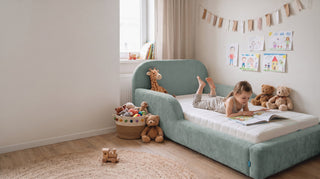
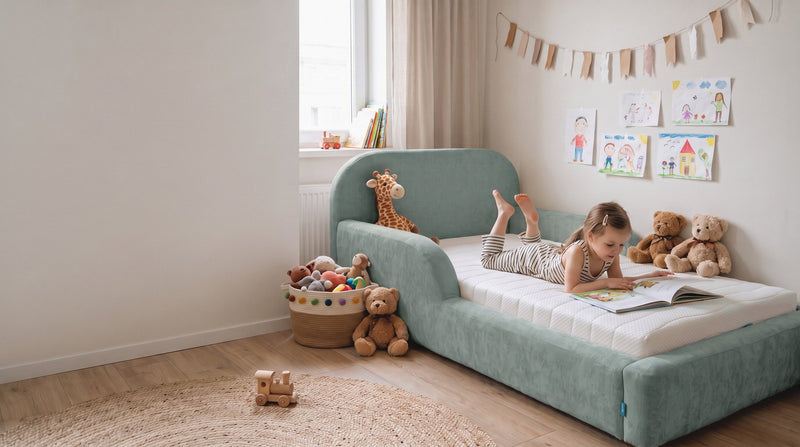
What matters, though, is less the size than the design. A bed with raised, padded edges creates a clear boundary, similar to the cot, just without bars. This conveys a sense of security and at the same time reduces the risk of rolling over the edge during sleep. Why soft, organic shapes can have advantages over separate bed rails, we explain in Fall protection without bars.
Height matters too. A low bed that your child can climb in and out of independently strengthens their sense of independence. At first, familiar things help: the same bedding, the same sleeping bag or the same duvet, and their favourite cuddly toy. After a settling-in period of usually one to three weeks, most children sleep just as soundly in the big bed as before.

Reading, cuddling, lying down together: the underrated advantage
For many families, the bedtime routine is the loveliest moment of the day. And this is exactly where the difference between the sizes is most obvious. In a 70×140 bed, lying down together is barely possible: adults sit next to it on the floor or on the edge. In a 90×200 bed, a parent can at least lie down on their side, read a book and wait until the eyelids grow heavy.
This is especially helpful in phases when children need more closeness: after starting nursery, during a house move, when a new sibling arrives or when your child wakes at night looking for comfort. It is then important that the bed and mattress can carry the extra weight of an adult. So check the maximum load stated by the manufacturer and make sure the slatted base is sturdy.
Lying down together should not become an obligation: many parents move to a chair next to the bed after the story. To plan the whole transition, read our guide From cot to kids’ bed in 5 steps.
Decision guide by age and room size
No size is right or wrong in itself. The following checklist will help you find the right option for your situation:
- Under about 2 years and a convertible cot available: 70×140 as an intermediate step makes sense, provided the mattress is still in good condition. But plan the next change already.
- Age 2 to 3, no convertible bed: going straight to 90×200 is usually worthwhile, as a new toddler bed is only used for a few years.
- From about 3 years or a height over 100 cm: a 70×140 bed will soon be too short. Here, 90×200 is almost always the better choice.
- Room under about 7 m²: measure carefully. A 90×200 bed often still fits if it stands against the wall and other furniture is chosen slimmer.
- Room from about 9 m²: 90×200 is no problem. If you read together a lot or want to lie down together, 120×200 is also worth considering.
- Siblings in the same room: two 90×200 beds need space. You could plan an L-shaped layout or place one bed lengthwise under the window.
Common mistakes when moving on from the cot
When switching to the first big bed, the same mistakes come up again and again.
- Switching too early: a new bed does not solve sleep problems. As long as your child sleeps well in the cot and does not climb out, there is no need to rush.
- Looking only at the purchase price: a cheap toddler bed can end up costing more over the years than a durable big bed, because a second purchase soon follows.
- Reusing the old mattress without checking it: after two to three years of intensive use, it is worth taking a critical look for dips, stains and odours.
- Not planning for fall protection: especially in the first few months, many children roll to the edge in their sleep. Raised edges or a soft rug in front of the bed provide security.
- Changing too much at once: a new bed, a new room, starting nursery and saying goodbye to the dummy in the same week is too much for many children. Better to take one step at a time.
- Not involving your child: children who get to help choose, for example the colour or the bedding, usually look forward to the new bed much more.

Frequently asked questions about kids’ beds: 70×140 or 90×200
Up to what age does a 70×140 kids’ bed fit?
Most children use a 70×140 bed until around 4 or 5 years of age. Height is what counts: from around 110 to 120 cm, the sleeping surface usually becomes too tight. Children who move around a lot often reach the limit sooner.
From what age can a child sleep in a 90×200 bed?
A 90×200 bed is an option as soon as your child is ready to leave the cot, which for many children is between 18 months and 3 years. Fall protection, a low entry height and a suitable mattress are important. For babies, a big bed is no substitute for a cot or baby bed.
Isn’t a 90×200 bed too big for a toddler?
Many toddlers get used to the bigger bed within one to three weeks. Raised, padded edges, familiar bedding and cuddly toys provide support and a sense of security. The nest feeling depends more on the design than on the size.
Which is cheaper in the long run: 70×140 or 90×200?
If you already own a convertible cot, 70×140 is an inexpensive intermediate step. If, however, you need to buy a new toddler bed with a mattress, you will pay again a few years later for a big bed. A one-off purchase in 90×200 is therefore often the more economical solution.
How much space does a 90×200 kids’ bed need in the room?
The sleeping surface is 1.8 square metres, plus a few centimetres for the frame. In a child’s room of around 9 square metres or more, that fits easily. In smaller rooms, it helps to mark the outline on the floor with masking tape first.
Can I reuse the mattress from the cot?
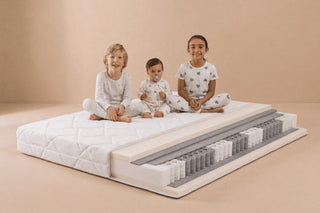
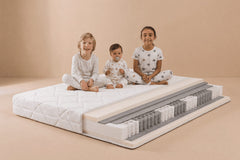
When converting to a 70×140 toddler bed, that is possible if the mattress is clean, keeps its shape and has no dips. A 90×200 bed needs a new mattress in the right size anyway. Look for age-appropriate firmness and a washable cover.


