



Moving from the cot to the first big bed is a small milestone, and almost every parent asks the same question: which bed guard for a kids’ bed actually suits us? In the shops you will find wooden rails, mesh guards, fold-down models, wedges and even tips involving pool noodles. Every solution has its place, but none suits every bed, every mattress and every child. Especially in an older flat in Zurich or Basel, where the children’s room is narrow and the bed cannot stand freely, the choice also affects space and everyday practicality. Here we compare all the common types objectively and show you what to look out for when fitting one yourself.
The short answer: there is no single best bed guard; what matters is the combination of bed, mattress and your child’s age. The most reliable solutions are those that are firmly attached to the bed or already part of its construction, such as a raised, padded edge or a screwed-on wooden rail. Add-on mesh guards and wedges are practical transitional solutions, provided they are fitted exactly according to the instructions and no gaps appear. A low bed positioned against the wall reduces the risk further, because any fall happens from a low height.
- There are five main groups: fixed wooden rails, add-on mesh or fabric guards, wedges and bolsters, integrated padded edges, and low beds or floor beds.
- There must be no gap between the mattress and the guard in which a child could become trapped.
- Always fit add-on solutions according to the manufacturer’s instructions and observe the recommended age.
- Most children need a bed guard until roughly the age of 4 to 6, some for less time, some for longer.
- A bed against the wall and a soft rug in front of it are simple, inexpensive additions.
Bed guards for kids’ beds: why they matter when moving up
In a cot, a child is protected on all sides. In an open bed, this boundary suddenly disappears, and children notice it in their sleep. Toddlers often turn over many times a night, slide across the sheet or end up with their feet at the head end. Depending on the model, the mattress of a kids’ bed sits about 20 to 45 cm above the floor, and considerably higher on a loft bed. A fall usually ends with a fright and a few tears, but furniture edges, toys or a hard parquet floor make it needlessly risky.
A bed guard has two jobs. First, it stops your child rolling over the edge in their sleep. Second, it provides a sense of boundary that many children know from the cot and that can be soothing when falling asleep. That is why it pays to plan the move carefully, as we describe in the guide From cot to kids’ bed in 5 steps. You can tell whether your child is ready by a few typical signs, for instance if they try to climb out of the cot. Read more in When is my child ready for a big bed?
Fixed wooden boards and integrated rails
The classic option is a board or a short wooden rail screwed firmly to the bed frame. Many kids’ beds come with one already; for others, it can be bought later as a matching accessory from the same manufacturer. The big advantage: because the guard is part of the construction, it is stable and does not slip. It usually covers half to two thirds of the bed’s length, so your child can climb in and out independently at the foot end.
Drawbacks: hard edges and corners can be uncomfortable when turning over at night, and some children bump their head or knee while half asleep. Slats also invite children to poke their arms and legs through. It is also important that accessories genuinely fit the bed model: a board from another manufacturer can often only be attached by improvising, and that is exactly where dangerous gaps appear.
Add-on bed guards with mesh or fabric
Add-on bed guards usually consist of a metal or plastic frame covered with mesh or fabric. Part of the frame slides under the mattress and is held in place by the mattress’s weight, sometimes supplemented by straps running around the slatted base or the bed. In Switzerland these models cost roughly CHF 30 to 90, and you can also find them second-hand on Tutti or Ricardo. They fit many beds, including those at the grandparents’.
The mesh is breathable and soft; your child can see through it and does not feel shut in. However, safety depends heavily on how it is fitted. If the frame is not firmly secured, a gap can form between the mattress and the mesh, especially if the mattress is soft or the child leans against it. So check that everything is secure every time you change the bedding. With second-hand models, the instructions must be included.
Fold-down rails
Fold-down versions can be swung down during the day, which makes bed-making easier. Make sure the mechanism locks reliably and that your child cannot release it themselves. There is a risk of trapped fingers, mainly at joints and hinges.

Bed wedges, bolsters and the pool noodle trick
Bed wedges are long foam blocks that are slipped under the fitted sheet. They raise the edge of the mattress so that your child feels a slight ridge and tends to roll back. They cost roughly CHF 20 to 60 and are light, discreet and good for travelling. Their protection is limited, though: a wedge slows a child down, it does not really hold them back.
Loose bolster cushions or rolled-up blankets slip easily and do not belong in a young child’s bed. In the first year, the rule applies anyway: no loose pillows or blankets in the sleeping area.
The pool noodle trick, taken soberly
The idea of putting a pool noodle under the fitted sheet keeps coming up in parenting forums. It creates a ridge of about 6 to 7 cm and costs next to nothing. As a reminder edge for older children who only rarely roll towards the side, it can work, for example on holiday. But it is not a tested safety product: the noodle can shift, the height is barely enough for a sturdy toddler, and some materials smell strongly. So see the trick as a stopgap, not as lasting protection.
Raised edge, floor bed and wall position
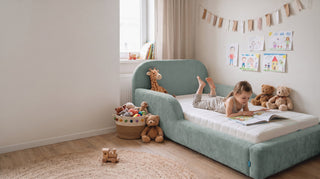
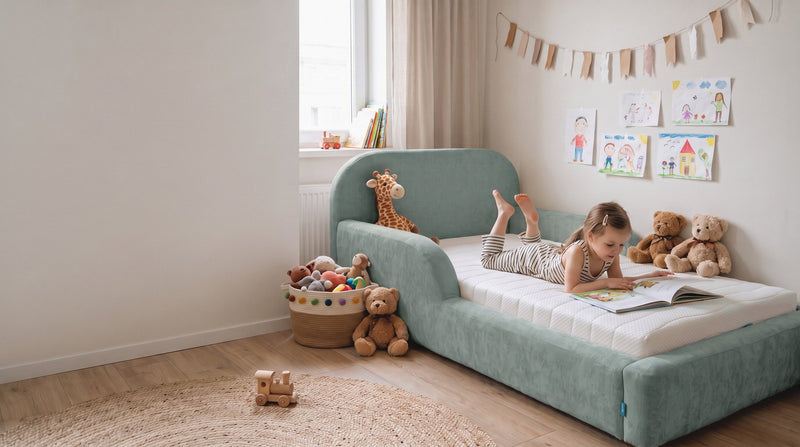
An increasingly popular alternative is a kids’ bed with high, fully padded sides. Here, the fall protection is part of the bed: there is nothing to fit, nothing can slip, and no gaps form between the mattress and the guard if the mattress fits the frame precisely. The soft padding cushions knocks when turning over, and the bed feels like a nest. We explain in detail why such organic shapes are the better choice for many families in the guide Fall protection without slats. The drawback: these beds usually cost more to buy than a simple bed with a clip-on guard.
Floor bed and low bed
With floor beds, the mattress lies directly on the floor or just a few centimetres above it. A fall is then little more than a roll. You should, however, ensure good ventilation so that moisture does not build up under the mattress, especially in cool rooms in older buildings at around 18 °C. A slatted base or a frame with an air gap helps.
Wall position
A bed with one long side against the wall only needs protection on one side. Important: there must be no gap between the wall and the mattress. Our article Furnishing a room for 2 to 5-year-olds shows how to plan the room sensibly.
Get CHF 25 off
Subscribe to our newsletter and get a one-time CHF 25 discount. ✓ 100-night trial ✓ 5-year warranty ✓ Free delivery
All types of bed guard compared
The following overview summarises the most important features. Prices are rough ranges from Swiss retailers and are intended only as a guide.
| Type | Advantages | Disadvantages | Rough cost |
|---|---|---|---|
| Fixed wooden board or rail | Stable, does not slip, durable | Hard edges, slats, awkward bed-making | often included with the bed, otherwise approx. CHF 30–80 |
| Add-on mesh or fabric guard | Flexible, soft, also for guest beds | Depends on fitting, risk of gaps | approx. CHF 30–90 |
| Fold-down rail | Handy for bed-making and bedtime stories | Hinges, mechanism must lock securely | approx. CHF 40–100 |
| Wedge or bolster | Discreet, light, good for travelling | Only a slight brake, can slip | approx. CHF 20–60 |
| Pool noodle under the sheet | Almost free, quick to improvise | Not a safety product, low edge | approx. CHF 5–10 |
| Integrated padded edge | No fitting, no slats, soft, nest feeling | Higher purchase cost | Part of the bed |
| Floor bed or low bed | Minimal fall height, independent getting up | Watch ventilation, little storage | approx. CHF 150–500 |
Many families combine two approaches, for example a low bed against the wall with a wedge on the open side.

Fitting a guard yourself: what to look out for
If you add a guard afterwards, go about it systematically. This checklist helps:
- Read and follow the instructions: fit the product exactly as intended and use only the parts supplied.
- Check the fit: before buying, find out which bed widths, frame types and mattress depths the model is designed for. A clip-on guard often holds less well on a very thin or very thick mattress.
- Do the gap test: push the mattress and guard apart with the flat of your hand. If a gap appears that a child’s arm or even head could fit into, readjust it.
- Check the height: the guard must rise noticeably above the mattress surface. Check again after changing the mattress or adding a topper.
- Observe the age guidance: manufacturers usually state a minimum and maximum age. Add-on guards are not intended for babies still of cot age.
- Check regularly: once a week, for example when changing the bedding, check straps, screws and hinges.
A securely fitted guard also helps with falling asleep, because your child feels safe. Calm rituals complement it well, as described in the article Bedtime rituals for toddlers.
How long does a child need a bed guard?
There is no fixed age limit. Many children move to a big bed between the ages of 2 and 3 and still need the guard for a few years after that. It often becomes unnecessary somewhere between 4 and 6, roughly when children start kindergarten. What matters, though, is not age but sleep behaviour.
These observations help you decide:
- In the morning, your child is usually lying roughly where they fell asleep.
- They have not rolled to the edge for several months.
- They get up safely at night, for example to go to the toilet, and find their way back without stumbling.
- Nights without a guard, for example at the grandparents’, go smoothly.
Phase it out gradually: first remove the guard for a few nights and place a soft rug or mat in front of the bed. If that goes well for two to three weeks, the guard can go for good. With restless sleepers, patience pays off; read more in the guide Child waking at night. A bed with an integrated edge does not need converting, by the way: the edge simply stays and does not bother older children either.
Common mistakes with bed guards
Most problems are caused not by the product but by the way it is used:
- Improvised fixing: attaching guards with cable ties or tape to beds they were not made for.
- Mattress too small: an 85 cm wide mattress in a 90 cm frame leaves gaps that arms or legs can slip into.
- Toys and cushions as a barrier: a pile of soft toys at the edge will not stop a child and can become a climbing aid.
- Hard furniture next to the bed: bedside tables with sharp corners or a toy box right by the open edge increase the risk of injury in a fall.
- Never checking again: straps loosen over time, especially with children who love bouncing on the bed.
- Removing it too early: taking the guard away just because a certain birthday has passed, even though the child still sleeps restlessly.

Frequently asked questions about bed guards for kids’ beds
From what age does a child need a bed guard?
As soon as your child moves from a cot to an open bed, usually between the ages of 2 and 3. Babies sleep in a cot or baby bed, and add-on guards are not intended for them. Always follow the manufacturer’s age guidance.
Which bed guard is the safest?
The most reliable solutions are those that are an integral part of the bed, such as an integrated padded edge or a properly screwed-on board. Add-on guards can also work well if they are fitted exactly according to the instructions and no gap forms.
Is a pool noodle enough as a bed guard?
As a short-term reminder edge for older children it can help, for example on holiday. However, it is not a tested safety product, because it can shift and only forms a low edge.
How high does a bed guard need to be?
It must rise noticeably above the mattress surface so that your child does not roll over it. Follow the manufacturer’s guidance and check the height again after every mattress change.
When can the bed guard come off?
Often between the ages of 4 and 6, but sleep behaviour is what counts. If your child has not rolled to the edge for months and gets up safely at night, you can remove the guard gradually.
Does a bed against the wall need two bed guards?
No, on the wall side the wall itself is enough, provided there is no gap between the mattress and the wall. The guard is then only needed on the open side.


