


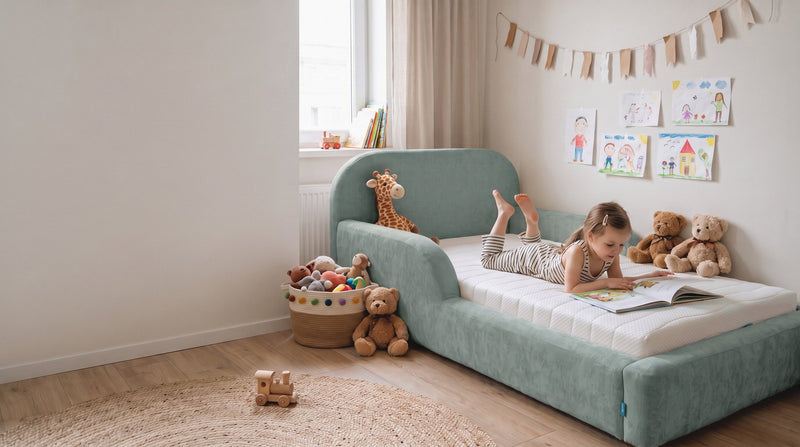

At some point between their second and third birthday, almost every family faces the same question: the cot is getting too small, your child is climbing out or wants to sleep 'like the big kids'. In the furniture shop, two options stand side by side: the compact junior bed at 70×140 cm, or a full-size kids' bed at 90×200 cm straight away. The junior bed looks child-friendly, affordable and small – the big bed seems sensible, but perhaps too much for a toddler. The decision affects your budget, the space in the nursery and how often you will have to change things again over the next few years. In this guide we compare both options honestly: with figures on how long each lasts, a cost comparison, tips on fall protection and a checklist that gets you to your answer in ten minutes.
The short answer: A junior bed makes sense if your cot converts anyway, the room is very small or you are planning to move in the next few years. If you need to buy a new bed regardless, a kids' bed in 90×200 or 120×200 cm is usually the better choice, because it lasts into the school years and beyond. What matters most is not just the size, but effective fall protection, a low sleeping height and a bed in which your child feels safe and secure.
- A junior bed (usually 70×140 cm) typically lasts until around age 5 or 6 – after that you need a second bed.
- A 90×200 cm kids' bed can be used from the toddler years into the teens, provided it has suitable fall protection.
- If you count the bed, mattress and bedding twice, going straight to a big bed is often cheaper than the detour via a junior bed.
- When moving out of the cot, the key factors are a low sleeping height, side protection and a familiar bedtime routine.
- Children under about 18 months should stay in a cot or baby bed.
What is a junior bed – and how does it differ from a kids' bed?
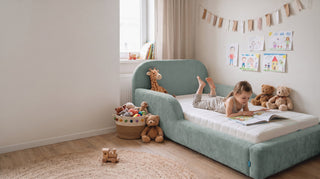
A junior bed is a low, shortened bed for toddlers, usually with a sleeping surface of 70×140 cm, less often 60×120 cm. That matches exactly the mattress size of many cots. This is why lots of cots can be converted into a junior bed: you remove two or three bars or a side panel, lower the slatted base to the bottom position, and the familiar mattress simply stays where it is.
A kids' bed in the stricter sense, on the other hand, has the dimensions of a single bed – 90×200 cm – or the more generous 120×200 cm. It is not just meant for the first few years but accompanies your child through kindergarten, primary school and often longer. To be suitable for a toddler, it needs a low sleeping height and side protection that prevents your child from rolling out at night.
So the main difference lies less in the look than in the time span: a junior bed is an interim solution for roughly three to four years, whereas a big kids' bed is a purchase for ten years or more. You can read which age generally suits the switch in our article Kids' bed: from what age?.
How long will your child fit in a junior bed?
A 140 cm sleeping surface looks enormous at first, when a two-year-old measuring around 85 to 90 cm is lying in it. But children grow quickly in the early years: according to common growth charts, many children are around 100 to 105 cm tall at four and around 115 cm at six. Because children stretch out, turn over in their sleep and like to have a cuddly toy or pillow at the head end, the mattress should be noticeably longer than the child. As a rule of thumb, many manufacturers allow about 20 cm of extra length.
In practice, then, a junior bed often becomes too short at five or six – and earlier for tall children. There is another point many people underestimate: at story time, during a fever in the night or after a bad dream, mum or dad will want to lie down for a moment. At 70 cm wide, that is barely possible. The following overview shows the differences at a glance:
| Criterion | Junior bed 70×140 cm | Kids' bed 90×200 cm | Kids' bed 120×200 cm |
|---|---|---|---|
| Typical starting age | approx. 18 months to 3 years | approx. 18 months to 3 years (with fall protection) | approx. 18 months to 3 years (with fall protection) |
| Fits roughly until | height of around 120–125 cm, often 5–6 years | teenage years, sometimes adulthood | teenage years and beyond |
| Floor space (mattress) | approx. 1 m² | 1.8 m² | 2.4 m² |
| Cuddling up at story time | barely possible | easily possible | very comfortable |
| Further purchase needed | yes, usually at 5–6 years | usually not | usually not |
If you are unsure which of the two standard sizes suits you better, you will find a detailed comparison in the article Kids' bed 70×140 or 90×200.
Cost comparison: buy once or twice?
At first glance, the junior bed is the cheaper option. In Switzerland, simple models start at around CHF 150, plus a 70×140 cm mattress. But the sums change as soon as you look at the whole period: at five or six, a second purchase is due – frame, mattress, fitted sheets and often a new duvet in a different size. On top of that come delivery, assembly and disposing of or reselling the old bed.
| Cost item | Option A: junior bed, big bed later | Option B: big bed straight away |
|---|---|---|
| Bed frame | approx. CHF 150–400, then CHF 300–1000 | once, approx. CHF 300–1000 or more |
| Mattress | 70×140 approx. CHF 80–200, then 90×200 | once, 90×200 |
| Bedding and fitted sheets | two sizes, everything twice | one size |
| Effort | choosing, delivery, assembly and disposal twice | once |
The price ranges are rough guidelines and depend heavily on materials and quality. Even so, the comparison shows that if you buy a junior bed new, you usually end up paying more than if you switch straight to a big bed. Things look different if your cot is already convertible. Then the junior bed step costs practically nothing, and you can save up at your own pace or wait until your child wants a say in choosing the big bed. A tip from everyday family life: junior beds in good condition can often still be sold on Swiss classified ad platforms or at children's second-hand markets, whereas mattresses are hard to sell for hygiene reasons.

Safety and fall protection: what really matters
Many parents opt for a junior bed because it feels safer: low, small, with a side guard. These points really are important – but they are not a feature of the bed size. A 90×200 cm kids' bed can also be low and have effective fall protection. Three things are decisive:
Sleeping height: the lower the top of the mattress, the less serious a fall. Many families make sure their child can get into bed independently without climbing.
Side protection: toddlers move around a lot at night. Protection covering at least the upper half of the body stops them from rolling over the edge in their sleep. It should be firmly attached to the bed and leave no gaps where arms or legs could get caught.
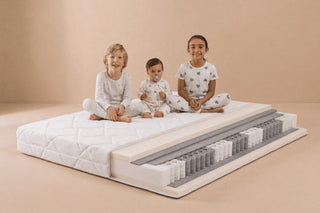
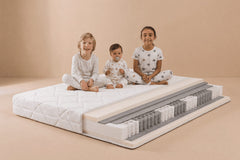
A well-fitting mattress: there should be no significant gap between mattress and frame. The mattress must match the sleeping surface exactly.
We explain the different kinds of fall protection and how they compare in the article Child falls out of bed – what to do?. One thing remains important: switching beds only makes sense once your child is physically able to get in and out safely on their own – for most children, from around 18 months at the earliest.
Space in the nursery: 70×140 versus 90×200 and 120×200
In many Swiss flats, children's rooms are on the small side – ten square metres or less is not unusual, especially in older city buildings. Here there is a lot to be said for a junior bed: it needs around one square metre of floor space, a 90×200 cm bed about 1.8 square metres and a 120×200 cm version around 2.4 square metres, each plus the frame.
Still, it is worth taking a close look at the floor plan. The difference of 60 cm in length and 20 cm in width seems large on paper but can often be offset if the bed is placed lengthways against the wall, leaving the play area in the middle of the room. Mark the outlines of the beds on the floor with masking tape – you will see immediately whether the wardrobe, chest of drawers and play mat still fit and whether doors and drawers open freely.
Think about the coming years too: starting school usually means adding a desk. If you plan for a big bed now, you will not have to rearrange everything later. If the room really is very small, or two siblings share it, a junior bed may be the more relaxed solution for a few years. You will find more ideas in the article ideas for a small kids' room.

Junior bed or kids' bed: which suits which family?
There is no one-size-fits-all answer, but there are typical situations in which one option is clearly ahead.
A junior bed works well if… your cot is convertible and the mattress is still in good condition; you plan to move in the next two or three years and do not yet know the future room; the nursery is very small, or a sibling is on the way and the cot will be needed again – in which case a second bed will be needed anyway.
A big kids' bed works well if… you need to buy a new bed regardless; you value a long-lasting purchase and do not want to go shopping again in three years; you like to snuggle in at story time and on restless nights; your child is tall or moves around a lot in their sleep.
An example from everyday life: the M. family from Winterthur converted their two-year-old daughter's cot into a junior bed because the baby who arrived in spring needed a cot of her own. Two years later the junior bed was already too short – and the next bed purchase was due. Looking back, they would have chosen a big bed with fall protection straight away.
Common mistakes when moving out of the cot
Switching too early: as long as your child sleeps well in the cot and does not climb out, there is no need to rush. A change made purely out of impatience often leads to restless nights.
Changing everything at once: a new bed, a new room, starting nursery and potty training all in the same week is too much for many toddlers. Plan the bed switch for a calm period instead.
Not involving your child: a child who gets to choose the bedding or help with assembly is more likely to accept the new bed as 'theirs'.
Dropping rituals: right now, familiar routines provide security – the same story, the same cuddly toy, the same lullaby.
Forgetting the surroundings: as soon as your child can get up on their own, they will explore the room at night too. Chests of drawers and shelves should be anchored to the wall to prevent tipping, sockets covered and cables out of reach. You will find a detailed guide to the transition in from cot to toddler bed.
Step by step to the right decision
With this checklist you can work out in a few minutes which option suits your family:
- Check what you have: can your cot be converted into a junior bed? Is the mattress still clean, firm and free of dips?
- Clarify your time frame: will you stay in your flat for the next five years? Is a sibling coming who will need the cot?
- Measure the room: mark the bed outlines with masking tape and check that the play area, wardrobe and later a desk will fit.
- Budget over five years: do not just compare today's price, but the bed, mattress and bedding for both options.
- Define safety: low sleeping height, firmly attached side protection, a snug-fitting mattress – regardless of size.
- Involve your child: let them help choose the colour or bedding and welcome the new bed with a small ritual.
If your answer to point 1 is 'no' and to point 2 is 'yes', there is a lot to be said for switching straight to a big kids' bed.
Get CHF 25 off
Subscribe to our newsletter and receive a one-time CHF 25 discount. ✓ 100-night sleep trial ✓ 5-year guarantee ✓ Free delivery

Frequently asked questions about junior beds and kids' beds
From what age is a junior bed suitable?
Most children move out of the cot between about 18 months and 3 years. Development matters more than age: your child should be able to get in and out safely on their own. A junior bed is not intended for babies.
Until what age does a 70×140 cm junior bed fit?
As a guideline, a junior bed fits up to a height of around 120 to 125 cm. Many children reach this at five to six years, tall children earlier. After that, a longer bed is needed.
Can a toddler sleep straight away in a 90×200 cm bed?
Yes, provided the bed is low and has firmly attached side fall protection. Many children feel comfortable in it, especially if their cuddly toy, pillow and bedtime routine stay the same.
Is a junior bed safer than a big kids' bed?
Not automatically. Safety depends on the sleeping height, the fall protection and a well-fitting mattress, not on the size of the bed. A low big bed with good protection can be just as suitable.
Can I keep using the mattress from the cot?
If you convert the cot into a junior bed, yes, as long as the mattress is clean, firm and free of dips. A big kids' bed needs a new mattress in the right size.
How can I best help my child get used to the new bed?
Keep the usual bedtime routine, let your child have a say in choosing and pick a calm period without other big changes. A few restless nights at the start are normal and usually settle after a few days.
This article is for general information only and does not replace advice from a paediatrician. If problems persist, please consult your paediatrician.


