


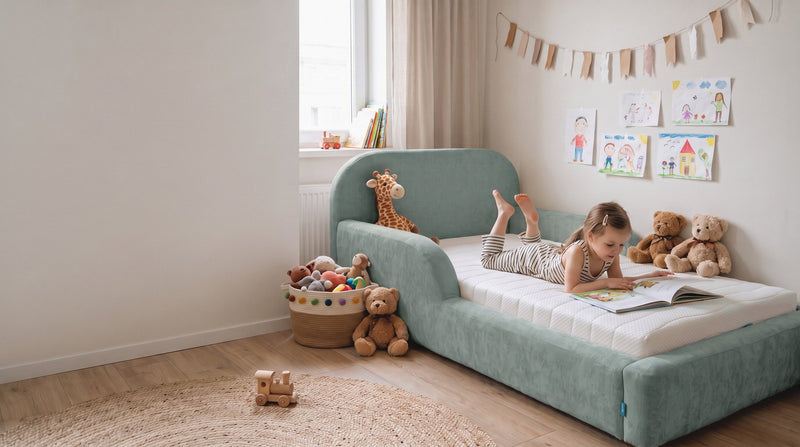

Anyone looking for a new bed after the cot quickly faces a wall of dimensions: 70×140, 80×160, 90×200, 100×200 or straight to 120×200? Many parents decide on gut feeling and only notice years later that the bed has become too short or is cluttering the bedroom. Yet one size has established itself as the standard in Switzerland and across Europe: the 90x200 kids’ bed. It fits into most rooms, accompanies your child from the toddler years well into adolescence and makes finding a mattress, topper and bedding much easier. In this guide, you will learn how much space a 90×200 bed really needs, how it compares with other sizes and when a wider bed is worth it after all. Including floor plan examples for typical children’s rooms between 8 and 12 m² and a list of the most common mistakes.
The short answer: for most families, 90×200 cm is the smartest choice, because the bed grows with your child, can be a purchase for 10 to 15 years and fits into practically any child’s room. Mattresses, bedding and accessories are available in this size in a huge range and are often cheaper than in special sizes. The limitations mainly concern reading together lying down and overnight guests. If you have more than 12 m² or often cuddle with your child in bed, 120×200 cm is the better option.
- 90×200 cm is the most common single bed size and also suits teenagers and adults up to around 1.85 m tall.
- Allow for external dimensions of about 100–110 × 210–220 cm, depending on the frame and padding.
- You need at least 60–70 cm of clear walkway in front of the long side, ideally 80 cm.
- Mattresses, toppers and bedding in 90×200 are available in a wide range, including second-hand on Tutti or Ricardo.
- 120×200 is worth it if you have plenty of space, share cuddle time or want a future teenage bed.
Why a 90x200 kids’ bed is the smartest standard size
A 90x200 kids’ bed is essentially a completely normal single bed, and that is precisely its greatest strength. Classic children’s beds measuring 70×140 cm work well for children aged roughly 2 to 6. At the latest when your child has a growth spurt in kindergarten or in first grade, things get cramped. A bed with a 200 cm sleeping length, on the other hand, will not need replacing for years to come. Even a 1.80 m teenager still has enough room above their head and below their feet.
The second advantage is choice. Because 90×200 is the standard size in furniture stores, online shops and bedding retailers, you will find mattresses in every firmness, waterproof protectors, toppers, fitted sheets and duvet covers in countless colours. Special sizes such as 80×160, by contrast, often cost more or have to be ordered in. The standard size also has the edge when reselling: a well-kept bed or mattress in 90×200 usually finds a new owner more quickly on Tutti or Ricardo.
Third, the room stays flexible. A single bed can be placed against almost any wall, even under a sloping ceiling or next to a window. You can read more about the basic decision between the two most common widths in our guide Kids’ bed size: 90 or 120 cm.
Space requirements: planning external dimensions and walkways
The most common mistake when measuring: the figure 90×200 only describes the sleeping surface, in other words the mattress. The bed itself is always larger. Slim wooden or metal frames add around 5 to 10 cm in each direction; upholstered beds with a surrounding edge or a tall headboard add more like 15 to 20 cm. So plan for a footprint of around 100 to 110 cm in width and 210 to 220 cm in length. When buying, always check the external dimensions on the product sheet.
The walkways around the bed are just as important. So that you can change the bedding comfortably, sit on the edge of the bed in the evening and reach your child at night without tripping, these guideline values are recommended:
- In front of the open long side: at least 60–70 cm, 80 cm is comfortable.
- In front of a wardrobe or chest of drawers with doors or drawers: 80–90 cm, so that everything opens fully.
- Between the bed and the radiator: a few centimetres of clearance so that the heat can circulate.
- Towards the bedroom door: the door should swing open freely without hitting the bed.
A simple trick: mark the external dimensions on the floor with painter’s tape and leave it there for a few days. You will see straight away whether the play mat, desk or wardrobe still have enough room. You will find more ideas for tight floor plans in Furnishing a small child’s room: 7 tricks for more space.
Sizes compared: 70×140, 90×200, 100×200 and 120×200
Which size suits your family? The following overview shows the most important differences at a glance. The external dimensions are rough guideline values and depend heavily on the individual model.
| Sleeping surface | External size approx. | Suitable for | Advantages | Disadvantages |
|---|---|---|---|---|
| 70×140 cm | 80 × 150 cm | approx. 2–6 years | Very space-saving, often convertible | Soon too short, second purchase needed |
| 90×200 cm | 100–110 × 210–220 cm | from approx. 2 years into adulthood | Standard size, widest choice, fits small rooms | Tight when a parent lies down too |
| 100×200 cm | 110–120 × 210–220 cm | School children and teenagers | A little more freedom of movement | Smaller choice of bedding and accessories |
| 120×200 cm | 130–140 × 210–220 cm | Children who like company in bed, teenagers | Room for reading and cuddling | Needs around 30 cm more width |
In short: 70×140 is an interim solution for a few years, 100×200 a niche. The real choice is usually between 90×200 and 120×200. The 30 cm difference sounds small, but in a 9 m² room it often decides whether there is still space for a desk or not.
Get CHF 25 off
Subscribe to our newsletter and get a one-time CHF 25 discount. ✓ 100-night trial ✓ 5-year warranty ✓ Free delivery

The right mattress for 90×200
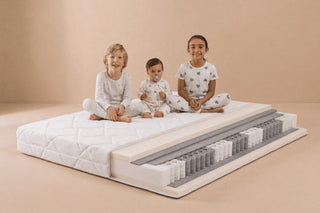
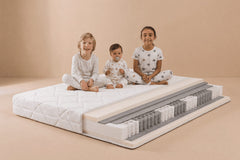
Even the best bed is of little use without a suitable mattress. The big advantage of the standard size: you can choose between cold foam, latex and pocket springs, in various firmness levels and heights. For children, a medium-firm mattress has proven itself, supporting the still light body without letting it sink in. Look out for these points:
- Height: children’s mattresses are usually 12 to 20 cm high. Check that the height matches the bed frame so that the side edge still sticks up far enough.
- Cover: a removable cover that can be washed at 60 °C is worth its weight in gold with children, for example after a night-time accident or a stomach bug.
- Ventilation: a slatted base or breathable underlay allows moisture to escape.
- Certificates: labels such as OEKO-TEX indicate tested materials.
- Load capacity: if Mum or Dad lies down during story time, the mattress should also be able to support adults.
In Switzerland, good children’s mattresses in 90×200 cost roughly between CHF 200 and 700. For hygiene reasons, a second-hand mattress is less advisable than a second-hand bed frame. A mattress protector significantly extends its lifespan.
Floor plan examples for typical Swiss children’s rooms
Many children’s rooms in Swiss rental flats measure between 8 and 12 m². This is how a 90×200 bed could fit in:
8 m² (approx. 2.6 × 3.1 m)
The bed goes lengthways against the long wall, ideally in a corner. With a bed width of 105 cm, around 155 cm of room width remains free: enough for an 80 cm walkway and a narrow chest of drawers or a 40 cm deep shelf on the opposite wall. Later on, a desk will fit better under the window on the short side.
10 m² (approx. 2.9 × 3.4 m)
Here, with the bed in the corner, there is enough floor space left for a play mat of around 120 × 170 cm and a 60 cm deep wardrobe. A bed with drawers or storage underneath also creates extra space for toys.
12 m² (approx. 3.2 × 3.8 m)
At this size you have some leeway. A 90×200 bed leaves plenty of free space for playing and learning. Alternatively, a 120×200 bed also fits here without things getting cramped. In older flats, for example in Zurich or Basel, bear in mind radiators under the window, decorative mouldings and doors that open inwards. You will find tips for furnishing with toddlers in Furnishing a room for 2- to 5-year-olds.

When 120×200 is the better choice
As practical as the standard size is, there are situations in which a wider bed makes more sense. A 120 cm wide bed is particularly worthwhile if one or more of these points apply to your family:
- Shared bedtime rituals: if you lie next to your child every evening, read aloud or stay until they fall asleep, 90 cm quickly becomes tight. On 120 cm, an adult and a child can lie side by side comfortably.
- Restless nights: if your child often wakes up and you then lie down with them, the extra width is pleasant for everyone.
- Siblings and overnight guests: for sleepovers or when a younger sibling occasionally wants to sleep in the same bed, 120×200 offers more options.
- Plenty of space: from around 12 m², the extra width hardly matters.
- Long-term planning: a 120 bed later serves teenagers as a comfortable bed and can also live on in the guest room.
Bear in mind, though: bedding for 120×200 is somewhat less widespread than for 90×200, and the bed needs around 30 cm more floor space. If you are unsure, mark out both options on the floor with tape and compare. For the switch from the cot, our guide From cot to kids’ bed in 5 steps will help.
Common mistakes when buying a 90×200 bed
- Measuring only the sleeping surface: anyone planning with 90 × 200 cm is often in for a surprise during assembly. Always check the external dimensions.
- Forgetting walkways: a bed that stands just 40 cm from the wardrobe causes trouble every morning.
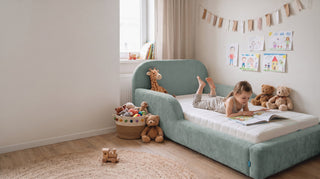
- Sleeping surface too high for small children: a loft bed or a very high bed is unsuitable for toddlers. To start with, a low sleeping height with side protection is ideal.
- No fall protection: especially when switching from the cot, children like to roll over the edge in their sleep. A raised, soft edge or a guard rail helps. More on this in Fall protection without bars.
- Not matching the mattress height: a mattress that is too thick reduces the height of the side edge.
- Overlooking hard edges: small children climb, romp around and bump into things. Rounded or padded edges are more pleasant in everyday life.
- Looking only at the price: a bed that will be used for 10 years or more is allowed to be solid. Good children’s beds in 90×200 cost roughly between CHF 300 and 1500.
Checklist: how to find the right bed
Before you order, go through these points step by step:
- Measure the room, including windows, radiators, sockets and the direction the door opens.
- Transfer the external dimensions of the bed you want onto the floor with tape.
- Check walkways: at least 60–70 cm in front of the long side.
- Think about what your bedtime rituals look like: does a parent often lie in the bed too?
- Match the fall protection and sleeping height to your child’s age.
- Choose the mattress to suit the frame height and make sure it has a washable cover.
- Check materials and certification labels.
- Compare delivery terms, return options and warranty.
And finally: involve your child in the choice. If they can help pick the bedding or the colour, they will usually look forward to the new bed more, and the move into the “big bed” will be easier.

Frequently asked questions about the 90×200 kids’ bed
From what age is a 90×200 kids’ bed suitable?
Many children move from the cot to a larger bed between around 18 months and 3 years. A 90×200 bed is suitable for this if it has a low sleeping height and side fall protection. For babies, a cot or baby bed remains the right choice.
How much space does a 90×200 cm bed need?
Depending on the model, the bed measures around 100 to 110 cm in width and 210 to 220 cm in length on the outside. On top of that, you need at least 60 to 70 cm of walkway in front of the open side. It fits well in a room of around 8 m² or more.
Is 90×200 too big for a toddler?
No, many toddlers feel comfortable in a larger bed as long as it feels cosy and secure. A raised edge, cuddly toys and familiar bedding help with this. Effective fall protection is important for the first few months.
Can a parent lie down in a 90×200 bed?
For reading a story or a quick cuddle it is usually enough, but in the long run it gets tight. If you regularly stay with your child for longer, consider 120×200 cm. Also make sure the bed and mattress can support an adult’s weight.
Which mattress fits a 90×200 kids’ bed?
Any mattress in the standard 90×200 cm size is suitable, ideally medium-firm with a removable, washable cover. The height should match the bed frame so that the side edge stays high enough. Cold foam, latex and pocket springs are all possible.
Is 100×200 worth it as a compromise?
The extra 10 cm provide a little more freedom of movement but hardly any room for a second person. At the same time, the choice of bedding and accessories is smaller. For most families, 90×200 or going straight to 120×200 is therefore the more sensible choice.


