



In their first years, a child spends around half of their time in bed – nose right up against the mattress, cover and bed frame. Little wonder that many parents want to know whether a kids’ bed is non-toxic before they buy. Yet this question is surprisingly hard to answer in a furniture shop or online: there are labels, words like “natural” or “tested” and sometimes just a green leaf. What actually means something, and what is marketing? And what should you look out for with wood, lacquer, foam and fabric? In this guide, you will learn what the different labels test, which materials tend to be unproblematic and which questions to ask the retailer before you order.
The short answer: strictly speaking, there is no such thing as completely “pollutant-free” furniture – the goal is to keep exposure as low as possible. Independent labels such as OEKO-TEX Standard 100 for textiles, the Blue Angel (Blauer Engel) for low-emission furniture or GOTS for organic textiles give reliable pointers, ideally with a verifiable number. FSC, on the other hand, only shows that the wood comes from responsibly managed forests. Combined with clear material details, an unobtrusive smell and open answers from the retailer, you get a pretty good picture.
- “Non-toxic” is not a protected term – look for independent, verifiable labels.
- OEKO-TEX Standard 100 tests textiles for harmful substances; FSC only says something about where the wood comes from.
- The critical areas are lacquers, adhesives in wood-based panels and foams – ask specific questions.
- A strong, pungent smell is a warning sign; air new furniture thoroughly before first use.
- Reputable retailers state materials, certificate numbers and care instructions without hesitation.
Non-toxic kids’ bed: what the term really means
“Pollutant-free” sounds clear-cut, but it is neither legally defined nor protected. Almost every material contains traces of substances that would be problematic in high concentrations – what matters is whether they are present in relevant amounts and whether they can get into the indoor air or onto the skin. Experts therefore prefer to speak of “low-pollutant” or “low-emission” products.
With a kids’ bed, three groups are of particular interest. First, volatile organic compounds (VOCs), which are released from lacquers, adhesives and foams and cause the typical “new smell”. Second, formaldehyde, found in some glues used in chipboard and fibreboard. Third, substances in textiles, such as certain dyes, plasticisers or finishes that make fabrics crease-resistant or stain-repellent.
Young children react more sensitively to such exposure than adults: relative to their body weight they breathe in more air, lie close to the materials for ten to twelve hours a night and like to put things in their mouths. That is no reason to panic – most furniture on the Swiss market is unremarkable. But it is a good reason to take a closer look at a kids’ bed than at the bookshelf in the living room. For how to choose the bed as a whole, read our guide Buying a kids’ bed: what to look for.
The most important labels at a glance
Labels offer the quickest orientation – provided you know what they cover. Many parents assume an eco-label automatically means “tested for harmful substances”. That is not always the case. The following overview shows what the common labels refer to:
| Label | Applies to | What it tells you | What it does not tell you |
|---|---|---|---|
| OEKO-TEX Standard 100 | Textiles (covers, upholstery fabrics, fillings, yarns, zips) | The certified textile has been laboratory-tested against a broad list of harmful substances; baby articles face the strictest requirements | Nothing about wood, lacquer or the frame; nothing about eco-friendly production |
| OEKO-TEX MADE IN GREEN | Textiles | Harmful-substance testing plus more environmentally friendly and socially responsible production, traceable | Nothing about non-textile parts |
| Blue Angel (Blauer Engel) | Including furniture, wood-based panels, mattresses, paints | German government eco-label with requirements for emissions and ingredients | Only for the specific product group and award criteria |
| GOTS | Textiles made from natural fibres | High share of organic fibres and restrictions on chemicals throughout processing | Nothing about the frame or foams |
| FSC / PEFC | Wood and wood-based panels | The wood comes from responsibly managed forests | No statement about lacquers, glues or emissions |
| EU Ecolabel | Including furniture, mattresses | Eco-label with life-cycle criteria, including restrictions on chemicals | Only valid for the specific labelled product |
Important: a label only ever applies to what was actually tested. If an upholstered bed carries OEKO-TEX, this refers to the textile components, not necessarily to every screw or panel inside.
Reading labels correctly: how to check the claims
A logo can be copied onto a product page in seconds. That is why genuine certificates can be verified – and it usually takes less than two minutes.
Look for the certificate number: with OEKO-TEX Standard 100, the label includes a test number and the testing institute. On the OEKO-TEX website you can enter the number and see which articles the certificate covers and whether it is current. Certificates are renewed regularly, usually every year.
Note the product class: OEKO-TEX distinguishes between several product classes. The strictest class is intended for articles for babies and toddlers up to 36 months. For bedding and covers that are in direct contact with your child’s skin, this is a helpful pointer.
Clarify the scope: with the Blue Angel or the EU Ecolabel, the product itself is certified, usually with the relevant award criteria stated. If this information is missing, it is worth asking.
Beware of made-up labels: phrases such as “eco-friendly”, “natural” or “kind to skin” without a testing body are advertising claims, not proof. That does not mean the product is bad – it just means you have no independent confirmation.

Materials: wood, wood-based panels, lacquers and upholstery
Besides labels, the material details reveal a lot. Every material has its own typical weak spots – and its own strengths.
Solid wood such as beech, birch or pine is considered straightforward, provided the finish is right. Waxed or oiled surfaces can release natural resins and fragrances; with lacquer, it depends on the formulation. Water-based lacquers generally give off fewer emissions than solvent-based ones. For children’s furniture, a saliva-resistant finish also makes sense, as toddlers love to chew on edges.
Wood-based panels such as chipboard, MDF or plywood are sturdy and affordable but contain glues. Asking about the formaldehyde emission class is reasonable here; in Europe, E1 is the usual minimum class, and many manufacturers now use low-formaldehyde or formaldehyde-free binders.
Upholstery and foams usually consist of polyurethane foam, fleece and cover fabric. There are dedicated testing programmes for foams, such as CertiPUR, while OEKO-TEX is what counts for the cover. An upholstered kids’ bed is therefore not inherently more “chemical” than a wooden bed – what matters is what has been tested. You will find a direct comparison of the two designs in Upholstered vs wooden kids’ bed.
The smell test and airing: what your nose tells you
Your nose is not a laboratory, but it is a useful early-warning sensor. A faint smell of wood, fabric or cardboard is normal and usually fades within a few days. A sharp, chemical or sickly-sweet smell that is still clearly noticeable after two weeks, however, is a reason to contact the retailer.
Here is the best way to handle a new bed:
- Remove the packaging soon after delivery and dispose of plastic film – fumes build up underneath it.
- Ideally assemble the bed a few days before the first night, or even one to two weeks before the planned move to the big bed.
- Air the room thoroughly for 5 to 10 minutes several times a day rather than leaving the window tilted permanently.
- Unpack the mattress too and let it air standing on its side.
- Wash new bedding before first use – this removes residues from production.
Warmth speeds up off-gassing. In summer, new furniture often smells more intensely, but also loses the smell faster. For sleep itself, a room temperature of 16 to 18 °C and humidity of around 40 to 60 per cent are comfortable. If you are setting up the room right now, you will find ideas in Setting up a toddler’s room.

Checklist: questions to ask the retailer
Good retailers welcome well-informed customers. Whether in a shop in Zurich, on the phone or by email: with these questions you will have a clear picture within minutes.
- Which materials is the bed made of? Frame, panels, padding, cover, feet – a complete list is a good sign.
- Which labels apply to which parts? And what is the test or certificate number?
- What surface treatment was used? Water-based lacquer, oil, wax or untreated?
- Which glues and wood-based panels are used? And what emission class do the panels have?
- Were flame retardants or impregnations used? For furniture for private use, flame retardants are generally not required in Switzerland.
- Is the cover removable and washable? This makes hygiene easier and helps wash out production residues.
- Where was the product developed and made? And is there a contact person for questions?
- What are the return and guarantee terms? If the smell does not go away, you should be able to return the bed without hassle.
If the retailer is evasive, only refers to general marketing phrases or cannot provide any numbers, it is perfectly fine to let that influence your decision. Read more about manufacturers and origin in our overview Children’s furniture in Switzerland.
Common mistakes and myths fact-checked
Myth: “Solid wood is always non-toxic.” The wood itself is usually unproblematic, but lacquer, stain or oil can give off emissions. Without details about the finish, the claim is incomplete.
Myth: “FSC means tested for harmful substances.” FSC and PEFC relate to forest management. They are valuable for the environment but say nothing about emissions from the finished furniture.
Myth: “If it is expensive, it must be safe.” Price says little about the formulation of lacquers or adhesives. Affordable products can be well tested – and expensive ones may not be.
Mistake: focusing only on the bed. The mattress, bedding, rug, freshly painted walls and new wardrobes also affect the indoor air. If you buy everything new at once, air the room especially generously.
Mistake: taking on second-hand furniture without checking it. A used bed has often already finished off-gassing – an advantage. With old, flaking layers of paint or unknown origin, however, be careful and inspect the surface closely.
Mistake: using fragrance sprays against the new smell. Air fresheners only mask odours and add further substances to the air. Airing the room is the better solution.
Around the bed: mattress, bedding and care
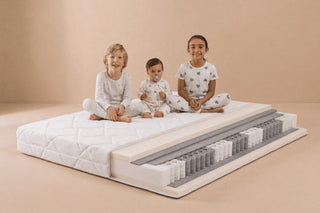
The bed frame is only part of the sleeping space. The mattress is closest to your child’s breathing zone, so it deserves the same care: ask about labels for the cover and filling materials and look for a removable, washable cover. Let a new mattress air unpacked for one to two days before first use.
For bedding, sleeping bags and cuddly toys, OEKO-TEX Standard 100 or GOTS are good pointers. Washing before first use, at 40 to 60 °C depending on the care label, removes finishing residues. Skip fabric softener and heavily perfumed detergents – both cling to the fabric and are unnecessary for sensitive skin.
For routine care, a slightly damp cloth and mild soap are all you need. Harsh cleaners, disinfectant sprays or solvent-based stain removers are rarely needed in a child’s room and can become a source of pollutants themselves. Airing regularly in the morning and before bedtime is not only good for the indoor air but also helps prevent damp and mould – an important issue in well-insulated new Swiss flats. And if your child struggles to settle in the evening, it is rarely down to the materials and usually more about rhythm and rituals.
Get CHF 25 off
Subscribe to our newsletter and get a one-time CHF 25 discount. ✓ 100-night sleep trial ✓ 5-year guarantee ✓ Free delivery

Frequently asked questions about non-toxic kids’ beds
How can I tell if a kids’ bed is non-toxic?
The most reliable indicators are independent, verifiable labels such as OEKO-TEX Standard 100 for textiles or the Blue Angel for low-emission furniture, combined with complete material details and an unobtrusive smell after airing.
What does OEKO-TEX Standard 100 test on a kids’ bed?
The label refers to the textile components such as the cover, upholstery fabric or filling. These are laboratory-tested against a broad list of harmful substances. It says nothing about wooden parts or production conditions.
Is an FSC label a sign that a bed is free of harmful substances?
No. FSC and PEFC confirm that the wood comes from responsibly managed forests. They make no statement about lacquers, glues or emissions from the finished furniture.
How long should a new kids’ bed be aired?
As a rule of thumb, it helps to unpack and assemble the bed a few days to two weeks before the first night and to air the room thoroughly several times a day. A faint natural smell usually fades quickly.
What should I do if the new bed smells strongly?
Keep airing thoroughly and do not let your child sleep in it for the time being. If a pungent or chemical smell persists after around two weeks, ask the retailer about materials and test certificates and use your right of return if necessary.
Are upholstered kids’ beds more polluted than wooden beds?
Not in principle. What matters are the materials used and the tests carried out. An upholstered bed with tested textiles can be just as harmless as a wooden bed with a low-emission finish.
This article is for general information only and does not replace advice from a paediatrician. If problems persist, please contact your paediatrician.


