


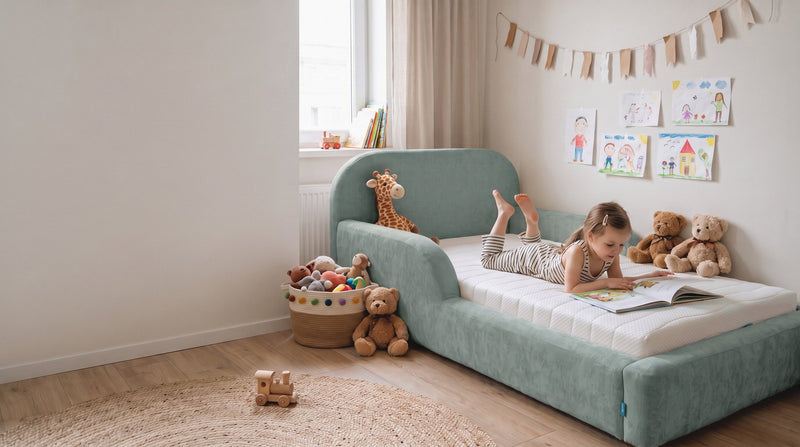

When people see an upholstered kids’ bed for the first time, they usually think about how good it looks and only much later about everyday life. Yet that is exactly where its real strengths show: at half past six in the evening, when your child jumps on the mattress one more time after brushing their teeth, or at three in the morning, when they roll half asleep towards the edge of the bed. Many parents in Switzerland buy the first big bed when their child outgrows the cot at between two and three years old, and then have to choose between wood, metal and upholstery. The differences seem small at first glance, but in daily use they are not. In this guide, you will find out which seven advantages an upholstered kids’ bed brings, where its honest limits lie and what to look out for when buying. That way you can decide whether this type of bed suits your family, your home and your budget.
The short answer: An upholstered kids’ bed offers soft edges instead of hard corners, a surrounding rim that gently frames the sleeping area and a cosy nest feeling that makes the move from the cot easier for many children. On top of that come comfort for bedtime reading, calmer room acoustics and a homely look. In 90 × 200 or 120 × 200 cm, it stays with your child well into their school years. In return, the cover needs a little more care, and it usually costs more than a simple wooden bed.
- All-round padding cushions bumps against the headboard and frame, but it does not replace supervision or a child-friendly room.
- A raised, soft rim frames the sleeping area without bars and feels like a nest to many children.
- Padded headboards turn the bed into a comfortable spot for bedtime stories, for mum and dad too.
- Fabric absorbs sound and feels warmer than wood or metal.
- Limits: stains, pet hair and a higher price are part of an honest assessment.
What makes an upholstered kids’ bed
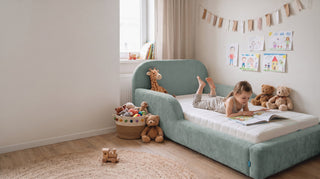
An upholstered kids’ bed usually consists of a sturdy inner frame, mostly made of wood or engineered wood, wrapped in foam and covered with a fabric such as bouclé, corduroy or woven textile. Unlike a classic wooden bed with a small padded cushion on the headboard, good models are covered all the way round: headboard, sides and footboard. The sleeping surface often sits slightly lower than the surrounding rim, creating a kind of hollow.
Typical sizes are 90 × 200 cm for a single child in a smaller room and 120 × 200 cm if there is space or if parents like to lie down next to their child in the evening. On many models, the entry height is deliberately low so that children from around two years old can climb in and out on their own. This is the key difference from a cot: your child decides when to get up and no longer needs an adult to do so.
The right moment for the switch depends less on age than on clear signals. Our article When is my child ready for a big bed? gives a good overview. One important point first: an upholstered kids’ bed is a bed for toddlers and older children, not for babies. Under around 18 months, a cot or baby bed remains the right choice.
Advantages 1 and 2: Soft edges and fall protection without bars
No hard edges when bumping into the frame
Toddlers move around in bed a surprising amount. They kneel, turn, stand up, let themselves fall backwards and often sleep sideways. With a wooden or metal frame, their head meets a hard edge; with an upholstered frame, it meets a surface that gives way. That will not prevent every bump, and no bed makes supervision unnecessary, but the typical “thud” against the headboard becomes far less alarming. Many parents only notice this when their child tumbles against the rim while playing and simply keeps laughing.
Organic fall protection without bars
The raised, padded rim acts as a gentle boundary. If your child rolls to the side in their sleep, they feel the soft resistance, much like a wall or a nursing pillow. Unlike a guard rail fitted afterwards, there are no gaps where arms or legs can get caught and no bars to climb. How strong this effect is depends on the height of the rim and of the mattress: if the rim only rises a few centimetres above the mattress, the effect is small. You can read more about this principle in Fall protection without bars. A practical tip: for the first few weeks, place a soft rug or play mat next to the bed anyway.
Advantages 3 and 4: A nest feeling and a favourite spot for reading
A sense of security when moving on from the cot
For your child, the cot was a clearly defined space. An open bed with no boundaries at all can suddenly feel huge, especially at 120 cm wide. A frame padded all the way round creates a shell again: there is something soft to feel on the left, on the right, at the head and at the foot. Many parents report that their child snuggles up against the rim during the first nights, just as they once did against the cot bars with a bumper. This feeling is hard to measure scientifically, but in everyday life it is often the difference between a bumpy and a relaxed transition. To plan the move step by step, see Moving on from the cot: how to make it stress-free.
Comfortable for reading and leaning back
In most families, the bedtime routine takes place in the child’s bed: pyjamas, teeth, two picture books, a song. Against a wooden headboard, you are sitting uncomfortably after ten minutes and stuffing pillows behind your back. A padded headboard works like the back of a sofa. You lean back, your child snuggles up beside you, and the story can go on a little longer now and then. Studies suggest that regular, calm bedtime routines make it easier for many children to fall asleep, and a comfortable spot makes them easier to keep up.

Advantages 5 and 6: Calm for ears, hands and eyes
Quieter, warmer and sound-absorbing
Anyone living in an older flat in Zurich or Basel with parquet floors and high ceilings knows the echo: every knock against the bed frame can be heard all the way to the living room. Fabric and foam dampen these noises. The creaking that can develop over time in simple wooden beds is also often less noticeable with upholstered frames. The cover also feels pleasant to the touch. If your child brushes the rim with their arm in winter at a room temperature of 18 to 20 °C, they touch a textile surface rather than cold metal. This does not affect the room temperature, but it does affect how cosy the bed feels.
A calm look and a tidier room
Children’s rooms quickly become colourful and cluttered. A bed with soft, closed shapes in muted tones such as mist grey, sand or sage brings calm into the room. It looks less like a piece of furniture for a specific age and more like a homely piece that also suits a schoolchild’s room. If you are interested in colours, you will find more ideas in Colours in the children’s room. A practical bonus: as the frame is closed, toys roll under the sides less often.
Get CHF 25 off
Subscribe to our newsletter and get a one-time CHF 25 discount. ✓ 100-night trial ✓ 5-year warranty ✓ Free delivery
Advantage 7: A bed that grows with your child into their school years
A kids’ bed measuring 90 × 200 or 120 × 200 cm is not a stopgap piece of furniture. A three-year-old is around 95 to 100 cm tall, a child in the fourth year of primary school is often already over 135 cm, and both fit easily on a 200 cm length. From the first year of kindergarten at around four until well into primary school, the bed stays the same; only the bedding and décor change. That saves a second purchase and another rearrangement of the children’s room. Which width makes sense is explained in detail in Kids’ bed size: 90 or 120 cm. The following table shows the differences from other types of bed at a glance.
| Criterion | Upholstered kids’ bed | Wooden bed | Metal bed |
|---|---|---|---|
| Edges | soft, all round | hard, often rounded | hard, sometimes thin struts |
| Side boundary | integrated soft rim | extra guard rail usually needed | extra guard rail usually needed |
| Comfort when leaning back | high | low without cushions | low |
| Acoustics | sound-dampening | neutral | can rattle |
| Care | vacuum the cover, treat stains immediately | wipe clean | wipe clean |
| Price range (rough) | rather higher | approx. CHF 150 to 900 | approx. CHF 100 to 500 |

Honest limits: care, pets and budget
An upholstered bed is not the best solution for every family. There are three points you should check honestly before buying.
- Care: Felt-tip pens, yoghurt or a night-time accident end up on the rim sooner than you would like. Look for hard-wearing, stain-resistant fabrics and vacuum the cover with the upholstery nozzle roughly every two weeks. Dab fresh stains with lukewarm water and a little mild soap, without rubbing. A mattress protector with a washable cover gives the sleeping surface extra protection.
- Pets: Cats love scratching soft fabrics, and dog hair clings easily to bouclé or corduroy. If you have pets, choose smooth, tightly woven fabrics and keep the bedroom door closed during the day.
- Budget: Upholstered beds are more complex to make and therefore usually cost more than a simple wooden bed. You can find inexpensive second-hand beds on Tutti or Ricardo, but with used upholstery it is hard to judge condition, smell and hygiene. So work out the price over a period of use of six to ten years.
The room plays a part too: in very small rooms, an upholstered frame takes up a few centimetres more than a slim wooden frame. So measure the external dimensions, not just the sleeping surface.
Checklist: how to choose the right model
Once you have decided on an upholstered kids’ bed, this order will help you choose.
- Check age and readiness: Is your child at least around 18 months old, are they climbing out of the cot, or do they want a “big” bed themselves?
- Decide on the size: Measure the room and allow around 60 to 70 cm of free space in front of the bed. 90 cm wide for small rooms, 120 cm for more space when reading.
- Look at the rim height and entry: The rim should clearly rise above the mattress, but the entry should be low enough for your child to get out on their own.
- Check the fabric and certifications: Ask about testing for harmful substances such as OEKO-TEX, abrasion resistance and care instructions.
- Test the stability: The inner frame should not wobble, even when an adult sits on the rim.
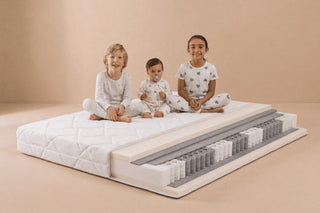
- Think about the mattress: The mattress must fit the bed exactly, with no gap to the frame, and its height must match the rim.
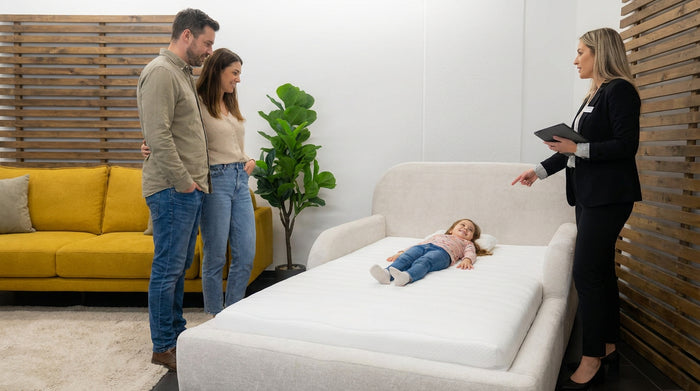
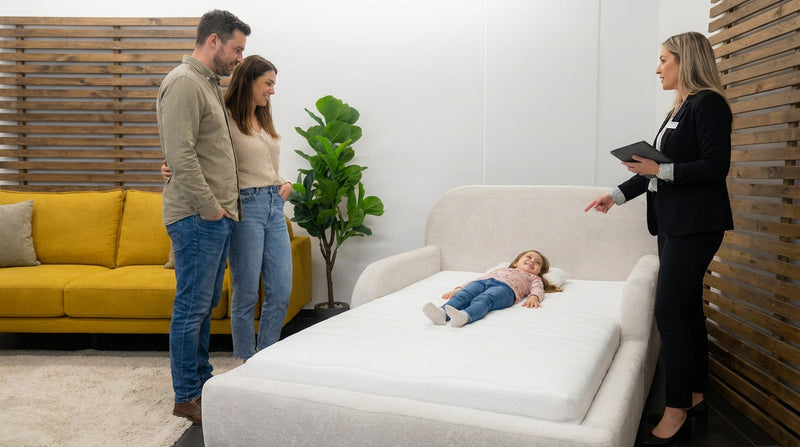
- Compare the terms: Trial nights, warranty, delivery and returns make a real difference for a larger piece of furniture.
Common mistakes when buying an upholstered bed
The most common mistake is buying the bed too early. An upholstered kids’ bed does not replace a cot, and specific recommendations apply to babies in their first year: sleeping on their back, their own bed in the parents’ room, no loose pillows or blankets and a room temperature of around 18 °C. If you have questions about this, your paediatrician is the right person to ask.
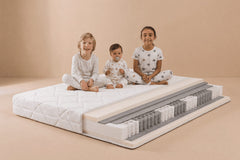
A second mistake concerns the mattress. A mattress that is too thin makes the rim look high but provides too little support. A mattress that is too thick raises your child so far that the rim loses its framing effect. Follow the manufacturer’s guidance on the recommended mattress height.
Third, many families underestimate the settling-in period. Even the most beautiful bed will not solve sleep problems overnight. Keep the familiar routine, put the new bed in the familiar spot and let your child help choose the bedding. Fourth: if you buy based on photos alone, the fabric can sometimes come as a surprise. If possible, order fabric samples or use a trial period to check the colour and feel at home in daylight.

Frequently asked questions about upholstered kids’ beds
From what age is an upholstered kids’ bed suitable?
An upholstered kids’ bed is intended for toddlers from around 18 months and for older children. Many families make the switch between two and three years of age. For babies, a cot or baby bed remains the right choice.
Does the padded rim replace a bed guard rail?
The raised, soft rim frames the sleeping area and helps many children stay in bed. How well it works depends on the height of the rim and the mattress. A soft rug next to the bed is still a good idea at the beginning.
How do I clean the cover of an upholstered bed?
Vacuum the fabric regularly with the upholstery nozzle. Dab fresh stains with lukewarm water and mild soap, without rubbing. Always follow the manufacturer’s care instructions.
Are upholstered beds suitable for families with pets?
In principle yes, but cats may scratch the fabric and pet hair tends to cling. Smooth, tightly woven fabrics are easier to care for. Keeping the bedroom door closed during the day gives the bed extra protection.
Which size is better: 90 or 120 cm?
90 × 200 cm fits well in smaller children’s rooms. 120 × 200 cm offers more space for reading and for a parent lying down alongside in the evening. Both sizes last well into the school years.
What should I look for in the mattress?
The mattress must fit the bed exactly, with no gap to the frame. Its height should match the bed’s recommended specification so that the rim stays effective. A washable cover makes everyday hygiene easier.


