



When you start looking for your child’s first big bed, you quickly face a fundamental question: an upholstered bed for kids or the classic wooden bed? In the furniture shop, the wooden bed looks solid and timeless, the upholstered bed soft and cosy, and both have convinced fans. On parenting forums you then read that upholstery is unhygienic and that wood is far too hard, and in the end you are more confused than before. Yet this is a piece of furniture that will ideally accompany your child for eight to ten years, every night and often during the day as a play island, reading den or trampoline. In this comparison, we take a sober look at what really matters in everyday family life: edges, fall protection, care, allergies, durability, moving house, sustainability and budget. That way you can decide which bed suits your child, your home and your daily routine.
The short answer: There is no fundamentally better material, just different strengths. An upholstered bed wins over toddlers with soft edges, a snug nest feeling and a gentle transition from the cot. A solid wood bed impresses with its sturdiness, long lifespan and easy-to-clean surface. If your child is moving beds between roughly 2 and 5 years of age, clambers about a lot or often bumps against the bed frame at night, there is a lot to be said for a well-made upholstered bed with a removable cover.
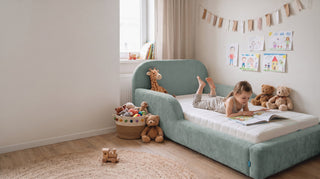
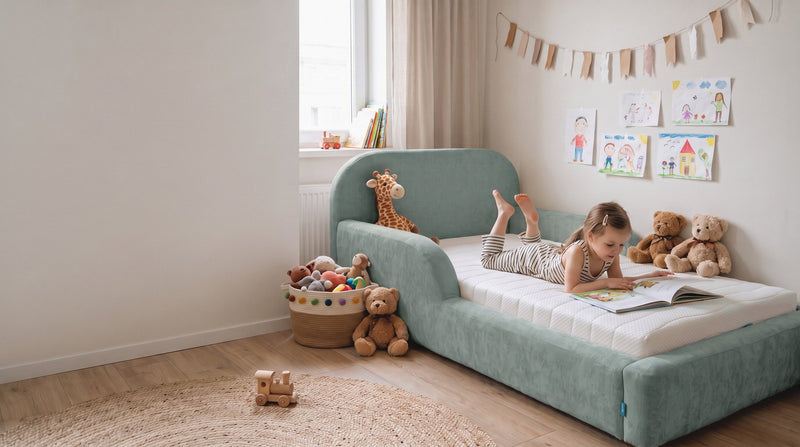
- Upholstered beds have no hard edges and give toddlers a sense of security – a plus when moving out of the cot.
- Wooden beds are very sturdy, easy to wipe clean and can often be handed down for decades.
- With both options, hygiene is a matter of care: a removable, washable cover makes upholstery practical for everyday life.
- When it comes to house dust mites, the mattress is what matters most, not primarily the bed frame.
- Whatever the material, look for testing for harmful substances, a stable construction and the right size (90×200 or 120×200 cm).
Upholstered bed for kids vs wooden bed: what really matters
Before going into detail, it is worth looking at how they are built. A wooden bed consists of a frame made of solid wood (for example beech, oak, pine or Swiss stone pine) or of wood-based materials such as chipboard and MDF with veneer or foil. An upholstered bed also has a load-bearing frame, usually made of wood or a wood-based material, which is padded with foam and covered with fabric.
So the real difference lies in the surface your child touches – and that is decisive for toddlers. Children between 2 and 5 sleep restlessly, turn sideways across the bed, climb in and out three more times in the evening and use the bed during the day as a stage for cuddly-toy theatre. That is why it is worth assessing the classic criteria from a child’s point of view: how does the edge feel when a head rolls against it at night? How easily do yoghurt stains come off? What happens when you move to a third floor without a lift? And what will the bed look like in seven years, when your kindergartener has become a primary school pupil? We go through these questions one by one.
Edges, bumps and fall protection
The most obvious difference is hardness. Wood is hard, even if the edges are rounded. If your child bumps against the headboard while climbing in or rolls against the side panel at night, the best case is a brief “ouch”, the worst a bump on the head. With wooden beds, you should therefore look for rounded corners with a noticeable radius and avoid sharp-edged fittings. An upholstered bed cushions such contact because the frame is soft all round. This is a real advantage, especially in the phase when children get up half asleep at night to come to you.
Fall protection: bars or organic shape?
With fall protection, it is height and shape that count, not the material. Many wooden beds rely on an attachable board or rails that are removed later. Upholstered beds often use a raised, padded rim that surrounds the child like a nest. We explain in detail why soft, rounded shapes without bars work well during the transition in our article Fall protection without bars. Whatever you choose, a low sleeping height of around 20 to 35 cm and a soft rug next to the bed make any slip-out more harmless. There should also be hardly any gap between the mattress and the frame, so that little arms and legs cannot get trapped.
Feel, security and looks
Children experience their bed with all their senses. A padded rim feels warm and soft; they can lean against it, rest their back on it during story time or sit their favourite cuddly toy on it. Many parents report that their child “settles” more quickly in a bed with a high, soft rim because they feel enclosed – much like in the familiar cot, just without the bars.
Wood has a different but equally lovely feel. Oiled solid wood feels natural, smells pleasant in the case of Swiss stone pine or pine and brings warmth to the room. If you like a Scandinavian or alpine interior style, a wooden bed is often the more fitting solution.
Visually, upholstered beds are much more varied today than they used to be. Muted colours such as powder pink, sage green, sand or light grey suit modern children’s rooms and combine well with wooden furniture. The best of both worlds is therefore often a soft bed next to a wooden wardrobe or shelf. You will find tips for a calm overall look in our guide Furnishing a room for 2 to 5-year-olds.

Care, stains and everyday hygiene
This is where the biggest reservation about upholstered beds lies – and it is only partly justified. You simply wipe a wooden bed with a lacquered or oiled finish with a damp cloth, and that’s it. Felt-tip pen on untreated wood is stubborn, though, and scratches from toy cars remain visible.
With upholstered beds, the cover is what counts. If it is removable and washable, the hygiene objection loses much of its weight: after a stomach bug brought home from nursery, the cover goes in the washing machine, just like the bedding. Glued-on covers, by contrast, can only be spot-cleaned. So when buying, pay attention to the following points:
- Removable cover, ideally with a zip or hook-and-loop fastening
- Washing temperature according to the care label (often 30 to 40 °C) and whether the fabric shrinks
- Hard-wearing, tightly woven fabrics with high abrasion resistance
- Dab fresh stains immediately with lukewarm water and mild soap – do not rub
- Vacuum once a week with the upholstery nozzle
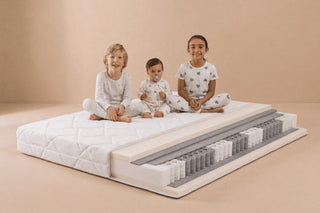
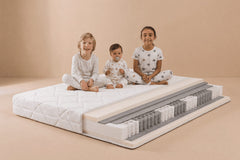
Regardless of the bed frame, the mattress needs a washable cover, and a waterproof, breathable mattress protector is worth its weight in gold during potty training.
Get CHF 25 off
Subscribe to our newsletter and get a one-time CHF 25 discount. ✓ 100-night trial ✓ 5-year warranty ✓ Free delivery
Allergies and dust: a sober look
Many parents worry that an upholstered bed is unsuitable for children with a house dust allergy. Yet it is well established that house dust mites live mainly where it is warm and humid and where skin flakes accumulate – in other words, in the mattress, pillow and duvet. By comparison, the bed frame plays a smaller role. Studies suggest that mite-proof mattress covers (encasings), regularly washing bedding at 60 °C and a well-ventilated room are the more effective levers for allergic children.
Still, every textile surface collects dust. If you choose an upholstered bed, vacuum the frame regularly and wash the cover at sensible intervals. Wooden beds have the advantage that dust can be removed completely with a damp cloth.
If your child has been diagnosed with an allergy, it is best to discuss the room set-up with your paediatrician. For everyone else, the indoor climate matters more than the bed material. Airing the room thoroughly two to three times a day, a bedroom temperature of around 16 to 19 °C and relative humidity of about 40 to 60 % are good guidelines. A bed made from tested materials, for example to OEKO-TEX, provides additional reassurance regarding harmful substances.
Durability, weight and moving house
A well-made solid beech or oak bed can last for decades and later be passed on to siblings or cousins or sold on Tutti and Ricardo. Chipboard beds are considerably less robust: screws loosen after being assembled and dismantled several times, and foil-covered edges peel off over time.
A well-made upholstered bed is also durable if the frame is stable and the cover is replaceable or washable. The weak point is usually the fabric: after many years of family life, it may show signs of wear.
Weight and transport
Solid wood beds measuring 90×200 cm often weigh 30 to 60 kg, depending on the type of wood and construction. Upholstered beds are often in a similar or slightly lower range, but are sometimes bulkier because padded parts cannot be dismantled as flat. For a period flat in Zurich with a narrow stairwell, it is worth asking before you buy how many parts the bed comes apart into and how big the largest package is. Our article Kids’ bed size: 90 or 120 cm answers the question of the right mattress size.

Sustainability and price ranges
When it comes to sustainability, solid wood from regional, certified forestry (such as FSC or PEFC, and for Swiss timber the Swiss Wood origin label) is in a strong position: a renewable raw material, repairable and easy to recycle at the end of its life. However, not every wooden bed is sustainable. Cheap wood-based materials with long transport routes often perform worse.
Upholstered beds consist of several materials, which makes later recycling more difficult. They become sustainable mainly through a long service life: a bed that grows with your child from toddlerhood to school age and is not replaced after three years saves resources. Fabrics tested for harmful substances, a replaceable cover and a solid guarantee are good indicators here.
As for prices, here is a rough guide for Switzerland (excluding mattress):
| Criterion | Upholstered bed | Wooden bed |
|---|---|---|
| Edges & bumps | Soft all round, very toddler-friendly | Hard; rounded corners important |
| Sense of security | Nest feeling thanks to a soft, high rim | Depends on model, rather open |
| Cleaning | Vacuum, wash cover (if removable) | Wipe with a damp cloth, scratches possible |
| Dust & allergies | Regular vacuuming needed | Dust easy to remove |
| Durability | Good with a stable frame and washable cover | Very high for solid wood, lower for chipboard |
| Sustainability | Through long use and tested fabrics | Strong with certified solid wood |
| Rough price range | approx. CHF 400 to 1500 | approx. CHF 200 (pine, wood-based material) to 1800 (Swiss solid wood) |
Our article Children’s furniture in Switzerland gives an overview of where to buy and what quality features to look for.
Myths fact-checked
“Upholstery is unhygienic”
Not in itself. With a removable, washable cover and regular vacuuming, an upholstered bed is easy to keep clean. Any surface that is never cleaned becomes unhygienic.
“Wood is always more sustainable”
Only if it is solid wood from responsible sources that is used for a long time. A cheap bed made of coated chipboard that wobbles after a few years is hardly more sustainable than a long-lasting upholstered bed.
“A soft bed is bad for the back”
A mix-up: it is the mattress that determines the sleeping position, not the padded frame. A point-elastic children’s mattress with the right firmness is crucial for both types of bed.
What suits whom? Your decision checklist
Go through the following steps together, ideally before you head to the shop or order online:
- Clarify age and stage: if your child is just moving out of the cot (usually between 2 and 4 years), soft edges and a nest feeling are particularly valuable. Our guide From cot to kids’ bed in 5 steps shows how to plan the switch.
- Observe their temperament: does your child love doing gymnastics in bed or sleep very restlessly? Then there is a lot to be said for upholstery.
- Take allergies into account: if a house dust allergy has been diagnosed, optimise the mattress and bedding first and discuss the room set-up with your doctor.
- Check space and living situation: measure the room, consider door widths and the stairwell, and keep any plans to move in mind.
- Be realistic about care: if you are short of time, make sure an upholstered bed has a washable cover, or choose an easy-care wooden finish.
- Plan how long it will be used: should the bed last until school age? Then go for 90×200 or 120×200 cm rather than a junior size.
- Check the quality: compare testing for harmful substances, guarantee, trial period and return options.
In short: a wooden bed suits families looking for a robust piece of furniture for many years and several children who value natural materials. An upholstered bed suits families with toddlers who are looking for a soft, secure transition and want a bed without hard edges.

Frequently asked questions about upholstered vs wooden beds for kids
From what age is an upholstered bed suitable for children?
A padded kids’ bed is suitable for the transition from the cot, which usually takes place between 2 and 4 years of age. For babies and children under around 18 months, a cot or baby bed remains the right choice.
Is an upholstered bed less hygienic than a wooden bed?
Not fundamentally. With a removable, washable cover and regular vacuuming, an upholstered bed is easy to keep clean. The mattress and bedding are also crucial for hygiene.
Is an upholstered bed suitable for a house dust allergy?
Mites live mainly in the mattress, pillow and duvet. Mite-proof covers, bedding that can be washed hot and good ventilation are therefore more important than the bed frame. If an allergy has been diagnosed, discuss the room set-up with your paediatrician.
Which bed lasts longer, wood or upholstered?
Solid wood beds are very durable and can often be used for generations. A well-made upholstered bed with a stable frame and washable cover will also accompany a child for many years into their school years.
How do I clean stains on an upholstered bed?
Gently dab fresh stains with lukewarm water and mild soap – do not rub. If the cover is removable, machine-wash it according to the care label.
What size makes sense for a kids’ bed?
At 90×200 or 120×200 cm, the bed grows with your child into their school years and beyond. The wider version offers room for story time and cuddles but needs more floor space in the room.


