






Sooner or later, almost every family wonders whether the cot still works or whether a kids’ bed without rails would be the better choice. Often the moment comes quite suddenly: one evening your child hangs a leg over the top rail, loudly protests against the bars or wants to sleep “like the big kids”. At the same time, worries creep in: will they fall out at night? Will they be standing in the living room at three in the morning? Will they still fall asleep if they can get up whenever they like? This guide shows you the age at which the switch usually makes sense, the signs that tell you your child is ready, and how to prepare the bed and the room so the first few weeks go as smoothly as possible.
The short answer: Most children move to a bed without rails at some point between roughly 2 and 3.5 years; before about 18 months, a switch is generally not recommended. What matters, though, is not the date on the calendar but the combination of development, behaviour and safety. If your child climbs out of the cot, that is a clear signal to act. If, on the other hand, they sleep happily in their cot, there is no need to rush.
- Typical age for the switch: around 2 to 3.5 years, not before about 18 months.
- The most important sign: your child climbs over the cot rail or seriously tries to.
- A bed without rails should be low, have raised edges and stand on a soft floor.
- The whole room needs to be childproofed, because your child can get up on their own at night.
- Don’t combine the switch with other big changes such as a new sibling or starting nursery.
Kids’ bed without rails: what age is typical?
There is no fixed age limit, but there is a range within which most families fall. Many children move to a bed without rails between their second and fourth birthdays, most often around 2.5 to 3 years. Before about 18 months, professionals generally advise against it. The reason is simple: younger children don’t yet understand that they are supposed to stay in bed at night, and they cannot judge the hazards in the room. At this age, the cot offers a clearly defined, safe place to sleep.
A common rule of thumb among paediatric professionals is this: if the top of the cot rail, with the base at its lowest setting, only reaches roughly to the chest of your standing child, climbing becomes more likely and the rail loses its protective effect. From that point on, a fall from a height of around 80 to 90 cm (the top of the rail) is riskier than a tumble from a low bed without rails.
It is also important to look at everyday life: a child who is still sleeping peacefully in a cot at 3 has no problem. A child who climbs over the bars every evening at 20 months, however, needs a solution sooner. You can find more on the specific signals in our article When is my child ready for a big bed?.
Signs of readiness: how to tell your child is ready
No single sign decides on its own. The more of the following points apply, the more likely your child is ready for a bed without rails:
- Climbing attempts: your child pulls themselves up on the rail, puts a foot on the edge or has already ended up on the floor. This is the most urgent signal.
- Lack of space: in a 70×140 cm cot, a child who is around 90 to 100 cm tall often bumps into the sides, tosses and turns or wakes more often.
- Their own wish: your child says they want a “big bed” or gets excited about the beds at their grandparents’ or friends’ homes.
- Language comprehension: they understand simple agreements such as “We stay in bed until the night light goes off”.
- Potty training: if your child is out of nappies during the day, they may want to be able to go to the toilet on their own at night.
An immediate switch is less advisable if your child is sleeping particularly badly at the moment, is very clingy or is often scared at night. In that case, it usually helps more to stabilise their sleep first. We have also summarised the five most important signs in Bye-bye cot: 5 signs.
Every child is different: why age alone isn’t enough
Two children of the same age can react completely differently to the switch. One stays nicely in bed from the very first evening and is proud of the new bed. The other discovers their new freedom and appears at the door ten times an evening during the first week. Both are normal and say nothing about your parenting.
The differences show up mainly in three areas:
- Temperament: curious, active children test boundaries more than more cautious children do.
- Motor skills: very agile climbers often need to move earlier, even if they are not quite ready emotionally.
- Sleep habits: children who already fall asleep independently with a fixed bedtime routine usually adjust more easily.
Siblings often differ considerably too. If your older child switched without any problems at 2, that doesn’t mean it will go the same way for the younger one. Watch your child consciously for a few weeks: how do they react to change? How well do they stick to simple rules? How are they sleeping at the moment? These observations tell you more than any age guideline. Studies also suggest that a very early switch may go hand in hand with more getting up at night in some children. That is another reason not to switch too early without good cause.

What a good bed without rails needs
Not every bed is suitable as the first step out of the cot. For toddlers, four features are particularly important:
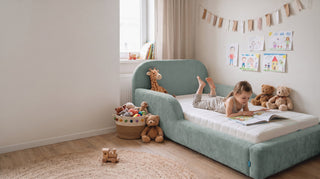
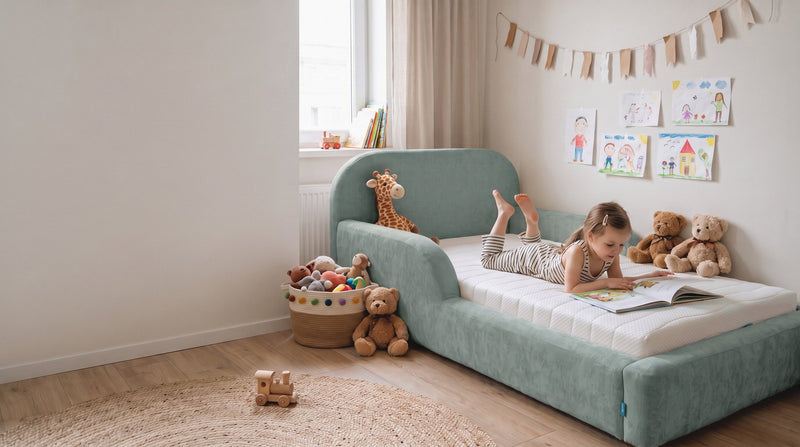
- Low sleeping height: the lower the mattress surface, the more harmless rolling out is. Many parents prefer a sleeping height of around 20 to 30 cm above the floor.
- Raised edges: a side edge that rises above the mattress stops children rolling away in their sleep and gives a sense of security. You can read how organic, padded shapes help with this in Fall protection without bars.
- No hard edges: toddlers easily bump themselves climbing in and out. Rounded or padded edges reduce the risk of bruises.
- The right size: a 90×200 or 120×200 cm bed grows with your child into their school years. That way you won’t have to switch again in two years’ time.
A soft floor around the bed is part of the package: a thick rug, a play mat or, during the transition, a floor cushion. This is especially worthwhile in an older flat in Zurich or Basel with parquet or tiled floors. Second-hand beds from Tutti or Ricardo can be an option; if you go that route, check the stability, screws and surfaces carefully. New kids’ beds cost roughly between CHF 200 and more than CHF 1,500, depending on material and size.
Childproofing the bedroom
When your child moves to a bed without rails, the safety situation in the room changes fundamentally. Your child can get up unsupervised at night or early in the morning and explore the room. So before the first night, go round the room at knee height and look at it from your child’s perspective.
- Secure furniture against tipping: fix chests of drawers, shelves and wardrobes to the wall. Toddlers pull out drawers and use them as steps.
- Secure the windows: fit lockable window handles or window restrictors, and don’t place any furniture under the window that your child could climb on.
- Sockets and cables: fit socket covers and route cables from the night light or baby monitor out of reach.
- Small items and medicines: anything that could be swallowed belongs out of reach, ideally not in the child’s room at all.
- Blind cords: tie up or shorten cords and chains on blinds.
- Door and stairs: check whether your child can reach the stairs at night. A stair gate may be sensible.
A dimmed night light helps your child find their bearings if they wake up. The room should be pleasantly cool; many families do well with around 18 to 20 °C. You’ll find more ideas for a safe, cosy room in Setting up a room for 2–5-year-olds.
Get CHF 25 off
Subscribe to our newsletter and get a one-time CHF 25 discount. ✓ 100-night trial ✓ 5-year warranty ✓ Free delivery

Ready or wait a little longer? The overview
The following table helps you put your observations into context. It doesn’t replace your own judgement, but it offers good guidance for a conversation between the two of you or with your paediatrician.
| Situation | Probably ready | Probably wait |
|---|---|---|
| Age | Around 2 to 3.5 years | Under about 18 months |
| Climbing | Climbs over the rail or tries to | Stays happily in the cot |
| Space | Regularly bumps into the sides, seems cramped | Still has enough room |
| Understanding | Understands simple rules and agreements | Can barely follow rules yet |
| Family life | Calm phase without big changes | New sibling, house move or nursery start coming up |
| Sleep | Generally sleeps well | Currently many sleep problems or fears |
If only the age applies in the right-hand column but your child is already climbing, safety comes first. In that case, a low bed without rails is often the safer option, provided the room is well prepared. If in doubt, it’s worth a quick chat at your next check-up.
The gentle transition plan for the first few weeks
A good plan takes the pressure off everyone. Here’s how to make the switch step by step:
- Announce it (1 to 2 weeks beforehand): tell your child about the new bed, look at picture books together or let them help choose the bedding.
- Bring familiar things along: the favourite soft toy, comforter and the usual sleeping bag or duvet move too. If possible, put the new bed where the old one stood.
- Get to know it during the day: let your child play, look at books or have their nap in the new bed before the first night.
- Keep the bedtime routine: bath, pyjamas, brushing teeth, story, song: the familiar sequence provides stability. You’ll find ideas in Bedtime routine from age 2.
- A clear, simple rule: “Stay in bed until the light turns green.” A sleep trainer clock can help.
- Calmly take them back: if your child gets up, lead them back to bed kindly and with few words. The more boring this is, the faster it loses its appeal.
- Praise in the morning: mention what went well. Little rituals like a sticker in the morning motivate many children.
Allow one to three weeks for everything to settle. Setbacks after a cold or after the holidays are normal. A detailed roadmap is also available in From cot to kids’ bed in 5 steps.
Common mistakes when switching
Many difficulties can be avoided if you know these typical pitfalls:
- Switching at the same time as a new sibling arrives: if you need the cot for the baby, your older child should ideally move two to three months before the birth or only a few weeks afterwards. Otherwise, they can quickly feel “evicted”.
- Starting nursery or playgroup at the same time: new childcare means a lot of excitement. Plan the bed switch a few weeks apart.
- Too many changes at once: a new bed, a new room, no more nappies and no more dummy in the same week is too much for most children.
- A bed that’s too high: a high sleeper or a standard adult bed without an edge is not a good first choice for toddlers. High sleepers are only suitable for considerably older children anyway.
- Room not childproofed: most risks lurk not in the bed but in the room around it.
- Inconsistency: sometimes allowing more play in the living room and sometimes not drags out the settling-in period.
And finally: don’t compare your child with others. Whether the neighbours’ child switched at 22 months or at 3.5 years makes no difference to your journey.

Frequently asked questions about a kids’ bed without rails
From what age can a child sleep in a bed without rails?
Most children switch between roughly 2 and 3.5 years. Before about 18 months, a switch is generally not recommended. What matters is development, behaviour and a safely set-up room.
What should I do if my child climbs out of the cot?
If your child climbs over the rail, a fall from a greater height is possible. In that case, a low bed without rails is often the safer solution. Childproof the room first and put a soft rug in front of the bed.
How can I stop my child falling out of the new bed?
Choose a low bed with raised edges and put a soft surface in front of it. If possible, place the bed with one long side against the wall. A small tumble from a low height is usually harmless during the early days.
My child keeps getting up at night. What helps?
Take your child back to bed calmly, kindly and with few words. A clear rule and a sleep trainer clock help many children. The behaviour usually settles after one to three weeks.
Should I switch beds before or after a sibling is born?
Ideally, switch about two to three months before the birth or a few weeks afterwards. That way, your older child won’t feel pushed aside. A switch right around the birth puts extra strain on many children.
What size makes sense for the first bed without rails?
90×200 or 120×200 cm have proven themselves because these beds grow with your child into their school years. A width of 120 cm also gives you room for a bedtime story together. What matters is that the room still has enough space to move around.
This article is for general information only and does not replace advice from a paediatrician. If problems persist, please contact your child’s paediatrician.


