


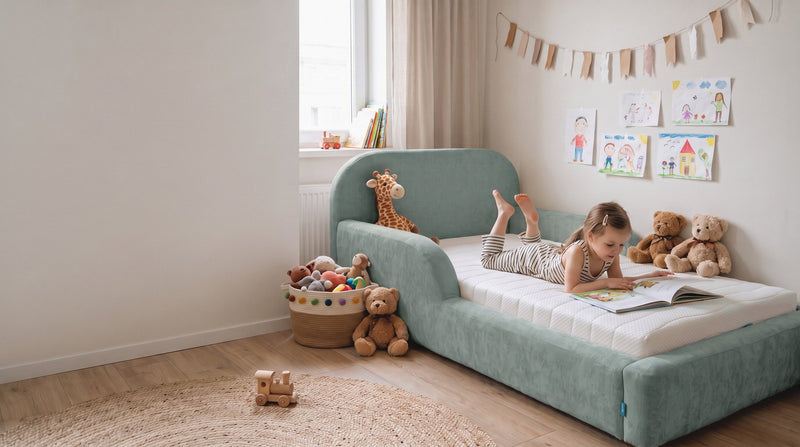

If you want to buy a children's mattress, you are quickly faced with a confusing choice: cold foam, pocket springs, latex, coir, plus firmness ratings, zones and labels. Yet the decision matters more than it first appears, because over the coming years your child will spend around ten to twelve hours a night on this surface. Between the ages of two and ten, a child typically grows from about 85 to roughly 140 centimetres and becomes two to three times heavier. A good mattress has to keep pace with this development without sagging or becoming too hard. Many parents simply reuse the thin mattress from the cot or go for the cheapest option – and are later surprised by dips, sweating or restless nights. In this guide, you will learn what really matters when it comes to size, firmness, materials, hygiene and harmful substances, and how to make a practical choice for everyday family life.
The short answer: For children aged two to ten, a medium-firm, point-elastic mattress that fits the bed exactly and does not sag is ideal. The most common and longest-lasting size is 90 × 200 cm, as it will see your child through to their teenage years. Look for a removable, washable cover, good air circulation and tested, low-odour materials. Whether you choose pocket springs or foam matters less than solid workmanship and an honest lie-down test with your child.
- Children need a mattress that supports them without feeling rock-hard – too soft is a more common problem than too firm.
- The mattress must sit flush within the bed frame all the way round; there should be no gaps wider than about two fingers.
- 90 × 200 cm or 120 × 200 cm are future-proof sizes and fit standard bed linen sold in Switzerland.
- A washable cover and a breathable core matter even more for children than for adults, because accidents and sweating are more frequent.
- Test together: if your child's spine stays straight when lying on their side, the firmness is usually right.
Why a children's mattress is more than a detail
A child's body is constantly changing. Bones, ligaments and muscles are developing, and over the first years of life the spine takes on its typical double S-curve. A mattress cannot “shape” this development, but it can help your child lie relaxed without constantly shifting position. To find out how much sleep is typical at each age, read our article How much sleep does my child need?.
Children move around far more at night than adults. A point-elastic mattress, which only gives way where pressure is applied, supports this freedom of movement. A surface that is too soft, on the other hand, lets the pelvis sink in and makes turning over harder work. Children are also light: a four-year-old often weighs just 15 to 18 kilograms. A mattress that is “medium” for adults feels considerably firmer to such a light body – one reason why adult firmness ratings are of limited use for children.
Scientifically, by the way, there is little research on the “perfect” children's mattress. What is well established is what paediatricians and sleep researchers generally emphasise: a calm, well-ventilated sleep environment, a level, supportive surface and regular sleep times.
Buying a children's mattress: choosing the right size
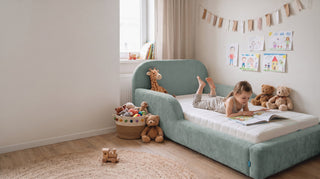
The size of the mattress depends on the bed – not the other way round. The cot size of 70 × 140 cm is enough for many children until around the age of four or five. If you are buying a new bed now, 90 × 200 cm is the most sustainable choice: this size will last into adulthood, and you will find bed linen, fitted sheets and mattress protectors in any Swiss department store. If you are planning for a sibling, morning cuddles or a very restless sleeper, 120 × 200 cm gives you plenty of room. You will find a detailed comparison in Kids' bed size: 90 or 120 cm?.
A precise fit is a must. The mattress should sit flush in the frame all the way round. If there are gaps, hands, feet or cuddly toys can get stuck, and the mattress slides about when your child clambers around. So measure the inside dimensions of the bed before ordering rather than relying solely on the product description. A tolerance of one to two centimetres is normal; a hand's width of space is too much.
Mind the height. Children's mattresses in 90 × 200 cm are often between about 12 and 20 centimetres deep. More important than the exact figure is that the mattress suits the bed: side fall protection becomes less effective if the sleeping surface sits too high. So check how much edge remains above the mattress.
Firmness and support: not too soft, not too hard
The golden rule is that children need a medium-firm mattress. For safety reasons, babies and toddlers under about two years old sleep on a firm, flat surface. From toddlerhood onwards, things can become a little more comfortable, but mattresses that are too soft remain unsuitable, because the pelvis sinks and the spine sags. Mattresses that are too hard are less often a problem for children, but can cause pressure on the shoulders and hips of side sleepers.
As firmness ratings (H1 to H5) are not standardised and mostly refer to adults, they only serve as a rough guide. How your child actually lies tells you more:
| Age | Typical weight | What matters |
|---|---|---|
| 2–3 years | approx. 12–16 kg | Level and supportive, rather firm; no soft toppers or piles of pillows |
| 4–6 years | approx. 15–22 kg | Medium-firm, point-elastic; child moves a lot and loves to jump |
| 7–10 years | approx. 20–35 kg | Medium-firm with good support; shoulder may sink in slightly when lying on the side |
A simple test: lay your child on their side and look at their back from behind. If the spine forms a roughly straight line, the firmness is right. If the waist sags, the mattress is too soft; if the shoulder pushes the pelvis upwards, it is probably too hard.

Materials compared: springs, foam, latex and natural fibres
Every material has its strengths, and there is no single “right” one for all children. What matters is quality, density and workmanship.
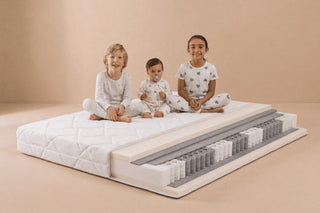
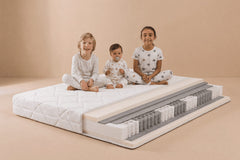
Pocket springs: each spring sits in its own fabric pocket and responds individually. This provides good point elasticity and plenty of airflow in the core – an advantage for children who sweat a lot at night. Pocket-spring mattresses are somewhat heavier, but they keep their shape and last well.
Cold foam: light, adaptable and often more affordable. Quality depends heavily on density: very light foams can develop dips more quickly. Look for open-cell structures so that moisture can escape.
Latex: very elastic and durable, but heavy and tends to be warmer. Natural latex can have its own smell; best avoided if there is a known latex allergy in the family.
Natural fibres such as coir or horsehair: often combined as a comfort layer, they feel firm and are breathable. Pure coir mattresses are usually too hard for older children.
Zones, for example seven areas with differing give, are designed to let the shoulders and pelvis sink in where needed. For children this is an added comfort, especially if the mattress is meant to last many years. Reversible mattresses with two usable sides also spread wear more evenly.
Hygiene, cover and sleep climate
Children's beds see a lot of everyday life: reading, cuddling, sometimes eating – and during the nappy-free transition, the odd accident happens. Many children only become reliably dry at night between the ages of five and seven, some later, and that is completely normal. A removable, washable cover with an all-round zip is therefore not a luxury for a children's mattress, but basic equipment. Check the care label to see at what temperature it can be washed.
A breathable, waterproof mattress protector is also worthwhile. It protects the core, but should not rustle or have a thick plastic layer that traps heat.
Sleep climate: for children's rooms, temperatures of around 16 to 18 °C and humidity of about 40 to 60 per cent are frequently recommended. In the morning, pull back the duvet and open the window wide for five to ten minutes so that moisture can escape from the mattress and the room. Avoid placing the bed directly against a cold outside wall, especially in older Swiss flats, so that no condensation forms on the underside of the mattress. A slatted base or ventilated bed base is clearly preferable to a solid board.
To keep dust mites at bay, regular airing, washing the cover and turning the mattress every few months all help.

Harmful substances, odours and labels explained
Relative to their body weight, children breathe in more air than adults, and they sleep with their face directly on the mattress. That is why many parents rightly look for tested materials. Independent textile labels such as OEKO-TEX provide guidance, because the certified components are tested for a range of harmful substances. Check carefully whether a label applies to the whole mattress or only to the cover.
A slight new smell straight after unpacking is normal for many mattresses. Leave the mattress unwrapped in a well-ventilated room for one to two days before your child sleeps on it. If a pungent smell does not disappear after several days, it is worth contacting the retailer.
Second-hand or handed down from a sibling? A well-kept mattress from within your own family is generally fine, provided it is clean, dry and not worn out. With mattresses of unknown origin, for example from online classifieds, caution is advisable: you know neither how they were stored nor how much they have already given way.
Common mistakes when buying a mattress
1. Reusing the old cot mattress. It is usually too thin and too small for the new bed. When moving from a cot to a toddler bed, a new, well-fitting mattress is part of the switch.
2. Buying too soft because it feels cosy in the shop. Adults test with their own body weight. For a child weighing 18 kilograms, the same mattress feels completely different.
3. Using a topper to “grow” the bed. Thick toppers often make the sleeping surface unstable and reduce the height of the bed edge above it.
4. Not measuring the inside dimensions. Frames and upholstery reduce the usable space in some beds.
5. Looking only at the price. A children's mattress gets intensive use for five to eight years. Broken down per night, a difference of a few francs is barely noticeable – unlike the quality of sleep.
6. Not taking advantage of a trial period. Whether your child sleeps well only becomes clear after a few weeks. Suppliers offering a sleep trial and easy returns take a lot of pressure off.
Step by step: finding the right mattress for your child
Step 1 – Clarify the bed and measurements. Measure the inside dimensions, decide on the sleeping surface you want and check how high the edge or fall protection is. For tips on the bed itself, see our guide Buying a kids' bed: what to look out for.
Step 2 – Observe how your child sleeps. Does your child mainly sleep on their side, on their tummy, or toss and turn constantly? Do they sweat a lot?
Step 3 – Choose material and hygiene features. For warm sleepers, an airy core such as pocket springs is a good fit. A removable, washable cover should always be on the list.
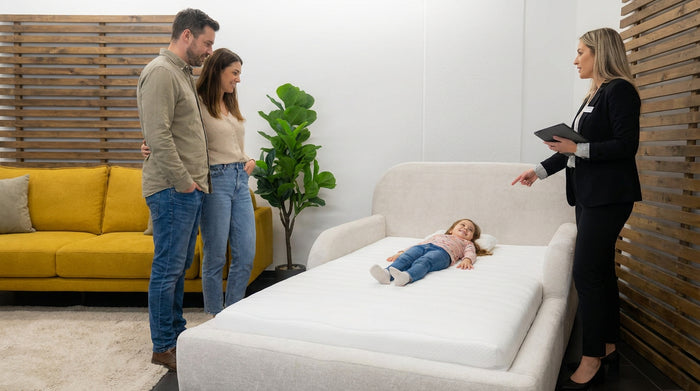
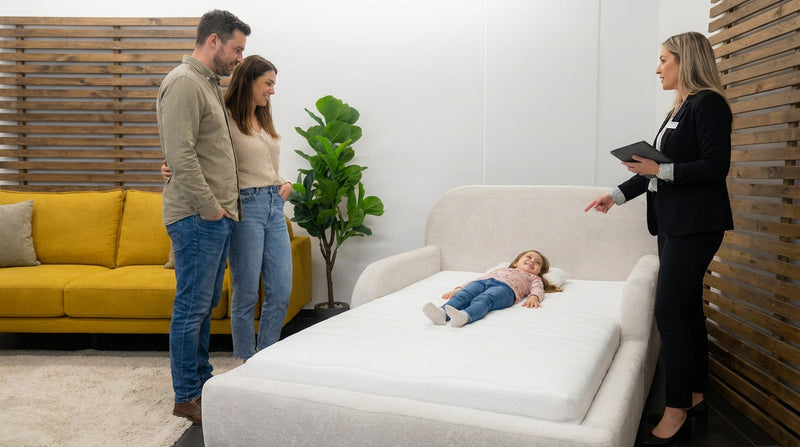
Step 4 – Test together. Let your child lie in their favourite position for a few minutes and check their spine while they lie on their side. Ask whether it feels “like a nest” or “like a trampoline”.
Step 5 – Settle in and observe. Allow two to four weeks to get used to it. New mattress, new bed, perhaps a new room: a familiar bedtime ritual helps your child take the change in their stride.
Step 6 – Look after it. Turn or rotate the mattress every two to three months, wash the cover regularly and replace the mattress after about five to eight years or if visible dips appear.
Get CHF 25 off
Subscribe to our newsletter and get a one-time CHF 25 discount. ✓ 100-night sleep trial ✓ 5-year guarantee ✓ Free delivery

Frequently asked questions about children's mattresses
At what age does my child need a new mattress?
At the latest when moving from the cot to a larger kids' bed, usually between the ages of two and four, your child will need a new, well-fitting mattress. After that, a good children's mattress often lasts five to eight years.
What firmness is right for children aged 2 to 10?
As a rule, a medium-firm, point-elastic mattress. If the spine stays roughly straight when lying on the side and the waist does not sag, the firmness is right.
Isn't 90 x 200 cm too big for a toddler?
No. Many children feel very comfortable in a big bed with soft edges, and this size will last them into their teenage years. What matters is suitable fall protection.
Are pocket springs or cold foam better for children?
Both can work well. Pocket springs score on airflow and shape retention, cold foam on low weight. Workmanship, density and a good lie-down test are what count.
How often should you turn and clean a children's mattress?
Turn or rotate the mattress roughly every two to three months, air it daily and wash the cover regularly according to the care label. A breathable mattress protector offers extra protection.
Can my child sleep on a second-hand mattress?
A well-kept, dry mattress from within your own family that is not worn out is usually fine. With mattresses of unknown origin, caution is advisable for reasons of hygiene and wear.
This article is for general information only and does not replace advice from a paediatrician. If problems persist, please consult your paediatrician.


