



The mattress in your child's bed is used for ten to twelve hours every night, plus naps, story time and the occasional pillow fight. Even so, many parents only ask themselves whether to replace the kids' mattress once a stain refuses to budge or their child suddenly sleeps in a dip. Unlike with adults, it is not just the material that changes but the body too: a 12-kilo toddler turns into a schoolchild weighing 30 kilos or more within a few years. Add to that sweat, leaking nappies, spilt milk and the droplets from the next cold. In this guide you will find out how long a kids' mattress realistically lasts, which signs tell you the time has come and how simple care can extend its life. We also look at what to bear in mind with second-hand mattresses, whether from an older sibling or a charity shop.
The short answer: A good kids' mattress usually lasts five to eight years with careful care, while basic foam mattresses often last considerably less. You should replace it at the latest when dips form, it no longer fits the frame, smells or stains won't go away or your child has outgrown it. Age alone is not a hard-and-fast rule: condition, hygiene and fit are what matter. With second-hand mattresses it pays to take a particularly critical look, especially for young children.
- Rule of thumb: pocket-spring and high-quality cold-foam mattresses often last 6 to 8 years, basic foam mattresses more like 3 to 5 years.
- The main signs: dips from around 1–2 cm, soft edges, gaps to the bed frame, lasting stains, a musty smell or mould.
- A change of size is usually due when moving from the cot (70×140 cm) to a children's bed (90×200 or 120×200 cm).
- A washable cover, a mattress protector, regular turning and good airing noticeably extend a mattress's life.
- Only accept a second-hand mattress if its origin, age and condition are known – for babies, many health bodies recommend a new mattress.
How long does a kids' mattress last?
There is no one-size-fits-all figure, but there are good guidelines. For adult mattresses, manufacturers and specialist retailers usually quote seven to ten years. With children the calculation is a little different: body weight is lower, but the mattress takes more of a beating. Children jump, kneel, always sit in the same spot during story time and often lie close to the edge. On top of that comes moisture from sweat and night-time accidents.
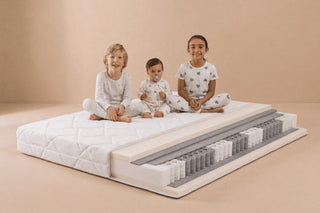
How long a mattress lasts depends mainly on the material and its density. With foam, density is a good indicator: the higher it is, the better the mattress generally keeps its shape. A pocket-spring core spreads the load across many individual springs and therefore often stays resilient for a long time. The overview below shows typical ranges achieved with normal use and good care:
| Mattress type | Typical lifespan | What to watch for |
|---|---|---|
| Basic foam (low density) | approx. 3–5 years | Softens faster, dips form easily |
| High-quality cold foam | approx. 5–8 years | Density and workmanship are decisive |
| Pocket springs | approx. 6–8 years, often longer | Well ventilated; check for noises and sagging springs |
| Natural mattress (e.g. coir, latex) | approx. 5–8 years | Follow care instructions; keep latex away from damp |
| Travel cot or folding mattress | varies widely | Intended for occasional use only |
Important: these figures are a guide, not a guarantee. A mattress used as a trampoline every day may be worn out after three years, while a well-kept mattress in the grandparents' spare room can still look good after ten. So it is better to check it closely on a regular basis rather than relying on the purchase date alone.
Replacing a kids' mattress: 7 signs it is time
The following pointers help you assess the condition objectively. Ideally, check the mattress twice a year, for example when switching to the winter or summer duvet.
1. Visible dips: Lay a slat or broom handle across the mattress. If there is a gap of more than about 1 to 2 cm in the middle, your child is no longer lying straight.
2. Soft edges: Press down on the edge with the flat of your hand. If it gives way noticeably more than the centre, your child will slip off more easily when sitting up.
3. Gaps to the frame: There should be hardly any space between the mattress and the bed frame. If more than two fingers fit into the gap because the mattress has shrunk or is the wrong size, it should be replaced.
4. Lasting stains and smells: If the core still smells musty or sour after thorough airing, moisture has got in.
5. Mould or mildew spots: Dark specks, usually on the underside, are a clear signal to replace it immediately.
6. Noises and noticeable springs: If it squeaks or you can feel individual springs, the core is worn.
7. Changes in sleep: If your child complains of back pain in the morning, keeps lying at the edge or would rather sleep in your bed, the mattress may play a part. But restless nights have many causes, as we explain in our article My child wakes up at night.
Replacing it as they grow: from cot to big bed
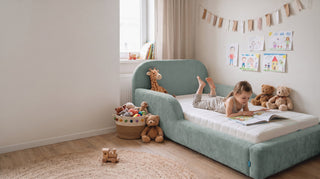
The most common reason for a new kids' mattress is not wear and tear but size. Baby beds and cots usually measure 60×120 or 70×140 cm. By the time your child moves into their first big bed at around two to four years old, they will need a new mattress to fit the new frame. For tips on making this step a relaxed one, read our guide From cot to toddler bed.
Many families in Switzerland go straight for the standard 90×200 cm size or for 120×200 cm at this point, so that bed and mattress grow with the child into their school years or beyond. That has a practical advantage: a high-quality mattress in a standard size can be used for many years, and you will find bedding in any department store. Our article Kids' bed 90×200: the standard size explains why this size is so popular.
Bear in mind when buying: a schoolchild weighing 30 to 40 kilos and a parent lying alongside at story time put far more strain on a mattress than a toddler. A mattress designed for this shared use will need replacing less quickly. Putting a small cot mattress into a larger bed, on the other hand, is no solution – the gaps all round are impractical and can become places to trip or get stuck.

Hygiene: sweat, dust mites and little accidents
Children sweat relatively heavily in their sleep, especially in the first few hours of the night. This moisture passes into the cover and, without protection, into the core as well. Together with skin flakes, it creates favourable conditions for house dust mites. For most children, mites are harmless, but if a doctor has diagnosed a dust mite allergy they can make symptoms worse. In that case it is worth talking to your paediatrician about suitable encasings and care measures.
Then there is the phase without nappies: hardly any child becomes dry at night overnight, and later on, fever or a tummy bug can still lead to accidents. A mattress with a removable, washable cover is enormously practical here. Depending on the care label, many covers can be washed at 40 to 60 °C. However, never put the core itself in the washing machine or soak it.
Our tip: A breathable, waterproof mattress protector under the fitted sheet reliably protects the core. Choose one with a membrane rather than plain plastic film so the sleeping climate stays comfortable. Keep a second protector in reserve – at three in the morning you will be glad you did.
If liquid does get into the core, blot the area straight away with an absorbent cloth, clean it sparingly with a little water and mild detergent and then let the mattress dry completely, ideally standing upright in an airy spot. If the smell remains, replacing it is usually the better choice.
Second-hand kids' mattress: what is reasonable?
The older sibling's bed, a cousin's mattress or a bargain from a second-hand shop: reusing things is appealing for the environment and the budget. With mattresses, however, caution is advisable. Unlike wooden furniture, they cannot be cleaned inside, and their history is often unknown.
For infants, as part of safe sleep guidance, many health bodies advise using a new, firm and well-fitting mattress where possible. The research on second-hand mattresses is not clear-cut; some studies have described associations without being able to establish a clear cause. So the rule is: if in doubt, go for new.
For older children, a second-hand mattress is more reasonable if these points are met:
- Its origin is known, ideally from within your own family.
- The mattress is no more than a few years old and has always been used with a protector.
- There are no stains, smells, dips or signs of mould.
- The cover is removable and will be washed before use.
- The size fits the intended bed frame exactly.
If any of these points does not apply, you are better off investing in a new mattress and saving elsewhere, for example on decor or storage.

Step by step: how to extend its lifespan
A few simple habits keep the mattress in shape and hygienic for longer. This routine has proven itself in many families:
Daily: After getting up, fold back the duvet and let the bed air for 15 to 30 minutes before making it. At the same time, open the window wide for a few minutes.
Weekly: Change the bedding or at least wash the fitted sheet, especially in warmer months and during illness.
Every one to three months: Turn the mattress over if it is designed to be reversible, and swap the head and foot ends too. This spreads the load more evenly. Use the opportunity to wash the cover and vacuum the slatted base.
Twice a year: Check the condition with the slat test, inspect the underside for mildew spots and give the mattress a good airing on a dry, sunny day – without leaving it in blazing sun for hours.
Keep an eye on the room climate as well: a temperature of around 16 to 20 °C and humidity between 40 and 60 per cent are considered comfortable and help prevent damp. Don't place the bed directly against a cold outside wall, and use a slatted base rather than a solid board so that air can circulate. You will find more ideas for a healthy sleep environment in Setting up a toddler's room.
Common mistakes and myths
Myth: "As long as nothing is broken, the mattress lasts forever": Material fatigue creeps in gradually. Your child gets used to a dip without complaining. That is why regular checks matter more than gut feeling.
Myth: "Kids' mattresses need replacing every year": That is unnecessary and not sustainable. A well-made, well-cared-for mattress can serve you well for many years.
Mistake: putting the mattress straight on the floor. Without air circulation, moisture builds up on the underside and mould can develop. If you use a floor bed, use a base or a breathable underlay.
Mistake: cleaning the core with lots of water. The moisture penetrates deep and hardly ever dries out completely. It is better to work sparingly and on the spot.
Mistake: simply keeping the old mattress when moving to a big bed. The dimensions rarely match, and the mattress often already has a few years behind it. Our guide Buying a kids' bed: what to look for sums up what to consider when buying a new bed and mattress.
Get CHF 25 off
Subscribe to our newsletter and get a one-time CHF 25 discount. ✓ 100-night trial ✓ 5-year guarantee ✓ Free delivery

Frequently asked questions about replacing a kids' mattress
How often should you replace a kids' mattress?
As a rule of thumb, good kids' mattresses last around five to eight years, basic foam mattresses often only three to five. But condition is what counts: dips, soft edges, gaps to the frame, lasting stains or smells are clear reasons to replace it.
Can a younger sibling reuse the mattress?
That can be reasonable if the mattress is in good condition, has always been used with a protector, has no stains or smells and fits the frame exactly. For babies, however, many health bodies recommend a new mattress.
How can I tell if the mattress is worn out?
Lay a straight slat across the sleeping surface. If there is a gap of more than about one to two centimetres in the middle or the edges give way noticeably, the mattress is worn out and should be replaced.
How often should the mattress cover be washed?
Many families wash the cover every one to three months and after accidents or illness. The permitted temperature is on the care label, often 40 to 60 degrees. The core itself does not belong in the washing machine.
What should I do if my child has wet the mattress?
Blot the liquid straight away, clean the area sparingly with water and mild detergent and let the mattress dry completely standing upright. If a smell remains, replacing it makes sense. A waterproof, breathable protector helps prevent this.
Does my child need a new mattress when moving to a big bed?
In most cases yes, because cot mattresses measuring 60 x 120 or 70 x 140 centimetres do not fit a big bed. A high-quality mattress in 90 x 200 or 120 x 200 centimetres can then grow with your child for many years.
This article is for general information only and does not replace advice from a paediatrician. If problems persist, please consult your paediatrician.


