








At four, your child's sleep changes noticeably, often within just a few months. The nap gets shorter or disappears altogether, the evenings bubble over with questions and stories, and suddenly a monster lives behind the curtain. At the same time, many children in Switzerland start kindergarten – with fixed morning hours, a large group and a mid-morning snack packed in a little bag. No wonder sleep in 4-year-olds raises new questions for many parents. Is it normal that she lies awake for so long in the evening? Does he still need a break at midday? And why is your child waking at night again when that seemed long over? This guide explains what is typical at this age and shows how to make everyday life genuinely easier.
The short answer: Most four-year-olds need 10 to 13 hours of sleep per 24 hours, and for many this sleep now happens almost entirely at night. Dropping the nap is normal at this age; a quiet break in the early afternoon is still worthwhile. Fears, nightmares and longer settling times are part of a developing imagination and usually become less frequent on their own. What helps most is a reliable rhythm with an early, consistent bedtime – especially in the first weeks of kindergarten.
- Sleep need at 4: around 10–13 hours in 24 hours, usually 10–12 of them at night.
- Most children drop their nap between 3 and 5 – a fixed quiet time replaces it well.
- Starting kindergarten under HarmoS (cut-off date 31 July): the first weeks are tiring, an earlier bedtime helps.
- Fear of monsters and nightmares are common at this age and not a sign that something is wrong.
- Get it checked if there is regular snoring, pauses in breathing or persistent daytime tiredness.
How much sleep does a 4-year-old child need?
International professional bodies such as the American Academy of Sleep Medicine recommend 10 to 13 hours of sleep per 24 hours for children aged three to five, including naps. This is a range, not a target: some four-year-olds are rested and cheerful after ten hours, others need twelve hours at night so they don't fall apart in the afternoon. The exact number matters less than how your child behaves during the day. A well-rested child usually wakes up on their own and gets through to supper without major meltdowns.
In practice, this means counting back from wake-up time. If your child has to get up at 6.45 am to set off for kindergarten at 7.50 am, the time to fall asleep is roughly between 7 and 7.45 pm. The following table shows typical variations:
| Wake-up time | Night-time sleep | Asleep by | Suits |
|---|---|---|---|
| 6.30 am | approx. 11 hours | 7.30 pm | early walk to kindergarten |
| 7.00 am | approx. 11 hours | 8.00 pm | lessons starting at 8.15 am |
| 7.00 am | approx. 11.5 hours | 7.30 pm | children with a high sleep need |
| 7.30 am | approx. 10.5 hours | 9.00 pm | only if your child seems fit during the day |
Allow around 30 minutes before sleep time for brushing teeth and a story. Guidelines for other ages: How much sleep does my child need?.
Naps: when they stop and what replaces them
Between three and five, most children say goodbye to their nap, though the exact timing varies a great deal. Typical signs: your child lies awake chatting for half an hour at midday, or does fall asleep but is still wide awake at 9 pm. Other four-year-olds still need 45 minutes on long days, otherwise their mood tips at 5 pm.
A middle way has proven itself: instead of a compulsory nap, there is a fixed quiet time of 30 to 45 minutes after lunch – looking at picture books, a calm audio story, lying on the bed or a floor cushion with a cuddly toy. If your child falls asleep, let them sleep, but wake them after about 45 minutes and ideally before 3 pm so the night doesn't suffer. On days with afternoon kindergarten or an outing on grandparents' day, the break often disappears completely; an earlier bedtime that evening makes up for it.
During the transition, expect mixed weeks: two days with a nap, three without. This is not a step backwards but the normal course of things. How to manage the transition step by step is explained in Dropping the nap.

Starting kindergarten under HarmoS: how sleep changes
In most cantons, the HarmoS agreement applies: children who turn four by 31 July start kindergarten in August. Some cantons allow a later start on request – if you are unsure, clarify this early with your local school administration.
For sleep, the start mainly means one thing: far more stimulation combined with fixed times. In many places, lessons begin between 8 and 8.30 am, and on top of that come the walk to kindergarten, group rules, noise and lots of new relationships. Many children are noticeably tired, tearful or overexcited in the evening during the first four to six weeks – even if they love kindergarten.
What helps: bring bedtime forward by 20 to 30 minutes during this phase. Deliberately plan quiet afternoons after kindergarten without extra classes, and keep weekends close to the weekday rhythm – an hour's difference is fine, three hours will catch up with you on Monday. A filling mid-morning snack and supper around 6 pm also help, because hungry children find it harder to settle.
Imagination, fears and nightmares
At four, imagination blossoms. Children invent whole worlds and vividly picture things that do not exist. However, the ability to reliably tell fantasy from reality lags behind this development. That is why fear of the dark, of noises or of the monster under the bed is very common at this age.
Nightmares also increase between three and six. They usually happen in the second half of the night; your child is awake, seeks comfort and often remembers them in the morning. Night terrors are different: they typically occur in the first hours after falling asleep, and children do not remember them afterwards.
Take the fear seriously without making it bigger. Rather than "Monsters don't exist", try "You feel unsure, I'm here, and your room is safe". Many children benefit from an action that gives them a sense of control: a small torch by the bed, a cuddly toy as a "guard", a quick joint check of the room. It is best to avoid scary content in the evening, even cartoons that seem harmless. You will find concrete strategies by age in Nightmares in children: what really helps.
The bedtime routine for 4-year-olds: a sample evening
Four-year-olds love predictability – and still like to negotiate for "just one more story". A fixed, visible routine takes the tension out of these discussions. This is what an evening with a sleep time of 7.45 pm might look like:
6.00 pm – supper. Eat together, then no more big meals. A glass of water is fine.
6.40 pm – quiet play. Puzzles, drawing, building. Screens are off now and the lights in the flat are dimmed.
7.10 pm – washing, teeth, pyjamas. Always in the same order. A picture card on the bedroom door helps children who can't read yet.
7.25 pm – story. Agree beforehand: two books or one story. Your child chooses, the number stays fixed.
7.40 pm – goodnight chat. What was lovely today, what was difficult? Three minutes are enough and noticeably ease many children.
7.45 pm – lights out. A short goodbye, night light on if wanted.
Start early enough to avoid rushing: a routine that ends 20 minutes later is better than a hurried one. Stick to the same sequence when grandpa or a godparent is putting your child to bed.
The bedroom: light, temperature and a bed that grows with your child
The surroundings often have more effect than you might think. Ideal is a fairly cool room of around 16 to 19 °C, a breathable duvet instead of heavy down and fresh air from a short burst of ventilation before bedtime. In summer, when it stays light in Switzerland until after 9 pm, blackout curtains or shutters make falling asleep much easier. When the clocks go back to winter time at the end of October, many children wake an hour earlier for a few days – shift bedtime gradually by 10 to 15 minutes in the week before.
A night light is often helpful for anxious four-year-olds. Choose warm, dimmed light close to the floor rather than a bright ceiling light. A small reading corner with a low shelf displaying books cover-forward turns choosing the bedtime story into a fixed ritual.
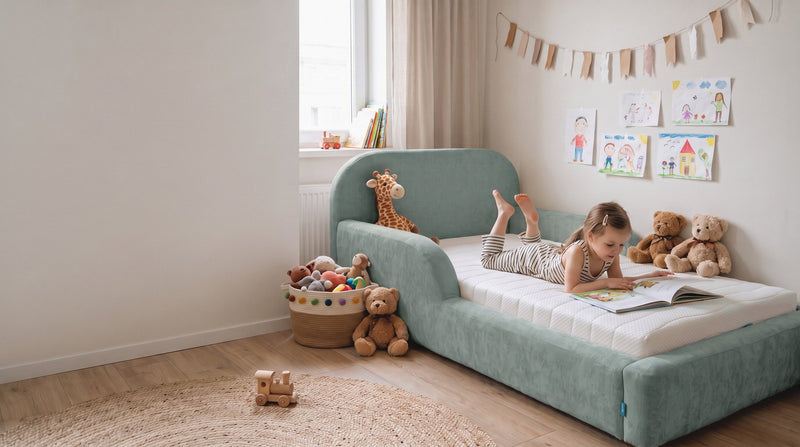
Many children move from a cot or junior bed to a proper bed by this age at the latest. A size that lasts into the school years makes sense, i.e. 90×200 or 120×200 cm. A low bed takes away the fear of falling out, and a sleeping surface with room for a parent to join briefly makes the bedtime story more relaxed.

Myths fact-checked
"If they go to bed later, they will sleep longer in the morning." Usually not. The internal clock wakes many children at roughly the usual time, regardless of when they fell asleep. The result is a shorter night and a hard day.
"Without a nap, they will fall asleep straight away in the evening." Sometimes. But overtired children often become more wound up. What works is the earlier bedtime, not keeping them awake.
"At four, a child should sleep through the night." Brief wakings between sleep cycles are normal at any age. Many four-year-olds occasionally call for their parents or pad into their room; how to respond lovingly and clearly is described in Child comes into the parents' bed at night.
"Early risers simply need less sleep." That is only true if your child is well-balanced during the day. If they wake at 5.30 am and are exhausted by 10 am, they are short of sleep. Causes and solutions can be found in Child wakes too early.
"Not dry at night yet means falling behind." Night-time wetting is still common at four and is not considered unusual at this age. Dry during the day but not yet at night – that is a normal developmental difference.
When to seek medical advice
Most sleep issues at four are phases that fade by themselves after a few weeks – especially when they coincide with a clear trigger such as starting kindergarten, moving house or a new sibling. Talk to your paediatrician if your child snores loudly on several nights a week or you notice pauses in breathing; if they are noticeably tired, unfocused or irritable during the day despite enough sleep; if they sleep very restlessly, often breathe through their mouth or sweat heavily; if fears become so strong that everyday life suffers; or if they start wetting the bed regularly again after a long dry period. The routine check-up at around four is also a good opportunity to ask about sleep. Your regional parent and child advice service is another easily accessible point of contact. Sleeping pills or supplements such as melatonin should never be given without medical advice – always clarify such questions with a doctor.
Helpful for the appointment: for one week, note the time your child fell asleep, night wakings, wake-up time and their mood during the day.

Get CHF 25 off
Subscribe to our newsletter and get a one-time CHF 25 discount. ✓ 100-night trial ✓ 5-year warranty ✓ Free delivery
Frequently asked questions about sleep at age 4
How many hours should a 4-year-old sleep?
The recommendation is 10 to 13 hours per 24 hours, including any nap. Most four-year-olds sleep 10 to 12 hours at night.
Does a 4-year-old still need a nap?
Some do, many no longer do. Most children drop their nap between three and five. A quiet break of 30 to 45 minutes after lunch is still worthwhile, even if your child does not fall asleep.
When should a kindergarten child go to bed?
Count back from wake-up time: if your child gets up at 6.45 am, sleep time is usually between 7 and 7.45 pm. In the first weeks of kindergarten, many children benefit from temporarily bringing bedtime forward by 20 to 30 minutes.
Is fear of the dark normal at 4?
Yes, very. At four, imagination grows faster than the ability to separate it from reality. A dimmed night light and calmly taking the fear seriously help more than explanations.
Why is my 4-year-old waking at night again?
Common reasons are nightmares, excitement about starting kindergarten, overtiredness, a room that is too warm or a need for closeness. Brief wakings are normal. Regular snoring or pauses in breathing should be checked by a doctor.
Is it normal that my 4-year-old is not yet dry at night?
Yes. Night-time wetting is still common at four and is not considered unusual at this age. If your child starts wetting again after a long dry period, talk to your paediatrician.
This article is for general information only and does not replace advice from a paediatrician. If problems persist, please contact your paediatrician.


