








It is just after two, the door opens, and a small person is standing beside the bed with a soft toy. Sometimes they say nothing, sometimes they simply climb in. For many families this is the night-time norm for months – with the result that nobody is properly rested in the morning and the discussion about how to handle it continues at the breakfast table. When a child comes into the parents' bed at night, there is almost never defiance behind it and almost always a mechanism that can be understood. And once you understand it, a power struggle turns into a question of organisation.
The short answer: children migrate at night because all people wake briefly between sleep cycles – and because children use those moments to check whether the environment still matches. If they wake alone and feel unsafe, they head for the place where they last experienced safety: your bed. There are three legitimate ways to handle this – allow it, contain it, or accompany it step by step. All three work if you consciously choose one and hold it for several weeks. What does not work is renegotiating every night.
- Night-time migration is linked to the normal waking between sleep cycles – it is not disobedience.
- The time of night reveals a lot: early on it points to falling-asleep habits, later to fears or environmental factors.
- Deliberately choose one of three lines – allow, contain or accompany – and stay with it for several weeks.
- Taking the child back calmly and with few words works better than explanations in the middle of the night.
- Check temperature (around 18 °C), darkness, thirst and the route to the toilet before working on strategies.
Why children migrate at night at all
Sleep runs in cycles. In toddlers a cycle lasts roughly 50 to 70 minutes, slightly longer in school-age children; a brief surfacing follows. This happens several times a night, in everyone, and normally goes unnoticed. What decides whether it stays a brief surfacing: whether the environment is still the same as it was at falling asleep.
That is where the key lies. A child who fell asleep in your arms or next to you wakes at half past eleven alone in a dark room – and in its perception the situation has changed. It tries to restore the earlier state. A child who fell asleep alone in its own bed finds the same situation on surfacing and often goes straight back to sleep. That is not a matter of character but of matching expectations.
The second mechanism is processing. Between two and six years imagination grows faster than the ability to categorise it. Dreams become more vivid, and at night a child cannot yet cleanly separate dream from room. It then comes not out of habit but because it needs reassurance. More on the differences between waking, nightmares and night terrors in night terrors in children.

The time of night reveals the cause
Before changing anything, it is worth noting only the time for a week. The pattern is often surprisingly stable – and it tells you where to start.
| When it happens | Likely cause | First point of action |
|---|---|---|
| 30–90 min after falling asleep | End of the first cycle, missing falling-asleep conditions | Practise falling asleep in own bed, withdraw in steps |
| Always around the same time, very early in the night | Night terror or deep-sleep phenomenon | Do not wake, ensure safety, review bedtime |
| Between midnight and 3 a.m. | Fears, dreams, thirst, toilet | Reassure, provide water, light the route |
| After 4 a.m. | Lighter sleep towards morning, cold, brightness | Check temperature and blackout, adjust bedding |
| Irregular, several times a night | Overtiredness, infection, changed routine | Bring bedtime forward, let the phase pass |
Two points are regularly overlooked. First, temperature: body temperature drops towards morning, and a room that is too cool reliably wakes a child. Around 18 °C is a good orientation for the night. Second, the route: if the child has to cross a dark corridor to reach the toilet, your bed is simply closer. A faint orientation light along the way sometimes solves this case within a week.
Three routes that all work
Route 1: deliberately allow it. You decide the child may come and set yourselves up for it – a wider bed, its own blanket, a defined side. That is a legitimate family decision as long as everyone gets enough sleep. The important word is «deliberately»: the difference between a family bed that works and nightly chaos lies in whether it is planned or fought over every night.
Route 2: contain it. The child may come, but not into the bed – onto a fixed mattress beside it that always lies there and belongs to them. For many families this is the best compromise: closeness stays possible, parental sleep is protected, and the step into their own room stays within reach.
Route 3: accompany and take back. The child is calmly returned every time, accompanied by gradually reduced presence in its own room. This is the most demanding route in the first two weeks and the calmest thereafter.
All three routes fail for the same reason: switching. If one night follows route 1 and the next route 3, the child only learns that it is worth trying every time. Agree as parents in advance – including who gets up on which night.
The take-back routine in five steps
If you choose route 3, execution decides. These five steps, identical every night:
1. No light. At most a very faint orientation light. Bright light signals «day» to the body and makes going back to sleep harder.
2. One single sentence. Always the same: «It is night time, your bed is waiting, I am here.» No explanations, no questions, no discussion of why.
3. Accompany, do not carry. If possible, the child walks back itself. Being carried is pleasant and strengthens the incentive; walking back makes its own route familiar.
4. Stay briefly, then leave. A minute with a hand on the back, then out. Do not wait until the child is asleep – otherwise the cycle starts again at the next surfacing.
5. The tenth time exactly like the first. This is the hardest point. The effect comes from uniformity, not from emphasis.
Expect more getting up in the first three to five nights, not less. That is the usual course and not a sign that it is not working.

Common mistakes
Talking at night. Every conversation at two in the morning makes getting up more interesting. Everything substantive belongs to the following afternoon.
Locking the door or shutting the child in. That creates fear and worsens the cause. Boundaries yes, helplessness no.
Reward systems too early. Stickers only work once a child can actually steer the behaviour. With genuine fear they are ineffective and add pressure.
Going to bed too late. Overtiredness leads to more restless sleep and more night waking. If your child takes a long time in the evening and often appears at night, a bedtime 20 to 30 minutes earlier is often the single most effective measure. See child won't sleep through the night.
Starting during an exceptional phase. Fever, teething, settling into nursery, holidays: these are not moments for changes. Wait for two calm weeks.
What the environment can contribute
Before fine-tuning strategies, a sober look at the room is worthwhile. Is it dark enough, especially in summer when it gets light at half past five? Is it really around 18 °C, or does the radiator run all night? Is there a glass of water within reach? Is there a route to the toilet the child can manage alone?
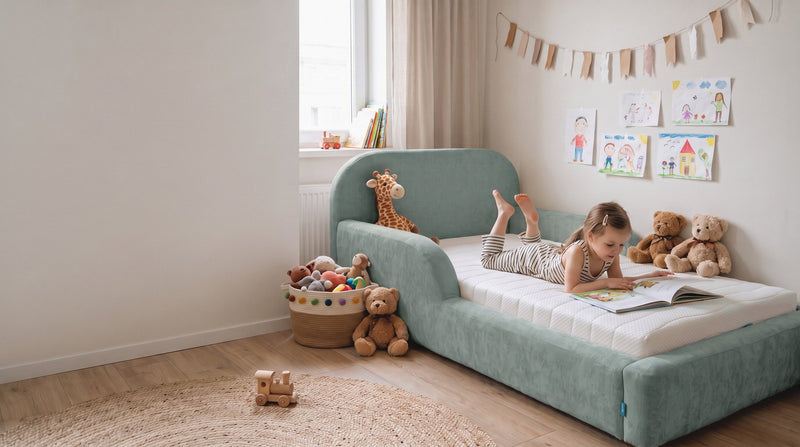
Another often underestimated point is the height of the bed. A child who cannot climb back in by itself at night calls out – and if it calls twice in vain, the third time it comes to you. A low bed that can be left and re-entered without help removes that hurdle. Equally important: a soft boundary that prevents the child rolling out and waking, without it feeling shut in – see fall protection without bars.
And finally noise: a bed that creaks at every movement wakes the child at exactly the points where it surfaces anyway. Lie in it yourself for one night and turn over a few times – within five minutes you will know whether this is an issue.
When to seek paediatric advice
Night-time migration is part of everyday life for many families and passes by itself. It is worth seeking medical advice if your child snores at night or shows pauses in breathing, if it regularly wakes with pain, if it seems persistently exhausted or very irritable during the day despite adequate opportunity to sleep, if severe night-time fears appear suddenly, or if you as parents get too little sleep over a longer period. In Switzerland the paediatric practice and parent and child counselling services are the first points of contact.

Get CHF 25 off
Subscribe to the newsletter and get a one-time CHF 25 discount. ✓ 100 nights trial ✓ 5-year guarantee ✓ Free delivery
Frequently asked questions when a child comes into the parents' bed at night
Why does my child come to us in the middle of the night?
Between sleep cycles everyone wakes briefly. Children unconsciously check in these moments whether the environment is still the same as when they fell asleep. If it is not – for instance because they fell asleep next to you and now wake alone – they seek out the familiar situation again.
Should I take my child back or let them stay in our bed?
Both are defensible. What matters is that you consciously choose one line and keep it for several weeks. Changing responses extend the phase, because the child learns that asking pays off. A good middle route is a fixed mattress beside the parents' bed.
How long does night-time migration last?
With a consistent approach, many families report a clear improvement after two to four weeks. In the first three to five nights getting up often increases at first – that is part of the usual course and does not argue against the method.
What does the time of night say about the cause?
Very early in the night, falling-asleep conditions or a deep-sleep phenomenon such as night terrors are most likely. Between midnight and three, dreams, fears, thirst and the toilet come to the fore. After four, cold and brightness are common triggers, because sleep becomes lighter towards morning.
Does it help to carry my child when taking them back?
If possible the child should walk back itself. Being carried is pleasant and strengthens the incentive to get up; walking back makes their own bed more familiar. Accompany them calmly, without light and without conversation.
When should I have this checked medically?
If your child snores at night or shows pauses in breathing, regularly wakes with pain, seems persistently exhausted during the day despite adequate sleep opportunity, suddenly develops very strong night-time fears, or if you as parents get too little sleep over a longer period.
This article provides general information and is not a substitute for paediatric advice. If problems persist, please speak to your paediatrician.


