







The evening always belongs to the same person. Dad reads the story, that is fine – but falling asleep? Only with mum. Anyone who tries otherwise meets protest and tears, and in the end the door opens and mum comes in. That works as long as everything works. As soon as someone falls ill, works late or stays away for a night, the habit turns into a real problem. And the person everything hangs on never gets a free evening for months. If your child only falls asleep with mum, that is neither coincidence nor a parenting mistake – it is a pattern that has built up and can be opened up again just as gradually.
The short answer: children fix on one person for falling asleep because falling asleep means letting go, and letting go requires maximum safety. The most familiar combination of smell, voice, rhythm and body position wins – and is reinforced every evening through repetition. The way out is not an abrupt switch but a relay handover: the second caregiver first takes over parts of the ritual, then the end of it, then the whole evening. Two to four weeks is realistic. What matters most is that the first person genuinely leaves the room.
- Fixing on one person is a learned safety pattern, not a sign of weak attachment to the second person.
- Abrupt switches usually fail – a relay handover over 2 to 4 weeks is the more reliable route.
- The second caregiver needs their own ritual, not a copy of the existing one.
- The most common mistake: the first person stays within earshot and steps in at the first protest.
- Do not start in an exceptional week – illness, holidays or starting nursery push the start back two weeks.
Why children fix on one person
Falling asleep is not doing nothing, it is an active transition: the body gives up control. For that to succeed, the nervous system has to rate the situation as safe. Children use very concrete signals for this – the smell of skin, the pitch of a voice, the pace of breathing, the way someone strokes a back, even the firmness of the shoulder they rest on. These signals form a package. And that package differs from person to person.
What happens next is simply learning through repetition. If the same person lay alongside for eighty consecutive nights, that person's package becomes linked with the state «safe enough to let go». Another person is not loved less – they are simply not part of the learned sequence. That is why children often react more strongly to the switch than their relationship with the second person would suggest.
On top of that the pattern reinforces itself. The more exhausted everyone is, the more likely the quickest route is chosen in the evening – which is the first person again. After a few weeks the fixation is stronger than at the start. That is why it is worth tackling the subject before it becomes acute. Groundwork on the sequence is in bedtime routine from age 2.

Why the switch usually fails
The typical scene: dad takes over, the child cries, after twelve minutes the door opens, mum arrives, the child settles immediately. The next evening it cries sooner and louder. What is learned here is not «dad works too» but «if I protest long enough, mum comes». The attempt has reinforced the fixation rather than loosening it.
The second reason for failure is trying to copy the existing ritual. If the second person performs exactly the same steps, the difference is emphasised rather than bridged – the child compares constantly. A ritual of their own works considerably better: different books, a different song, a different sitting position, a different opening sentence. Then it is not a failed substitute but a thing in itself.
The third reason is timing. Many families start precisely when there is no alternative – the evening before a business trip, during a feverish weekend, in the middle of settling into nursery. That is when child and parents have the least capacity. Plan the start for an ordinary week without special events instead.
The relay plan over three to four weeks
The basic idea: the second person grows into the evening from the outside in, while the first person leaves the room progressively earlier. No step begins before the previous one has run calmly for two to three evenings.
| Phase | Second caregiver | First caregiver | Duration |
|---|---|---|---|
| 1 | Takes over bath, pyjamas and one book | Joins only for the last book | 3–5 evenings |
| 2 | Takes over all the reading and the song | Comes only for the goodnight line, then leaves | 3–5 evenings |
| 3 | Stays in the room until the child is asleep | Says goodbye before the song and stays away | 4–7 evenings |
| 4 | Handles the whole evening alone | Is in the house, but not in the room and not audible | 1 week |
| 5 | Evenings alternate | Takes turns again | ongoing |
Two rules make the difference. First: the first person says goodbye visibly and clearly – «I am going now, dad is staying with you, we will see each other in the morning.» Slipping away secretly creates mistrust and extends the phase. Second: they do not come back. Crying may be accompanied, but by whoever is present. If you sense you cannot hold that line, a smaller step is the better route – not a half-hearted big one.
What the second caregiver can do differently
An own repertoire. Two or three books that are only read on these evenings. A song only this person sings. That creates a reason to look forward to the evening.
An own position. Not the same side, not the same posture. Some children settle better when the second person sits on the floor beside the bed rather than lying on it.
More daytime presence, not more evening presence. This sounds indirect but works strongly: if the second person takes on more exclusive time during the day – getting dressed, the walk to nursery, the weekend bath – trust grows where it comes more easily. The evening benefits from that.
Patience with their own pace. The second person needs a few evenings to relax too. Children sense tension immediately. If the evening is experienced as a test, that transfers.
Introduce a transitional object. A cloth or t-shirt belonging to the first person, left in the bed, bridges the gap without that person being present. Introduce it during the day. More ritual ideas in bedtime rituals for toddlers.

Common mistakes
Steps that are too big. Going from «always mum» straight to «dad does everything alone» is too much for most children. Smaller steps feel longer and are in fact faster.
The first person stays within earshot. Children notice whether someone is waiting next door. If possible, the first person leaves the flat on the decisive evenings – a walk, an errand, an hour at a friend's. That changes the situation more than any agreement.
Discussing it in front of the child. Debates about whose turn it is tonight turn the evening into a negotiation. Agree beforehand, then announce.
Giving up after three evenings. The first two to three evenings are almost always the hardest. Anyone who stops after evening three never sees the point where it turns.
Going to bed too late. An overtired child has fewer reserves for change. If falling asleep already takes a long time, sort out the bedtime first – see child won't fall asleep.
The emergency plan when it has to happen fast
Sometimes there is no time for four weeks – a hospital stay, a work trip, an appointment. In that case: announce the change during the day, concretely and more than once, with a clear time anchor («When you have slept twice, I will be back»). Have a transitional object ready that smells of the absent person. And keep the ritual otherwise exactly the same – same time, same order, same room.
Expect the first night to be difficult and the second to be noticeably better. And plan for the return: many children react the following day with more clinginess than before. That is normal and settles within a few days if you go back to the usual structure and do not immediately introduce new rules.
What the sleeping place can contribute
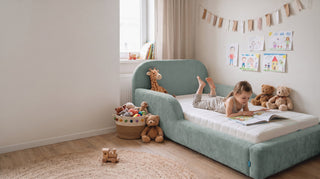
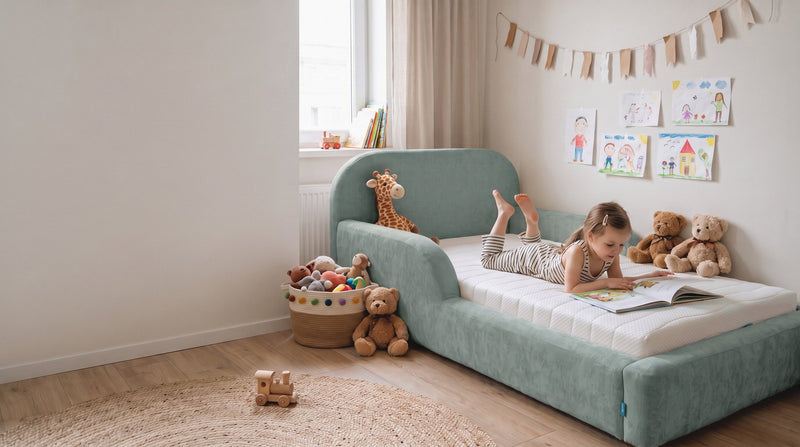
For some children the fixation on one person has a practical side: the sleeping place only works with company. A high, narrow bed with a hard edge is simply uncomfortable for a second person – anyone who holds out half-sitting beside it for an hour becomes restless, and that transfers. A wide, low bed on which an adult can lie comfortably makes the handover easier for everyone, because the second person stays relaxed.
A soft boundary all round helps too. It gives the child a feeling of being enclosed even when nobody is lying alongside – exactly the function otherwise provided by the caregiver's body. And a bed that does not creak lets the second person leave the room without waking the child again. These are not miracle cures, but they take friction out of a process that requires patience anyway.
When support makes sense
Speak to your paediatrician if your child shows very strong separation anxiety during the day too, if falling asleep regularly takes more than an hour over months despite a calm structure, if night-time waking comes with snoring, pauses in breathing or pain, or if the strain on you as parents becomes so great that you are permanently short of sleep. In Switzerland, parent and child counselling services are a low-threshold first point of contact that often helps families within a few appointments.

Get CHF 25 off
Subscribe to the newsletter and get a one-time CHF 25 discount. ✓ 100 nights trial ✓ 5-year guarantee ✓ Free delivery
Frequently asked questions when a child only falls asleep with mum
Why does my child only fall asleep with one particular person?
Falling asleep means letting go, and for that the nervous system needs maximum safety. Children link that state to a very concrete package of smell, voice, breathing rhythm and body position. Many similar evenings bind that package firmly to one person – which says nothing about the bond with the second person.
How long until the other parent can handle settling to sleep?
With a gradual relay handover, most families reckon on two to four weeks. Each stage should run calmly for two to three evenings before the next begins. Big jumps usually do not shorten the process but lead to setbacks.
Should the first caregiver step in when the child cries?
Preferably not. If they appear during the protest after all, the child learns that persistent crying achieves the goal and the pattern hardens. If you cannot hold that line, choose a smaller step where the child does not reach real distress in the first place.
Should the second person use the same ritual?
Better not. An exact copy invites comparison. An own repertoire – different books, a different song, a different sitting position – makes the evening something in its own right rather than a substitute, and children usually accept it faster.
What helps when the change has to happen at short notice?
Announce the change during the day, several times and concretely, with a time anchor the child understands. Have a transitional object ready that smells of the absent person and keep the rest of the sequence exactly the same. The first night is usually the hardest, the second noticeably easier.
When should I seek support?
If very strong separation anxiety is present during the day too, if falling asleep regularly takes more than an hour over months, if night waking comes with snoring, pauses in breathing or pain, or if you as parents are permanently at your limit.
This article provides general information and is not a substitute for paediatric advice. If problems persist, please speak to your paediatrician.


