




At the start it was ten minutes. Then twenty. By now you lie next to your child for forty minutes, barely daring to breathe, and if you move too soon the whole thing starts again. Staying with a child until they fall asleep is a good thing – until it eats the entire evening and you doze off yourself at half past eight with the dishes still in the kitchen. Many parents in Switzerland are stuck in exactly this phase and do not know how to get out of it without leaving their child to cry alone. The good news: wanting to end bedtime support does not mean having to choose between closeness and independence. There is a route in between, and it is well described.
The short answer: do not end bedtime support all at once, but in small steps that are predictable for the child. The best-known variant is the chair method: you stay in the room but move the chair a little further from the bed every three to five evenings, until you are finally outside. For most families that takes two to four weeks. Two things decide the outcome: letting each stage settle before starting the next, and announcing what you are doing. Start no earlier than around two years old, and never in an exceptional week.
- Bedtime support does not have to end abruptly – stages of 3 to 5 evenings are the more reliable route.
- The chair method increases the distance gradually without leaving the child alone.
- Announce rather than sneak away: children need predictability more than presence.
- Reckon on 2 to 4 weeks, and on setbacks after illness, holidays or other changes.
- Check first: bedtime, afternoon nap, room temperature and darkness.
Why bedtime support becomes so persistent
The mechanism behind it is unspectacular. When a child falls asleep in the presence of another person, its nervous system learns that this state is part of falling asleep. Because all people surface briefly several times between sleep cycles, the condition is not checked once a night but again and again. If it is missing, the child wakes properly – and calls out.
That is why many families experience two problems at once: falling asleep takes a long time, and the child wakes frequently at night. Both share the same root. And both change when the child learns to produce the transition into sleep itself – not left alone, but accompanied with decreasing intensity.
The second reason for the persistence is practical: the support works. It is the quickest route in the evening, and in an exhausting week you choose the quickest route. So the phase extends evening by evening without anyone having made a decision. The most effective first step is therefore not a trick but a date: decide which evening you will begin.

Is your child ready?
Before around two years, a gradual withdrawal is too early for most children – attachment needs and separation anxiety are still too strong, and nights become harder for everyone rather than easier. Between two and six years the window is good. These signals suggest now is the time:
Your child can occupy itself alone for ten to twenty minutes during the day. It understands simple announcements and can hold them in mind for a few minutes. It has a stable bedtime and actually becomes tired in the evening – rather than wired. It is not currently ill, not in the middle of settling in somewhere and not in a period of upheaval.
Against it: an ongoing nursery settling-in period, a new sibling, a move, a week of illness, teething or the end of a holiday. In those cases wait for two to three calm weeks. Postponing is not procrastinating; it saves you a failed attempt. To check whether the overall amount of sleep is right, see how much sleep does my child need?
The chair method step by step
You place a chair next to the bed and move it towards the door over several evenings. The child is never alone, but closeness decreases predictably. Only move to the next stage when the current one has run for two to three evenings without major protest.
| Stage | Where you sit | What you do | Typical duration |
|---|---|---|---|
| 1 | Directly by the bed | Hand on the back, no conversation | 3–5 evenings |
| 2 | By the bed, without physical contact | Presence only, calm breathing | 3–5 evenings |
| 3 | One metre away | Quiet humming or nothing at all | 3–5 evenings |
| 4 | In the middle of the room | Sit quietly, respond briefly to calls | 4–6 evenings |
| 5 | At the door, inside | Stay visible, do not speak | 4–6 evenings |
| 6 | Outside the door, audible | Answer briefly every few minutes | 3–5 evenings |
| 7 | In the next room | Announced check-ins | until it holds |
Two details decide the outcome. First: respond briefly and always the same way – one word, one sound, no more. Every conversation extends the waking phase. Second: after a difficult evening do not go back a stage, stay one evening longer on the current one. Going back only makes sense if two to three consecutive evenings clearly fail.
The alternative: the interval model
Some children respond to seated presence with more excitement rather than less – they talk, check, demand attention. For them a different model works better: you settle them as usual, then deliberately step out briefly and come back reliably.
How it runs: after the ritual you announce that you are just fetching something and will be right back. The first time you return after 30 seconds, then after a minute, then two, then three. The decisive part is that you really do come back – every time, even when the child is calm, and even when it is nearly asleep.
What is learned here is not «being alone is bearable» but «leaving means coming back». For many children that is the decisive step, because it takes the fear out of being left. After one to two weeks most children fall asleep within these intervals. Then lengthen the gaps slowly.
The two models can be combined but not mixed: pick one and stay with it for two weeks. Switching is the most common reason neither works.

Myths fact-checked
«Staying with your child spoils them.» No. Bedtime support is a widespread and legitimate way of getting children to sleep. It only becomes a problem when it is no longer sustainable for the family – that is an everyday argument, not a pedagogical one.
«It stops by itself eventually.» Partly true: most children do eventually fall asleep independently. But without intervention the timing is hard to predict and often lies years later than parents expect. Acting actively shortens the phase.
«You just have to let them cry, then it goes quickly.» Speed is not the only criterion. The gradual routes described here take longer but are considerably less demanding for child and parents – and a route you can sustain works better than one you abandon after three nights.
«If I sneak out, they won't notice.» They will – at the latest at the next surfacing between two sleep cycles. Sneaking away raises alertness and makes the following evenings harder.
«A sleep aid or melatonin will get us through this phase.» Sleep aids and melatonin are not a matter for self-medication in children. If you are getting to that point, talk to your paediatrician.
What to do about setbacks
Setbacks are not exceptions but the normal course. After an infection, after a holiday, after a weekend at the grandparents', the child suddenly wants the closeness of stage one again. That does not mean the work was wasted.
The usual approach: deliberately go back two stages, stay there for three to four evenings, and then work your way up faster than the first time – two evenings per stage is usually enough. Children remember the route; the repetition is almost always noticeably quicker.
What to avoid: trying a new method during the setback phase. That is exactly when the temptation is greatest, because it feels like failure. Stay with the familiar route – familiarity is the most effective ingredient in this situation.
And deliberately write off weeks of illness: if your child has a fever, go back to close support without a guilty conscience. The structure will return afterwards. Insisting on a method during illness loses more than it gains.
What the environment can contribute
Part of the evening's difficulties has nothing to do with the support itself. Check three things before starting: the bedtime (an overtired child becomes wired, not calm), the afternoon nap (too late or too long shifts the evening considerably, see dropping the afternoon nap) and the stimulation level in the last hour before bed.
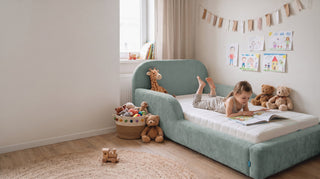
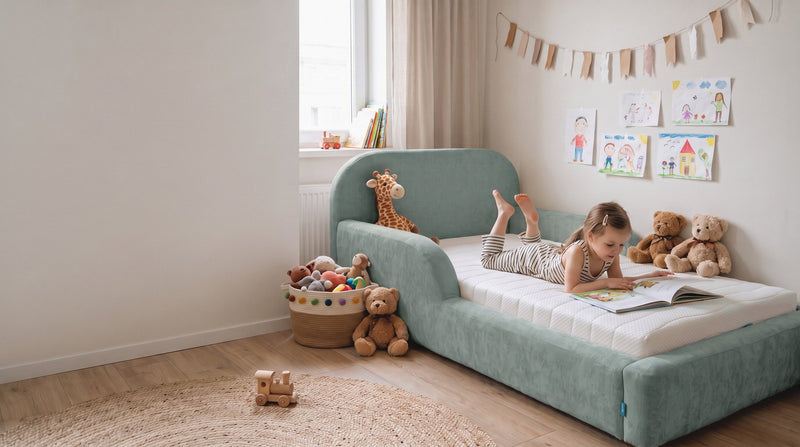
Then there is the sleeping place itself. If you have to climb over a hard bed edge each time you withdraw, or the bed creaks at every movement, each stage becomes harder than it needs to be. A low bed that is soft all round, on which you can lie or sit comfortably at stages one and two, takes physical tension out of the situation – and children sense that tension. A soft, enclosing boundary helps too, because it takes over part of the sense of security that otherwise comes from your presence. More on room design in furnishing a child's room.

Get CHF 25 off
Subscribe to the newsletter and get a one-time CHF 25 discount. ✓ 100 nights trial ✓ 5-year guarantee ✓ Free delivery
Frequently asked questions about ending bedtime support
At what age can you end bedtime support?
A gradual withdrawal suits most children from around two years. Before that, attachment needs and separation anxiety are usually still too strong. More important than age, though, are the signals: the child should understand simple announcements, be able to occupy itself briefly and not be in the middle of a period of upheaval.
How long does it take before a child falls asleep alone?
With a stepwise approach most families report two to four weeks. Each stage should run calmly for two to three evenings before the next begins. Moving faster risks setbacks that cost more time in the end.
What is the chair method?
With the chair method you stay in the room but sit on a chair that moves further from the bed towards the door over several evenings. The child is never alone, but closeness decreases predictably. After six to seven stages you are outside the room.
Can I sneak out of the room once my child is asleep?
Better not. Because children wake briefly several times between sleep cycles, they notice the change at the latest then – and become more alert on the following nights. An announced departure with a reliable return works considerably better than sneaking away.
What should I do after a setback following illness or a holiday?
Deliberately go back two stages and stay there for three to four evenings. The route can then usually be repeated much faster, often with two evenings per stage. Do not switch methods at this point – familiarity is exactly what works best then.
Are melatonin or herbal sleep aids an option?
Sleep aids and melatonin are not a matter for self-medication in children. If sleep problems persist over a long period and the usual measures do not help, discuss it with your paediatrician rather than giving something yourself.
This article provides general information and is not a substitute for paediatric advice. If problems persist, please speak to your paediatrician.


