



Few bed shapes have caught on as strongly in recent years as the house bed. On Pinterest it looks fantastic, in a child's room it feels instantly cosy, and children love the idea of having their own little house. Search for “children's bed” today and you almost automatically land on a house-shaped frame.
At the same time we hear the same two sentences from many families: “We would buy it again” – and “We wish we had known beforehand what we were letting ourselves in for”. Both are true. The house bed has real strengths, and it has drawbacks that no product photo shows, because they only appear in daily life.
This article takes an honest look at both sides. We look at what a house bed actually delivers, where its structural weaknesses lie, from what age it makes sense and what to watch for in terms of safety and placement.
At the end we set the common alternatives side by side – from the floor bed to the junior bed to the upholstered children's bed – so you can decide which shape suits your child, your room and your daily routine. There is no right or wrong here, only a fits or does not fit.
The short answer: A house bed is a low children's bed with an open wooden roof frame above it. Its strengths are high play value, a feeling of security and a usually very low entry height – children often go to bed more willingly. Its drawbacks are structural: hard wooden edges at head height, a construction that invites climbing, a strong presence in the room and awkward bedding changes. A house bed makes sense from around three years, once your child stands securely, stays in bed at night and understands that the roof frame is not for climbing. For younger children a low bed without a roof structure is the calmer choice.
- Biggest strength: children associate the bed with something of their own – which noticeably eases the move on from the cot.
- Biggest weakness: hard edges and posts at head height, exactly where a child moves during sleep.
- A house bed invites climbing. That is not a parenting problem but construction – expect it.
- Allow 15–20 cm more floor space than a frame bed with the same sleeping surface.
- Fabric canopies, fairy lights and garlands on the roof are the most common safety mistake with house beds.
What a house bed is – and why it became so popular
A house bed is essentially a low bed frame with an open gable-shaped frame above it: four posts, two roof slopes, usually a ridge beam. The sleeping surface sits low, often just 20 to 30 cm above the floor. It exists with and without side fall protection, with solid boards or open struts.
The design became popular via two routes at once. First the Montessori idea: a low bed a child can get into and out of independently, instead of being lifted out of a cot. Second the visual language of social media, where the house bed works as the anchor of a calm, bright children's room.
The psychological core touches something real. Children between two and six seek out spaces with clear boundaries: the den under the table, the tent made of blankets, the spot behind the sofa. A bed with a suggested roof meets exactly that need. It explains why many parents report that after the change their child goes to bed more willingly. We see the same observation with any bed shape that creates a nest-like feel – the roof frame is one way there, but not the only one.
The real benefits
The move on from the cot is easier. This is the most frequently named benefit, and it is not imagined. A child moving from an enclosed cot to an open sleeping surface loses a boundary they had grown used to. The roof frame gives some of that boundary back – visually, not physically. More on this stage in our article from cot to toddler bed.
Low entry height. Most house beds sit very low. A child can climb in and out independently, and rolling out of bed ends after 20 centimetres on a rug rather than after 50 on a wooden floor.
Play value. During the day the bed is a den, a shop, a spaceship. That is not a side effect but a genuine gain for many families, especially in small flats where the bed already takes up a third of the room.
Independence. No lifting, no dropping a cot side. Your child decides when they get up – which defuses many conflicts during the autonomy phase between two and four.
The drawbacks people rarely mention
Hard edges at head height. This is the weightiest point. Children sleep restlessly, turn, roll to the side and bump into things. In a house bed, posts and roof struts of solid wood sit exactly where the head travels during sleep. Nighttime bumps against a wooden edge are the most common reason families later pass a house bed on.
An invitation to climb. To a three-year-old a roof frame does not look like decoration but like a ladder. That can be handled with good parenting, but not argued away – the construction says “climb me”.
Presence and footprint. A house bed needs roughly 15 to 20 cm more width and length than its sleeping surface and feels considerably more dominant than a flat frame. In a 9-square-metre room that is noticeable. How to plan small spaces cleverly is covered in our article on setting up a small children's room.
Changing the bedding. Underrated but relevant daily: the roof frame gets in the way. Anyone who has changed a fitted sheet in a house bed with a low gable knows what we mean.
Reading together becomes uncomfortable. Lying down next to your child in the evening only works to a limited extent – the frame restricts exactly where an adult would need room.

Safety: what to watch for
A house bed is not unsafe – but it has more points to check than a simple frame. These six are the most important.
1. No fabric on the roof. Cloths, canopies and curtains on the gable are the most common mistake. They can come loose, fall down and in the worst case cover a face. If fabric, then firmly tensioned and only outside the sleeping surface.
2. No fairy lights on the frame. Cables in the bed are a strangulation hazard regardless of voltage. Lighting belongs on the wall or the ceiling.
3. Check the gaps. Between struts the same logic applies as with a cot: a gap in which a head or arm can become trapped is a problem. Either under 6.5 cm or clearly over 25 cm.
4. Stability. A house bed is top-heavy. Check whether it tips when a child pulls sideways on the roof frame. Wall fixing is sensible on lightweight models.
5. Edges and screws. All edges rounded, all screw heads countersunk or covered. Run your palm over every reachable surface.
6. Distance to wall and furniture. No gap between bed and wall that a child could slip into. The full list is in our safety checklist.
From what age does a house bed suit?
The common guidance “from 3 years” is usable as orientation, but it does not describe what matters. More important than the date of birth are three observations: does your child stand securely and climb in a controlled way? Do they stay in bed at night rather than getting up and walking around the room? And do they understand a rule like “we don't climb on the roof” well enough to follow it most of the time?
If all three are yes, little speaks against a house bed. At two out of three we would still wait. At one or none, a bed without a roof structure is the considerably calmer choice – for your child and for your sleep.
Regardless of this: no open bed of this kind is intended for babies or very small toddlers under around 18 months. At that age a child belongs in a cot, and in the first year the official safe infant sleep recommendations apply: on the back, in their own bed in the parents' bedroom, no loose blankets or pillows, room temperature around 18 °C. Whether your child is ready can be checked against the signs in our article is your child ready for a big bed.
Get CHF 25 off
Subscribe to the newsletter and get a one-off CHF 25 discount. ✓ 100-night trial ✓ 5-year guarantee ✓ Free delivery

The alternatives compared
The house bed is one of several answers to the same need: a bed that feels secure and that a child can get into independently. Here are the common shapes side by side.
| Bed type | Strengths | Weaknesses | Best suited from |
|---|---|---|---|
| House bed with roof frame | High play value, nest-like feel, usually a low entry height | Hard edges at head height, climbing-frame effect, dominates the room | approx. 3 years, once the child stands securely and understands not to climb |
| Floor bed / Montessori bed | Very low, no risk of falling from a height, independent getting in and out | Little enclosure, dust and draughts at floor level, changing bedding is awkward | approx. 18 months, with a child-proofed room |
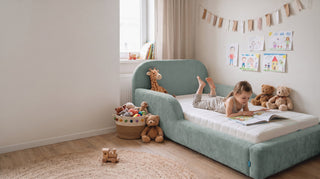
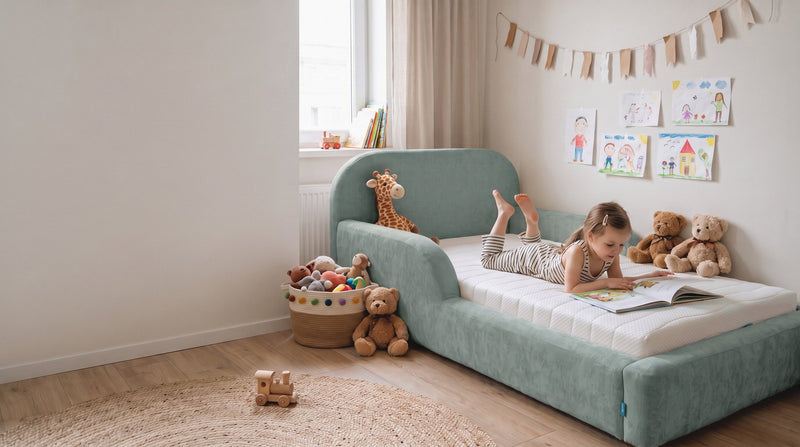
| Upholstered children's bed | No hard edges, organic fall protection, nest-like feel without a roof structure | Larger external dimensions than a bare frame, the cover needs care | approx. 18–24 months as a first big bed |
| Junior bed (70×140 to 90×160) | Small footprint, familiar size after the cot | Often too short after 2–3 years, a second purchase is needed | approx. 2 years, when space is tight |
| Classic children's bed 90×200 | Grows with your child into their teens, wide mattress choice | Looks large at first, a bed guard is often needed | approx. 2–3 years |
| Loft bed | Saves floor space, creates a play area underneath | The height demands maturity, hard to read together, risk of falling | 6 years at the earliest |
What stands out is that these shapes differ less in comfort than in where the boundary comes from. With a house bed it comes from above, with a floor bed not at all, with an upholstered children's bed from the sides. That last variant solves the edge problem: the boundary sits at mattress height rather than head height, and it is soft rather than hard. More on this principle under fall protection without bars.
Common mistakes with house beds
Deciding by looks rather than room size. Measure the floor space including external dimensions before ordering and allow 60 cm of movement space along the long side.
Decorating the roof. It is the biggest temptation and the biggest safety mistake. Leave the gable clear.
Switching too early. A child who still gets up at night and wanders the room is not safer in an open bed, just out of it sooner.
Choosing the wrong mattress height. A very tall mattress lifts the child closer to the roof frame and shrinks the interior space. Stick to the height the manufacturer specifies.
Not retightening the frame. A house bed has many connections, and children move it daily. Tightening all screws once every six months is enough.
Decision aid: six questions
Answer these honestly and the decision usually makes itself.
1. How old is your child, and do they stay in bed at night? Under three and out of bed at night argues against a house bed.
2. How big is the room? Under 10 m² the presence of the bed becomes an issue.
3. Do you lie down to read? If so, an open bed without a roof frame is considerably more practical.
4. How easily does your child bump into things at night? Children who move a lot in their sleep benefit from soft edges.
5. How long should the bed last? House beds mostly come in 90×200 cm – enough into the teens, if the roof frame is still wanted by then.
6. Who changes the bedding? An unromantic question with a very practical answer.

Frequently asked questions about house beds
From what age does a house bed make sense?
Around three years serves as orientation. More important than age are three observations: your child stands securely and climbs in a controlled way, they stay in bed at night rather than wandering the room, and they understand a rule such as “we don't climb on the roof”. If all three apply, little speaks against it. An open bed of this kind is not intended for children under around 18 months.
What are the biggest drawbacks of a house bed?
The most important are the hard wooden edges and posts at head height, exactly where a child rolls during sleep. On top of that come the climbing effect of the roof structure, a considerably larger footprint than a flat frame, awkward bedding changes and the fact that reading together in bed becomes cramped.
Can I put a canopy or fairy lights on a house bed?
Better not. Fabric on the roof frame can come loose and fall down, and cables in the bed area are a strangulation hazard regardless of voltage. Both rank among the most common safety mistakes with house beds. Leave the gable clear and put lighting on the wall or ceiling, out of reach from the bed.
How much space does a house bed really need?
Allow roughly 15 to 20 cm more width and length than the sleeping surface alone, because posts and frame build outwards. A bed with a 90×200 cm sleeping surface therefore occupies about 105×215 cm of floor space. Add around 60 cm of movement space along the long side, otherwise making the bed becomes a daily chore.
Is a house bed better than a floor bed?
Neither – they solve different problems. A floor bed is lower and completely open, but offers no boundary at all and the room has to be fully child-proofed. A house bed gives visual boundaries back but brings edges at head height. Which suits depends on age, sleeping behaviour and the room.
Can a house bed be used into school age?
Yes, provided the sleeping surface is 90×200 cm. On paper the size lasts into the teens. The practical question is a different one: many children find the roof frame childish from around eight to ten. If the bed should stay for a long time, check whether the gable can be removed later.


