


Anyone looking for a children's bed in Switzerland will find offers between 129 and 2,400 francs within an hour – for what appears to be the same piece of furniture: a frame, a slatted base, a 90×200 cm sleeping surface. That is confusing, and it cannot be explained by “brand” alone.
On top of that, the purchase price is only part of the sum. The bed is joined by a mattress, a slatted base, a protector and bedding. Anyone who budgets only for the bed regularly ends up several hundred francs out.
This article maps the Swiss market: which price ranges are realistic in 2026, what actually drives the price, where savings are made that you do not see straight away, and which additional costs belong in the budget. All figures are rough guides – they vary considerably by retailer, material and promotions.
At the end we show a calculation that says more in a child's room than any price comparison: the cost per night. It does not automatically lead to the most expensive bed, but it answers the question that really sits behind the budget.
The short answer: For a solid children's bed in 90×200 cm, Swiss prices sit roughly between 300 and 800 francs; very simple models start at around 100 to 300 francs, while premium upholstered and solid wood beds run from 800 to 1,800 francs and above. Realistically add 150 to 500 francs for a children's mattress, 60 to 250 francs for a slatted base if it is not included, and around 100 to 250 francs for a protector and bedding. The price is driven above all by material, joining technique, edge finishing, upholstery and whether spare parts exist. Convert the price to the usable life – a bed that lasts eight years is often cheaper per night than two beds lasting three years each.
- Realistic range for a solid bed in 90×200 cm: around CHF 300–800, premium CHF 800–1,800.
- Budget for the whole system: bed plus mattress plus slatted base plus protector and bedding.
- Price drivers are material, joints, edges, upholstery and spare part supply – not the colour.
- When ordering from abroad, import tax and customs clearance fees can cancel out the price advantage.
- The most honest figure is the cost per night over the actual usable life.
The 2026 price brackets at a glance
The overview below summarises what you can expect in each bracket. All figures are rough guides for Switzerland and refer to the common 90×200 cm size; individual cases can differ upwards and downwards.
| Price bracket (bed 90×200, rough guide) | What you typically get | Where savings are usually made | Realistic usable life |
|---|---|---|---|
| approx. CHF 100–300 | Simple frame in chipboard or pine, often without a slatted base | Joints, edge finishing, spare parts, surface | 2–5 years |
| approx. CHF 300–800 | Solid wood or good board material, sturdy roll-up base, clean edges | Padding, cover quality, spare part supply | 5–10 years |
| approx. CHF 800–1800 | Very solid frame, sprung slat frame, upholstery or solid wood, replacement parts | Little – here execution is what decides | 8–15 years |
| from approx. CHF 1800 | Design pieces, bespoke builds, elaborate upholstery and fabrics | Nothing systematic; price follows material and manufacture | 10 years and more |
| Children's mattress 90×200 | approx. CHF 150–250 entry, CHF 250–500 mid-range, above that premium | Cover quality and durability of the core | 5–8 years |
| Slatted base 90×200 | approx. CHF 60–250 depending on design | Number of slats, caps, central reinforcement | 8–10 years |
Two things stand out in this table. First: the biggest jump in quality happens between 300 and 800 francs – this is where you move from “lasts a few years” to “lasts into secondary school”. Second: above roughly 1,800 francs you are no longer primarily buying durability but material, design and manufacturing effort.
What actually drives the price
Material. Coated chipboard is cheapest, MDF sits above it, solid wood – beech and oak in particular – considerably higher. With upholstered beds the fabric comes on top: an abrasion-resistant furnishing fabric costs several times a simple cover fabric, and you can tell the difference after three years.
Joining technique. The most invisible price element. A bed held together with plastic cam fittings is cheaper than one with metal fittings or mortised wooden joints – and it starts creaking and wobbling sooner.
Edge finishing. Rounded, cleanly edge-banded surfaces cost machining time. This is exactly where savings are made in the lower price segment, and exactly where a child's head arrives at night.
Upholstery. It is a manufacturing step of its own with its own material and its own handwork. Upholstered beds therefore sit systematically above comparable frame beds.
Spare parts and service. Keeping slats, covers and fittings in stock for years costs money, and that sits in the price. In return you get a bed that does not have to be replaced after one broken part.
The extra costs missing from the budget
The most common budgeting mistake is counting only the bed. A complete sleep system consists of four items, and the mattress is often the second most expensive of them.
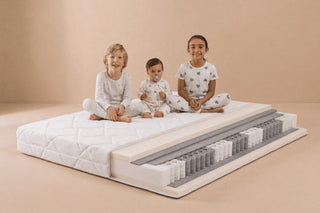
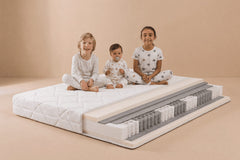
Mattress. In Switzerland reckon on roughly 150 to 250 francs for a solid entry model and 250 to 500 francs for the mid-range. What matters is set out in our article on buying a children's mattress.
Slatted base. Not included with many beds. A roll-up base starts at around 60 francs; a sprung slat frame with caps is more like 150 to 250 francs. Why the base matters more than you think is covered in our article on slatted bases in children's beds.
Mattress protector. 40 to 90 francs, and one of the few items guaranteed to pay for itself during the bedwetting years.
Bedding. Two sets are the minimum, three are realistic: around 60 to 160 francs.
Delivery and disposal. Check whether delivery goes into the flat and whether the old bed is taken away. Otherwise both turn up as a surprise.

Why Swiss prices are higher
A comparison with German or French shops almost always comes out in favour of abroad – at least at first glance. There are factual reasons for that: higher wages in retail and logistics, higher rents for warehouse and showroom space, smaller volumes for the Swiss market and warranty handling within the country.
A second look puts the difference into perspective. When ordering from abroad, import tax, any customs duties and the carrier's clearance fees can be added. For a bulky piece of furniture, freight costs are also considerably higher than for a parcel – and in the event of a return you may bear those costs a second time.
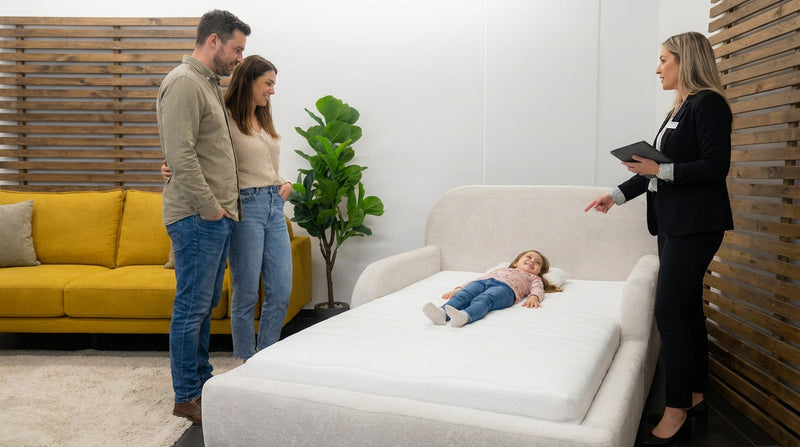
Warranty handling matters in practice too. A broken side panel from a supplier with no Swiss presence means shipping abroad, waiting and freight costs. With a domestic supplier it is usually a replacement part. That difference appears in no price comparison but becomes relevant when it counts. How a return works is described in our article on buying a children's bed.
The calculation that really counts: cost per night
The purchase price says little as long as the usable life is missing. So calculate like this: price divided by (years × 365).
A bed at 1,200 francs that lasts eight years costs 1,200 ÷ 2,920 nights = roughly 41 centimes per night.
A bed at 300 francs that lasts three years costs 300 ÷ 1,095 = roughly 27 centimes per night – but you buy three times in eight years, around 900 francs, and go through dismantling, disposal and repurchasing twice.
The numbers show two things. First: expensive is not automatically cheaper per night – anyone claiming otherwise is massaging the sum. Second: the difference lies less in price than in durability. An affordable bed that lasts eight years is the best choice of all. So the real question is not “how expensive” but “how long”.
And count the resale value. A neutrally designed, well-kept bed can be passed on via Swiss second-hand platforms for a realistic share of its original price; a bed with printed motifs hardly at all.
Get CHF 25 off
Subscribe to the newsletter and get a one-off CHF 25 discount. ✓ 100-night trial ✓ 5-year guarantee ✓ Free delivery

Where you can save – and where not
Sensible savings: on timing. Promotions around Black Friday, spring and clearance periods deliver real discounts on furniture. Also sensible: skip add-ons you do not need – bed drawers, attachments, adjustment mechanisms.
Equally sensible: buy bedding and protectors separately and more cheaply rather than in the bed manufacturer's set.
Do not save on the mattress. It is in direct contact with your child, every night, for years. Of all the items, it is the one where moving up a price bracket shows most clearly.
Do not save on edges and joints. Neither can be changed after purchase, and together they determine how safe and how durable the bed is.
Do not save on the right of return. A cheap bed without a home trial can become expensive if your child does not take to it.
Common budgeting mistakes
Counting only the bed price. The classic. Plan the whole system from the start.
Going smaller to save money. A shorter bed is cheaper but will be replaced in three to four years – the saving disappears entirely. For the size comparison see 70×140 or 90×200.
Overlooking shipping costs. Bulky goods cost money, especially in mountain and outlying regions.
Forgetting disposal of the old bed. Bulky waste stickers or collection services cost extra in many municipalities.
Not planning for assembly. If you book an assembly service, it belongs in the budget; if not, a free afternoon belongs in the plan.
Deciding by percentages rather than francs. “40% off” says nothing while the starting price is unknown.
How much to sensibly spend
A rule of thumb that holds up in practice: budget for the whole sleep system – bed, mattress, base, protector, bedding – in proportion to the usable life you expect. For a bed intended to carry from toddler age into secondary school, 800 to 1,500 francs for the complete system is realistic. For an interim solution over three years, 400 to 600 francs is enough.
More important than the absolute figure is the split. If the budget is tight, weight the mattress more heavily than the frame: a simple, solid frame with a good mattress sleeps better than the other way round. The frame can be replaced later without the mattress having to go too – the reverse only works at the same size.
And plan a buffer for what nobody budgets: a second cover, a replacement slatted base after a few years, another set of bedding after the third night of illness. Around ten per cent of the total budget is a realistic reserve for this.

Frequently asked questions about children's bed prices in Switzerland
What does a good children's bed cost in Switzerland?
For a solid bed in 90×200 cm the realistic range sits roughly between 300 and 800 francs. Very simple models start at around 100 to 300 francs, while premium upholstered and solid wood beds run between 800 and 1,800 francs and above. These figures are guide values and vary considerably by retailer, material and current promotions.
What costs come on top of the bed?
Reckon on 150 to 500 francs for a children's mattress, 60 to 250 francs for a slatted base if it is not included with the bed, 40 to 90 francs for a mattress protector and 60 to 160 francs for two to three sets of bedding. Delivery charges for bulky goods and fees for disposing of the old bed may be added.
Why are children's beds more expensive in Switzerland?
Behind it lie higher wages in retail and logistics, higher rents for warehouse and showroom space, smaller volumes for the Swiss market and warranty handling within the country. When ordering from abroad, import tax, customs duties and clearance fees may be added, and freight costs for bulky furniture are considerably higher than for a parcel.
Is an expensive children's bed worth it at all?
That is decided not by the price but by the usable life. Divide the price by years times 365 and compare the cost per night. An affordable bed that lasts eight years comes out better than an expensive one that gets replaced, and better than a cheap one that has to be replaced by a second after three years. So durability and size are what count.
Where should you never economise on a children's bed?
On the mattress, on edge finishing and on the joints. The mattress is in direct contact with your child every night for years. Edges and joints cannot be changed after purchase and determine safety and lifespan. You can sensibly save on timing, on add-ons and on bedding.
How much should I budget for a complete sleep system?
For a bed intended to carry from toddler age into secondary school, 800 to 1,500 francs for the complete system of bed, mattress, base, protector and bedding is realistic. For an interim solution of around three years, 400 to 600 francs is enough. Add roughly ten per cent as a reserve for spare parts and another set of bedding.


