


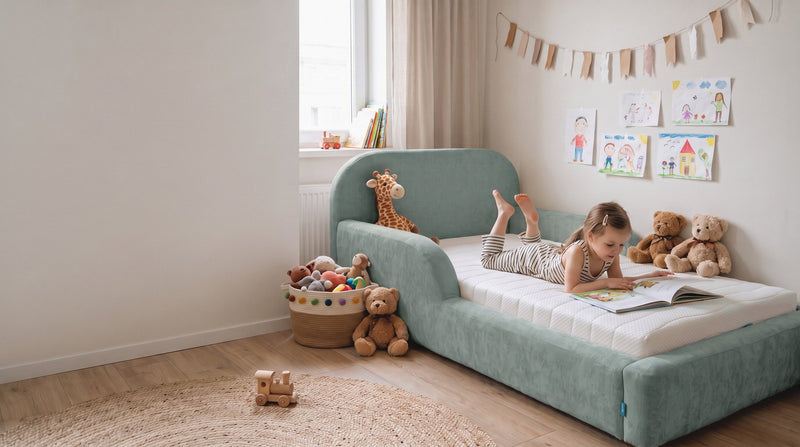

A children's bed is used for three to eight years on average – and is often still in good condition afterwards. On Tutti, Ricardo, Anibis and in Swiss second-hand stores there are therefore hundreds of beds available at any time, many at a fraction of the original price. Anyone prepared to organise a vehicle and spend an hour checking genuinely saves several hundred francs.
At the same time a children's bed is not furniture like any other. A child spends ten to twelve hours a day in it for years, and the parts safety depends on – joints, gaps, bed guards – are exactly the ones you cannot see in a listing.
This article is the practical guide to it. We go through which parts of a bed are worth buying used and which are not, which safety questions come before price, how a good viewing works and what awaits you when transporting it in Switzerland.
One thing up front, because it is the most common mistake: you do not buy the mattress second-hand. Why is explained below – the reason is not squeamishness but the fact that exactly the properties that matter cannot be assessed from the outside.
The short answer: A second-hand children's bed is worth it if the frame is solid wood or sturdy board material, all the fittings are present, the model designation is known and you can inspect it in person. Depending on age and condition, reckon on 30 to 60 per cent of the original price. Do not buy the mattress used – hygiene, wear and mite load cannot be assessed from outside – and treat the slatted base with caution, because sagging transfers to the new mattress. With loft and bunk beds, having every safety part present is the decisive condition; without a manual and model designation, better to walk away.
- Always buy the mattress new – that is the item where second-hand never makes sense.
- Completeness before price: missing special screws or fittings quickly make a cheap bed expensive.
- Ask for the model designation and manufacturer before you drive over – much can be settled in advance.
- Realistic prices are 30 to 60 per cent of the original price, depending on age and condition.
- With loft and bunk beds: no complete safety parts and manual, no purchase.
When second-hand genuinely pays off
Buying used makes sense when three conditions come together: the frame is in a material that ages slowly, the model is identifiable, and you can look at it in person. If one of the three is missing, the risk rises considerably.
It works particularly well with solid wood beds from known manufacturers. They are robustly built, damage is visible, spare parts often still exist, and the resale value is high enough that you can pass the bed on yourself later. Also good: plain frames in 90×200 cm, because they match the most common size and leave you free to choose the mattress.
We would be more reserved about beds with many plastic connectors, converted modular beds where parts may be missing, and upholstered beds without a removable cover – the last of these simply cannot be brought back to a hygienically sound state.
Second-hand stops paying off above roughly 60 per cent of the original price. From that point the difference buys you a new bed with a guarantee, a right of return and complete parts. What price ranges are realistic new is covered in our article on children's bed prices in Switzerland.
What you can buy used – and what you cannot
Not every part of a bed ages the same way. The overview below ranks the components by how well their condition can be judged from outside.
| Part | Buy second-hand? | Reasoning | What to check |
|---|---|---|---|
| Solid wood bed frame | Yes | Ages slowly, damage is visible, can be cleaned thoroughly | Cracks at joints, worn screw holes, complete fittings |
| Coated board bed frame | With caution | Edges chip, cam fittings wear after repeated assembly | Swollen edges, wobbly corners, how many house moves it has seen |
| Upholstered bed / padded frame | Only with a removable cover | Padding cannot be washed out, odours stay | Is the cover removable and washable? Check for stains underneath |
| Slatted base | Rather not | Sagging is hard to spot and transfers to the new mattress | Hairline cracks in slats, sagging in the middle, ask its age |
| Mattress | No | Hygiene, wear and mite load cannot be assessed reliably | Buy new as a matter of principle – the most important item |
| Bed guard / accessories | Yes, if they fit | Simple parts, condition clearly visible | Exact fit to the model, complete set of screws |
| Loft bed / bunk bed | Only with the manual | Safety-relevant parts, completeness is decisive | All safety fittings present, manual and model designation |
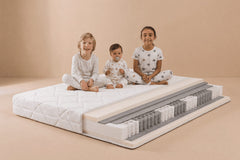
The clearest line runs at the mattress. You cannot tell how many nights a mattress has carried, whether liquid has soaked into the core, how far the core has already given way or what the mite load is. A cover can be washed, a core cannot. For an item in direct bodily contact every night, that is the wrong place to save – and usually the one where the price advantage is smallest anyway. What matters in a new mattress is set out in our children's mattress guide.
The safety questions that come before price
Before you talk about price, settle these five points – ideally by message, before you drive over.
1. Manufacturer and model designation. With these you can check online whether there have been recalls, whether spare parts are available and how the bed was originally assembled. A seller who can name neither is a warning sign.
2. Year of manufacture or purchase. Safety requirements for children's furniture have developed over the years. On a bed that is 20 years old, gaps and construction may no longer match current practice.
3. Completeness. Are all fittings, screws, covers and – where present – safety parts included? Special screws cannot always be replaced at a DIY store.
4. Manual. Without assembly instructions a dismantled bed quickly becomes a puzzle. Many manufacturers publish manuals online – check that in advance.
5. With loft and bunk beds: the guard rail. Here completeness is not a convenience question. If part of the rail is missing, the bed is unusable. The rules are set out in our article on loft beds and age.

The viewing checklist
Take twenty minutes and work through these points in order. Ideally with two people, so one inspects and one takes notes.
1. Look at the bed assembled if possible. A dismantled bed hides wobble and creaking.
2. Shake all four corners. If the frame moves noticeably, the joints are worn.
3. Run your palm over every reachable edge. Splinters, chipped coating, sharp spots.
4. Check the screw holes. Frayed or re-drilled holes mean: assembled and dismantled repeatedly.
5. Look at the underside and back. That is where water marks, mildew spots and repairs show.
6. With upholstery: open the cover and look underneath. Stains, smell, discolouration.
7. Smell test. Musty means damp, and damp in wood or padding is hard to get out.
8. Count all screws and small parts and check them against the manual.
9. Measure the external dimensions, do not trust the description.
10. Ask why it is being sold. A house move or a child who has outgrown it are good answers.
11. Take photos, including of the fittings – useful for reassembly.
12. Only then talk about the price.
Price and negotiation: what is realistic
As a rule of thumb, a well-kept children's bed changes hands in Switzerland for roughly 30 to 60 per cent of its original price. At the upper end sit beds one to three years old from known manufacturers, as new and complete; at the lower end older models, beds without a manual or ones that have to be collected and are hard to transport.
Negotiating works best with concrete arguments rather than a blanket offer. “The slatted base sags in the middle, I would have to buy a new one” is more persuasive than “would 200 do?”. Work out before the viewing what you will have to spend additionally – slatted base, spare parts, cleaning – and deduct that amount with reasons.
A second lever is collection. If you are flexible and can come at short notice you have a good position, especially with sellers under time pressure because of a move. Conversely: once you are there and the bed is good, haggling over the last twenty francs is rarely worth it.
And do the honest comparison. A bed at 250 francs that entails a new slatted base at 120 and a hire vehicle at 90 francs costs 460 francs – already in the price range of a simple new bed.
Get CHF 25 off
Subscribe to the newsletter and get a one-off CHF 25 discount. ✓ 100-night trial ✓ 5-year guarantee ✓ Free delivery

Transport and collection in Switzerland
Transport is routinely underestimated when buying used. A dismantled bed in 90×200 cm needs a load area at least 210 cm long – which rules out most estate cars unless the rear seats fold completely flat.
Workable routes are a van from a car-sharing or hire station, a trailer, or a van from someone you know. Count the cost into the purchase price: a half-day hire plus mileage can eat a noticeable share of the saving depending on distance.
Settle three things before you set off: is the bed already dismantled or do you have to do it there – and if so, with whose tools? Is there a lift or is it four floors? And is someone there to help carry? A beech bed frame in 120×200 cm is manageable with two people, not alone.
Take blankets or cardboard for padding. The most common transport damage to used beds happens not at the seller's but on the journey home.
Common mistakes
Taking the mattress because it comes with it. The single most common mistake. Even “barely used” does not change the fact that you cannot judge the core.
Buying without checking completeness. One missing special screw can mean the bed cannot be assembled.
Deciding from photos alone. Wobble, creaking and smells show up in no picture.
Not counting the transport. It can halve the saving.
Buying a loft bed without a manual. Safety-relevant parts without documentation are an avoidable risk.
Not checking the external dimensions. Especially with house beds and upholstered beds, the external size differs considerably from the sleeping surface.
Paying too much. Above 60 per cent of the original price is rarely sensible.
After the purchase: refurbishment
Plan an afternoon for refurbishment before the bed is used. Wipe wooden frames with a damp cloth and a mild cleaner, then let them dry thoroughly. Untreated areas can be lightly sanded and re-treated with an oil or lacquer suitable for children's furniture – look for the corresponding marking and air the piece well before your child sleeps in it.
Wash removable covers at the highest approved temperature, ideally 60 degrees. Vacuum upholstered parts without a removable cover thoroughly, dab them with a slightly damp cloth and air them for several days – and accept that not everything can be removed this way.
Finally the most important step: retighten all connections, check the gaps, feel along the edges and inspect the base. The full list is in our safety checklist. Retighten the screws again after two weeks – wood settles after assembly.

Frequently asked questions about buying a second-hand children's bed
Can you buy a used children's mattress?
We advise against it. From the outside you cannot tell how many nights a mattress has carried, whether liquid has soaked into the core, how far the core has already given way or what the mite load is. A cover can be washed, a core cannot. For a part in direct bodily contact every night, that is the wrong place to save.
What is a fair price for a used children's bed?
As a rule of thumb, well-kept children's beds change hands in Switzerland for roughly 30 to 60 per cent of the original price. At the upper end sit beds one to three years old from known manufacturers, as new and complete. Above 60 per cent, the difference usually buys you a new bed with a guarantee and a right of return.
What should I look at most closely during the viewing?
Shake all four corners to spot worn joints, run your palm over every edge, check the screw holes for fraying and inspect the underside and back for water marks and mildew spots. Do a smell test and count all screws and small parts against the manual.
Should I take the slatted base too?
Rather not. Sagging in the middle is hard to spot once installed, but it transfers directly to the new mattress and causes premature dips there. If you do take it, check every slat for hairline cracks at the support points and measure the slat gap – above 4 cm is too much for a children's mattress.
Can I buy a used loft bed or bunk bed?
Only if every safety part is present and you have the manufacturer, model designation and assembly manual. With these beds, safety depends on the completeness of the guard rail, ladder and connections. If a part is missing or the model cannot be identified, we would advise against the purchase.
How do I clean a second-hand children's bed properly?
Wipe wooden frames with a damp cloth and a mild cleaner and let them dry thoroughly. Wash removable covers at the highest approved temperature, ideally 60 degrees. Vacuum upholstered parts without a removable cover thoroughly, dab them with a slightly damp cloth and air them for several days. Then retighten all connections.


