


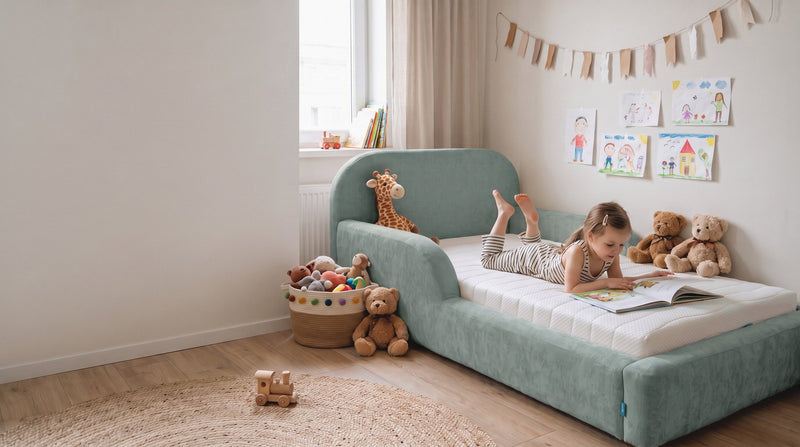
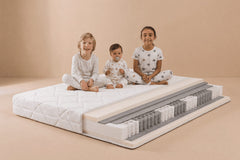

Starting school changes your child's day fundamentally: the alarm goes off earlier, the timetable is fixed, and in the afternoon there is homework, football practice or music lessons. At the same time, evenings often drift later – because something still needs doing, because an older sibling stays up longer or because the tablet is calling. This is exactly where sleep for school-age children comes under pressure, usually without anyone consciously deciding it. The effects rarely show straight away; they creep in: in the mornings, in concentration, in the mood late in the afternoon. This guide shows how much sleep 6- to 10-year-olds really need, how to work out the right bedtime backwards from the start of school, and how homework, hobbies and screens can fit into a school day without cutting the night short.
The short answer: Professional bodies such as the American Academy of Sleep Medicine (AASM) recommend 9 to 12 hours of sleep a night for children aged 6 to 12. For most 6- to 10-year-olds, that means around 10 to 11 hours in practice, with younger children needing a little more and older ones a little less. If school in Switzerland starts at 7.30 or 8.20am, a sensible time to fall asleep is therefore usually between 7.30 and 9pm. What matters is less a perfect time than a reliable rhythm – at weekends too.
- AASM recommendation for 6- to 12-year-olds: 9 to 12 hours of sleep a night.
- Work out bedtime backwards from the start of school – including the journey and time to fall asleep.
- Schedule practice, music lessons and homework so that the last hour before sleep stays calm.
- Switch off screens about an hour before bed and charge devices outside the bedroom.
- At weekends, shift wake-up time by no more than about an hour.
Sleep for school-age children: what the recommendations say
The most widely cited guidance comes from the American Academy of Sleep Medicine. In 2016 its expert panel reviewed the available studies and recommended 9 to 12 hours of sleep per 24 hours for children aged 6 to 12. The American Academy of Pediatrics adopted these figures, and paediatricians in Switzerland work with similar ranges.
It is important to read this range correctly. It describes how much sleep helps children, on average, get through the day healthy and alert – not a number every child has to hit exactly. A six-year-old in their first year of primary school often needs more like 10.5 to 11.5 hours, while a ten-year-old girl frequently manages well on 9.5 to 10 hours. On top of that come individual differences: some children are naturally short sleepers, others need the upper end of the range.
The most reliable measure is therefore your child. If they usually wake up on school days by themselves or without much effort and stay balanced until the evening, the amount is right. For an overview of every age group, see our age guide How much sleep does my child need?.
Working out bedtime backwards from the start of school
In many Swiss municipalities, lessons begin between 7.30 and 8.20am, and on some days later depending on the timetable. Because the morning sets the wake-up time, the only thing you can really adjust is the evening. Calculate it like this: start of school minus the journey minus time for breakfast and getting dressed gives you the wake-up time. From that, subtract the amount of sleep that suits your child, then another 15 to 20 minutes to fall asleep.
| School starts | Wake up (approx.) | Asleep by, for 11 h | Asleep by, for 10 h |
|---|---|---|---|
| 7.30am | 6.30am | 7.30pm | 8.30pm |
| 7.50am | 6.50am | 7.50pm | 8.50pm |
| 8.20am | 7.15am | 8.15pm | 9.15pm |
The "11 h" column tends to suit children in their first and second years of school, the "10 h" column nine- and ten-year-olds. If your child starts later on certain days, it is still worth keeping a similar wake-up time – a fixed morning stabilises the body clock more than any evening rule.
How to tell your child is not getting enough sleep
Tired school children rarely look tired in the classic sense. Instead of yawning, many become fidgety, irritable or unfocused. That makes lack of sleep easy to confuse with defiance, boredom or a hard day at school. Typical signs include:
- Your child is hard to wake on school days and needs several attempts.
- They fall asleep on short car journeys or on the sofa in the afternoon.
- Their mood regularly tips in the late afternoon, especially after their afternoon snack.
- Teachers report concentration problems, particularly in the first lessons of the day.
- At weekends they sleep two or more hours longer than during the week.
On their own, these signs say little. If several appear together over weeks, it is worth taking an honest look at your evenings. Studies show fairly consistently that shorter sleep in children goes hand in hand with poorer attention and more mood swings. Whether sleep is always the sole cause cannot, however, be concluded with certainty from these data – other factors often play a part. If your child takes a very long time to fall asleep in the evening, you will find possible reasons in Child won't fall asleep.

Homework, practice, music lessons: the packed evening
At school age, time is rarely swallowed up by one single thing, but by the sum of everything. A realistic Wednesday looks like this: school until lunchtime, lunch club or the walk home, homework, football at 5.30pm, home at 7.15pm, dinner at 7.30pm. Add a shower, packing the school bag and a bedtime story, and it is soon 9pm.
Three levers help without your child having to give up their hobbies:
Do homework early. Learning usually goes better straight after a short break in the afternoon than after dinner. Many children in their first four years of primary school only have manageable homework anyway – it does not belong in the last hour before sleep.
Bundle late appointments. Two late practice evenings a week are perfectly manageable for most children; four much less so. Where classes offer a choice of time, the earlier slot is worth it.
Lighten the evening after practice. Prepare dinner in advance, pack the school bag and gym bag in the afternoon, shower as soon as you get home. That leaves 30 to 45 calm minutes before the lights go out.
Screen time in the evening
Tablet, a parent's phone, games console or a favourite series – at school age, screens come into play almost inevitably. Research shows relatively consistently that evening screen use in children is linked to falling asleep later and sleeping less. How big a role light plays compared with content is still debated. Much suggests that stimulation matters most: an exciting game or an episode ending on a cliffhanger keeps the mind awake, and "just one more round" pushes bedtime back in very practical terms.
Tried-and-tested rules of thumb from family life:
- No screens for roughly an hour before bed.
- Devices sleep outside the bedroom, for instance at a charging station in the hallway.
- No television and no console in the bedroom.
- Exciting content in the afternoon, calm audiobooks in the evening.
It helps to make it a family rule: if the parents' phones also stay in the kitchen from 8pm, there is less negotiation. And children who often have bad dreams benefit particularly from low-stimulus evenings – more on this in Nightmares in children.
Weekends, holidays and the clocks changing
Many school children catch up on Saturday on what they missed during the week – and sleep until nine or ten o'clock. In the short term that is understandable, but it is unhelpful for their rhythm: the body clock shifts later, Sunday evening becomes a struggle to fall asleep and Monday starts with a little jet lag. Experts call this "social jet lag".
A workable rule: at weekends, get up no more than about an hour later than on school days. If your child really needs to catch up on sleep, an earlier bedtime on Friday is usually better than a lie-in until midday.
During the summer holidays, the rhythm can relax. About a week before school starts again, though, it is worth readjusting bedtime and wake-up time in steps of 15 minutes a day. The same principle helps when the clocks change at the end of March and the end of October: shift bedtime gradually over the three or four days beforehand rather than absorbing the whole hour at once. In spring especially, when it suddenly stays light late into the evening again, blackout curtains help.

The school-night evening plan, step by step
A fixed routine takes the pressure off everyone because it replaces discussions. The example assumes falling asleep at 8.15pm – adjust it to match the table above:
6.30pm – Dinner. Not too late and not too heavy. After that only water, no caffeinated drinks such as iced tea or cola.
7pm – Screens off. Devices go to the charging station; from now on, quiet activities: Lego, drawing, a board game.
7.30pm – Getting ready. Shower or wash, brush teeth, lay out clothes for tomorrow, check the school bag.
7.45pm – Bedtime. Reading aloud or reading alone, a short chat about the day. Many school children only tell you now what is on their mind.
8.15pm – Lights out. The room is dark, quiet and on the cool side, around 16 to 18 °C.
It also helps to separate work and sleep areas: the desk stands by the window, the bed in a quieter corner, and in the evening there are no open exercise books lying on it. How colours and light contribute to calm is covered in Kids' room colours and sleep.
Common mistakes – and when to seek medical advice
Never adjusting bedtime. What suited a six-year-old may be too early at nine. Check once every school year whether your child lies awake for a long time in the evening.
Mistaking tiredness for energy. Overtired children often get wound up in the evening. That is not a sign that they are not tired yet.
Using the alarm as the only signal. Children who only get out of bed with an alarm and a lot of effort are often not sleeping enough.
Using the bed as a punishment or a homework spot. The bed should be associated with calm, not with trouble or schoolwork. Homework belongs at the desk.
Talk to your paediatrician if your child is persistently tired during the day despite enough time in bed, regularly snores loudly or has pauses in breathing, has great difficulty falling asleep for weeks or often lies awake for long periods at night, or if their sleep and mood suddenly change noticeably. Sleeping pills or melatonin are not something parents should give on their own initiative – these questions are for a doctor.

Get CHF 25 off
Subscribe to our newsletter and get a one-time CHF 25 discount. ✓ 100-night trial ✓ 5-year warranty ✓ Free delivery
Frequently asked questions about sleep for school-age children
How many hours of sleep does a child aged 6 to 10 need?
The American Academy of Sleep Medicine recommends 9 to 12 hours a night for 6- to 12-year-olds. For most children in their first four years of primary school, around 10 to 11 hours is a good guide; younger children tend to need more than older ones.
What time should a school child go to bed?
Work backwards from the start of school: wake-up time minus 10 to 11 hours of sleep minus around 15 to 20 minutes to fall asleep. With school starting between 7.30 and 8.20am, the time to fall asleep is usually between 7.30 and 9pm.
Can my child have a lie-in at the weekend?
A little longer, yes, but ideally no more than about an hour beyond the usual wake-up time. Otherwise the body clock shifts, Sunday evening becomes difficult and Monday starts with tiredness.
How long before bed should screens be switched off?
As a rule of thumb, about an hour. Besides the light, the content matters most: exciting games and series keep children awake. Devices are best charged outside the bedroom.
How can I tell if my school child is not sleeping enough?
Common signs are great difficulty waking up, falling asleep in the car or on the sofa, an irritable mood in the late afternoon, concentration problems and sleeping much longer at weekends. A single sign says little; several together over weeks are a signal.
When should we seek medical advice?
If your child is persistently tired despite enough time in bed, regularly snores loudly or has pauses in breathing, has great difficulty falling asleep for weeks, or if their sleep and mood suddenly change significantly. Sleeping pills or melatonin should never be given without medical advice.
This article is for general information only and does not replace advice from a paediatrician. If problems persist, please consult your child's paediatrician.


