


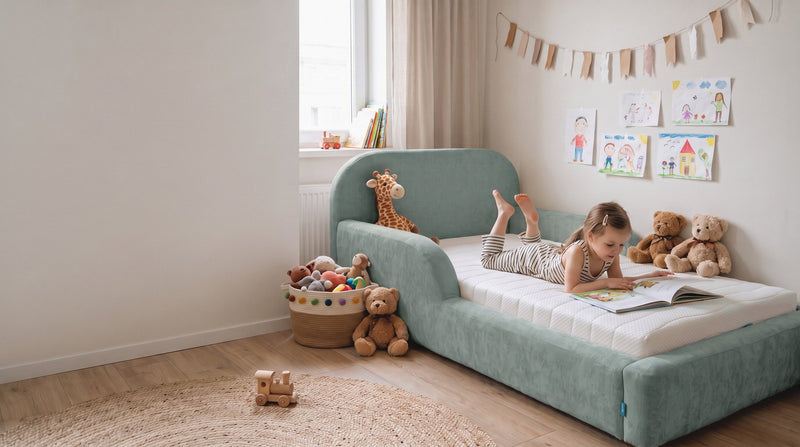

In the bed shop, your child lies down on a mattress, bounces twice and says “that’s fine”. The label says H2; at the next retailer, the same firmness is suddenly called “medium” or “H3”. This is where many parents start to feel unsure: which kids’ mattress firmness is right when a child weighs just 15 or 25 kilograms and their spine is still growing? Too soft and the hips sag; too firm and the shoulders and hips are pressed, especially in children who like to sleep on their side. On top of that, a children’s mattress is often used for six to eight years, from the first big bed well into primary school. In this guide you’ll find out what firmness ratings really mean, how firmly a child should lie and how to check the firmness yourself at home in five minutes.
The short answer: Children should generally sleep on a firm to medium-firm mattress – one that the body sinks into by only a few centimetres and on which the spine stays straight when lying on the side. The ratings H1 to H5 are not standardised: each manufacturer decides for itself what H2 or H3 means, and most charts are designed for adults. So rely less on the label and more on a simple lying test with your child. More important than any single firmness rating are point elasticity, a level surface and a core that doesn’t sag even after years of use.
- H1 to H5 is not a standard but a manufacturer’s rating – an H2 from brand A can feel like an H3 from brand B.
- Children are light: a 20 kg load compresses a mattress far less than an adult does, which is why the same mattress feels firmer to a child.
- The goal is a straight spine when lying on the side and a sinking depth of just a few centimetres – not “as hard as possible”.
- For babies the general rule is: firm and flat. Soft layers, toppers or pillows don’t belong in a baby’s cot.
- The hand test and the side-lying test tell you more about the right firmness than any label.
Kids’ mattress firmness: why H1 to H5 isn’t a standard
The ratings H1 to H5 look like an official scale, but in reality they are not a binding standard. There is no universally applicable test procedure that determines from which measured value a mattress may be called “H2” or “H3”. Each manufacturer defines its own firmness ratings, often using an internal chart with body weight ranges. Typical recommendations are “H2 up to about 60 kg” or “H3 up to about 80 kg” – but these charts are almost always intended for adults.
For you as parents, this has two consequences. First, you can’t directly compare the firmness ratings of different brands: an H2 from a furniture store can feel firmer than an H3 bought online. Second, the weight logic hardly applies to children: a three-year-old usually weighs between 12 and 17 kg, a six-year-old between 18 and 24 kg. These weights are far below what the scales were designed for.
Some suppliers therefore don’t use H ratings for children’s mattresses at all, describing the firmness with words such as “firm”, “medium-firm” or “balanced”. What matters is how the mattress behaves under your child’s weight – and that’s fairly easy to check at home.
Why children lie differently from adults
Children aren’t simply small adults, not even in bed. Their head is larger in relation to their body, their shoulders are narrower and their pelvis is less pronounced. As a result, their weight is spread more evenly across the sleeping surface, with fewer “pressure points” than in adults. So a mattress needs to give less to be comfortable for a child.
At the same time, the spine is still developing. The typical double S-curve forms over the first years of life as children learn to sit, stand and walk. A surface that is too soft, in which the pelvis sinks deeply, puts the back into a hammock position. Whether this causes harm in the long term is not clearly proven – but a surface that supports the body evenly is considered sensible.
Then there is sleep behaviour: toddlers often turn over many times a night, lie sideways, on their tummy, on their side and end up at the foot of the bed by morning. A mattress with good resilience makes these movements easier, whereas very soft or slow-responding materials can make turning over harder. If your child wakes up often during the night, it’s worth looking at the many possible causes – our article Child wakes up at night gives a good overview.
How firm by age and weight?
As there is no standardised scale, the following table can only be a guide; the weights are rough averages. It describes how a mattress should feel and behave under the child – not which label it has to carry.
| Age (approx.) | Weight (approx.) | Recommended support | What to look for |
|---|---|---|---|
| 0–12 months | 3–10 kg | firm and flat | cot with a suitable baby mattress, no toppers or pillows |
| 1–3 years | 10–16 kg | firm, minimal sinking | snug fit in the frame, no gaps at the edges |
| 3–6 years | 14–24 kg | firm to medium-firm | good resilience, straight spine when lying on the side |
| 6–10 years | 20–35 kg | medium-firm | point elasticity for shoulders and hips, zones can be useful |
| 10 years and up | from approx. 30 kg | medium-firm, depending on weight and sleeping position | manufacturers’ adult charts gradually become relevant |
An everyday example: four-year-old Lina from Zurich weighs 17 kg and almost always sleeps on her side. The ideal mattress for her is one her shoulder sinks into slightly while her waist and hips stay supported. Her ten-year-old brother, who weighs 34 kg, compresses the same mattress considerably more.

Point-elastic rather than simply hard: what matters besides firmness
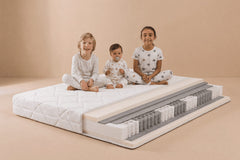
The firmness rating only describes how much a mattress gives overall. Just as important is how it gives. A point-elastic mattress gives where pressure occurs – at the shoulder, for example – and stays stable next to it. An area-elastic mattress, by contrast, sinks in over a large area, rather like a trampoline.
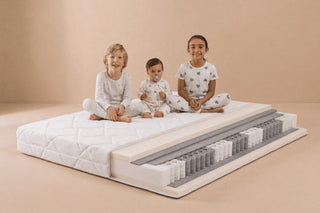
Pocket springs: each spring sits in its own fabric pocket and works largely independently. This gives good point elasticity and very good air circulation, which is pleasant for children who sweat at night.
Cold foam: open-cell foam is light and point-elastic. Quality depends heavily on density; very light foams can develop a dip over time.
Latex: very elastic and durable, but heavy.
Memory foam: reacts to warmth and moulds itself slowly. It tends to be used cautiously for toddlers who move a lot, as it can slow down turning over.
Comfort zones (for example 5 or 7 zones) are meant to let the shoulders and pelvis sink in a little more. In small children the effect is smaller, because shoulders and hips are still close together. As your child grows, zoning becomes increasingly relevant. You’ll find more buying criteria in our guide Buying a kids’ bed: what to look for.
How to test the firmness at home: step by step
The good news: you don’t need any measuring equipment to judge whether the mattress suits your child. Here’s how:
- Side-lying test: your child lies relaxed on their side, knees slightly bent. Look at their back: the spine should form roughly a straight line. If the waist sags, the mattress is probably too soft; if the shoulder sits very high and the upper body tilts, probably too firm.
- Hand test on the back: slide a flat hand under the lower back. It should fit with slight resistance. If it slips through effortlessly, support is lacking; if it barely fits, the pelvis is sinking too deep.
- Check the sinking depth: lay a ruler across the mattress next to the hip. In children up to about six, the body usually sinks in by only 1–3 cm.
- Edge test: your child sits on the edge – it shouldn’t buckle much.
- Observe rather than ask: during the first two to three weeks, notice whether your child complains about their neck or back in the morning or moves around unusually restlessly.
Important: new mattresses often need a few nights to settle. So don’t judge the firmness after the first night, but after about three to four weeks.

Common mistakes and myths fact-checked
Myth: “The harder, the healthier.” A board-hard surface used to be considered ideal. Today, a firm but point-elastic surface is generally recommended. An extremely hard mattress doesn’t support the waist of side sleepers and presses on shoulders and hips.
Myth: “Children need the same as adults, just smaller.” Because of their low weight, an adult mattress often feels firmer than expected to a child. An adult mattress in 90×200 can still be a good fit if the lying test works out – more on this in the article Kids’ bed 90×200: the standard size.
Mistake: adding a topper to improve things. A thick, soft topper often changes the firmness more than expected. It isn’t necessary for young children, and soft layers should be left out entirely for babies.
Mistake: taking on a used mattress without checking it. A mattress already used by an older sibling or an adult may have a dip you only notice when you run your hand over it.
Mistake: forgetting the slatted base. A sagging base or slats spaced too far apart make even a good mattress feel softer. As a rule, the gap between slats shouldn’t exceed about 4–6 cm, but the mattress manufacturer’s instructions are what count.
Get CHF 25 off
Subscribe to our newsletter and get a one-off CHF 25 discount. ✓ 100-night trial ✓ 5-year guarantee ✓ Free delivery
Cuddles, siblings, transitions: everyday family use
In real family life, a mattress rarely carries just one child: on Sunday mornings a parent joins in for a cuddle, and during a thunderstorm a younger sibling might too. That’s why load capacity matters as much as firmness: a children’s mattress rated for only 40 kg can give way sooner under regular extra weight.
Another point is the move from cot to big bed, usually somewhere between two and four years of age. Until then, many children are used to a rather firm, thin baby mattress. A much softer mattress in the new bed can feel unfamiliar. A similarly firm sleeping surface helps the new bed feel familiar. You’ll find tips for this step in the article From cot to toddler bed.
Reversible mattresses are practical: if the mattress is flipped and rotated every three months, the load is spread more evenly and dips develop more slowly. Room temperature plays a part too: at 16–20 °C most children sleep comfortably, and temperature-sensitive foams change their firmness less than in a very warm attic room.
When the firmness no longer fits
A children’s mattress often accompanies your child for many years. During this time, body weight not infrequently triples, and the material ages. The following signs suggest the firmness is no longer right:
- A visible or noticeable dip of more than about 1–2 cm, even after flipping.
- Your child always rolls into the same hollow at night or lies sideways across the bed strikingly often.
- Complaints of back or neck pain in the morning that disappear during the day.
- The edges are so soft that your child slides off when sitting down.
As a rough rule of thumb, good-quality mattresses last six to ten years for children, depending on material, care and use. However, persistent pain isn’t always down to the mattress – in such cases, talk to your paediatrician. If a bigger bed is on the cards anyway as your child grows, take a look at the pros and cons in the article Kids’ bed 120×200: the benefits.

Frequently asked questions about kids’ mattress firmness
Which firmness is right for a kids’ mattress?
There is no universal firmness rating, because H1 to H5 are not standardised. Children usually sleep well on a firm to medium-firm mattress that they sink into by only a few centimetres and on which the spine stays straight when lying on the side.
Are firmness ratings H2 and H3 the same for all manufacturers?
No. Each manufacturer defines its own firmness ratings, usually with weight charts for adults. An H2 from one brand can feel like an H3 from another, which is why a lying test tells you more than the label.
Is a hard mattress healthier for children?
Not automatically. A firm and level surface makes sense, but an extremely hard mattress can put strain on the shoulders and hips of side sleepers. Ideal is a firm, point-elastic mattress with good resilience.
How can I tell if the mattress is too soft?
Let your child lie on their side and check whether the spine forms a straight line. If the waist sags, or a flat hand slides effortlessly under the lower back when lying on the back, the mattress is probably too soft.
Can my child sleep on an adult mattress?
Yes, if the sleeping properties are right. Because of their low body weight, an adult mattress often feels firmer to children. Use the side-lying test to check that your child is well supported, and avoid soft toppers for young children.
How often should you check the firmness of a kids’ mattress?
A quick check about once a year makes sense, especially after growth spurts or when a sibling takes over the mattress. Look out for dips, soft edges and whether your child complains of back or neck pain in the morning.
This article is for general information only and does not replace advice from a paediatrician. If problems persist, please consult your paediatrician.


