







The evening goes well, the ritual is in place, the child is tired – and then it stands at the edge of the bed and says: «I want to sleep with you.» Every evening, all over again. For many families in Switzerland this is the most gruelling phase of the whole toddler period, because it lasts so long and because it happens precisely when everyone is at the end of their strength. On top of that comes the quiet worry of having done something wrong. The good news first: when a child won't sleep in their own bed, it is in the vast majority of cases a developmental matter and not a parenting mistake. And there is a way through – just rarely a fast one.
The short answer: children usually reject their own bed not because of the bed but because being alone at night overwhelms them. Attachment needs, separation anxiety and an immature sense of time make the night a long stretch for two- to five-year-olds. What helps is not more firmness but more predictability: an identical sequence every evening, noticeable closeness at the start of the night, and a withdrawal in small, announced steps over two to four weeks. Abrupt changes and night-time negotiations almost always extend the phase.
- Rejecting their own bed usually expresses separation anxiety – a normal developmental step, not a regression.
- Between 2 and 5 years this phase is most common; it often returns during developmental leaps and changes.
- Predictability works better than strictness: same sequence, same words, same order.
- Withdrawing in small steps over 2–4 weeks reaches the goal more reliably than a single break.
- Check the basics too: room temperature, darkness, fall protection and accumulated tiredness.
Why children reject their own bed
From a three-year-old's point of view, night is not a period of time but a state with no recognisable end. At this age children have no reliable sense of time: «in a minute» and «tomorrow morning» both mean roughly «sometime». When you leave the room, it is not clear to the child that you will be back in eight hours – it only knows that you are gone now.
Then there is separation anxiety, which reaches a second peak between roughly two and four years after already appearing in babyhood. It is developmental and not a sign of poor independence – on the contrary: it presupposes that the child has understood that people continue to exist even when they cannot be seen. It is precisely this understanding that makes being alone conscious.
The third factor is processing the day. Young children encounter an enormous amount that is new every day, and part of that is worked through in the evening and at night. Closeness reduces the tension this creates. If your child is in an intense phase – settling into nursery, a new sibling, a move, a language leap – the need for closeness rises measurably. That is temporary. If falling asleep is generally difficult, it is also worth reading child won't fall asleep.

The most common triggers by age
Depending on age, different reasons dominate – and different answers help:
| Age | Most common reason | What usually helps |
|---|---|---|
| 18–24 months | Move from the cot, unfamiliar openness | Create a nest-like feel, familiar bedding, fall protection |
| 2–3 years | Separation anxiety, autonomy phase, no sense of time | Consistent ritual, clearly announced withdrawal, night light |
| 3–4 years | Imagination and fears, processing the nursery day | Take fears seriously and name them, brief reassurance |
| 4–5 years | Habit, need for attention in the evening, sibling dynamics | Reliable one-to-one time during the day, clear evening structure |
| 5–7 years | Worries, starting school, changed rhythm | Talk during the day, not in bed; review the bedtime |
Important: a relapse after weeks of good nights is normal and almost always tied to an event – illness, holidays, a new day at daycare. Treat it as an episode, not a fresh start. Usually it is enough to go back one step for one or two weeks and then continue on the familiar path.
Four strategies for the evening
1. Always the same sequence, always the same order. Children orient themselves by sequences, not by clock times. Three to five fixed steps – teeth, pyjamas, two books, a song, lights – give the night a beginning. Do not change the order, not even at the weekend. Ideas in bedtime rituals for toddlers.
2. Offer closeness rather than negotiating it. Give the closeness deliberately before the protest, not in response to it. Ten minutes of undivided attention in bed – no phone, no doorway conversation – works better than thirty minutes of discussion afterwards.
3. Make the night predictable. Say concretely what will happen: «I am going to the kitchen now, I will check on you twice, and when it is light I will come and get you.» Stick to it, even when the child is already asleep. Children remember whether announcements hold true.
4. Increase the distance slowly. If you have been staying in the room, sit by the bed for a few evenings, then in the middle of the room, then at the door, then outside it. Three to five evenings per position. It takes two to four weeks and is still the fastest route, because it produces hardly any setbacks. More detail in bedtime routine from age 2.
Five strategies for the night
5. Short, calm, identical. If your child comes at night, take it back – few words, friendly, no light, no explanation. One sentence will do: «It is night time, I am here.» The less conversation there is, the less interesting getting up becomes.
6. Establish a transitional object. A soft toy, a cloth, one of your t-shirts – something that smells of home and always stays in the bed. Introduce it during the day, not in the middle of the night.
7. A mattress beside the parents' bed rather than the parents' bed. If the way to their own room is still too far, a fixed interim solution is better than a new one every night. It should, however, have a stated interim goal and not become permanent.
8. A light you will not regret. A very dim, warm night light close to the floor takes the fear away for many children without disturbing sleep. Brighter is not better – the light should show the outlines of the room, nothing more.
9. Praise in the morning, do not negotiate in the evening. Name concretely the next morning what worked: «You woke up in your own bed.» Reward systems are usually unnecessary; morning attention works better than a sticker.

A realistic 3-week plan
Week 1 – lay the groundwork. Fix the ritual, stabilise the bedtime, check the environment. Do not change the level of closeness yet. Goal: the evening runs the same way every day.
Week 2 – first distance. You stay in the room but no longer in the bed. Sit on the edge, a hand on the back is allowed. After three evenings, move a little further away. At night: consistently take the child back, same words.
Week 3 – door and reassurance. You sit at the door and leave earlier, but return reliably twice. The announced return is the decisive building block: it replaces presence with reliability.
Expect an intermediate step to need two attempts. That is not failure, it is the normal case. More important than pace is not jumping between methods: three weeks on one path beat three days on three paths by a wide margin.
Common mistakes that extend the phase
Introducing new rules at night. At three in the morning nobody is in a state to learn – neither child nor parents. All changes are discussed during the day and begin in the evening.
Sometimes this way, sometimes that. If the child is allowed into the parents' bed on two nights out of seven, it does not learn «no» but «it pays to ask long enough». Decide deliberately on one line – with or without a family bed – and hold it for a while.
Going to bed too late. Overtired children fall asleep worse, not better. If falling asleep regularly takes more than 30 to 40 minutes, the bedtime is often too late or the nap too long. See dropping the afternoon nap.
Arguing fears away. «There's nothing there» does not help, because the child experiences the opposite. Better: acknowledge the feeling, look at the room together, then return to the routine.
Turning the topic into a running conversation. If sleep is discussed constantly during the day, it grows larger than it is. Talk it through clearly once, then act.
When the bed is part of the problem
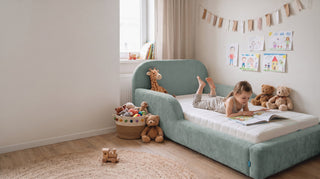
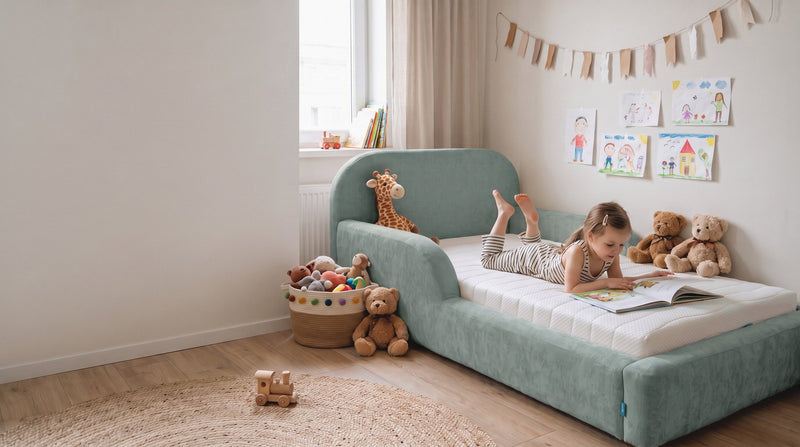
For some children something really does come down to the sleeping place – usually one of three things. First, openness: children coming from a cot often experience a large, open bed as unprotected. A soft, enclosing boundary that makes closeness tangible without shutting them in removes that factor; more in fall protection without bars.
Second, height. A high bed turns getting out at night into a small risk and getting back in into an obstacle the child needs help with – and that is exactly when it calls. A low bed the child can leave and re-enter independently noticeably reduces night-time calling for some children.
Third, hard edges. A child that bumps into a wooden edge at night wakes up – and associates the bed with discomfort. Beds padded all round remove that cause. It does not replace a strategy, but it takes away obstacles that would otherwise work against you every evening.
When to seek paediatric advice
In most families this is a phase that passes with patience and a clear approach. Speak to your paediatrician if the refusal of the child's own bed comes with strong anxiety that persists during the day; if your child sleeps markedly too little over months and seems exhausted or very irritable during the day; if night-time waking involves pauses in breathing, marked snoring or pain; or if you as parents reach a point where you no longer get enough sleep yourselves. That is not a failure but a sensible moment to seek support – in Switzerland also via parent and child counselling services.

Get CHF 25 off
Subscribe to the newsletter and get a one-time CHF 25 discount. ✓ 100 nights trial ✓ 5-year guarantee ✓ Free delivery
Frequently asked questions when a child won't sleep in their own bed
At what age should a child sleep in their own bed?
There is no binding age limit. Many children manage the step between three and five years, others earlier or considerably later – both are within the normal range. What matters less than age is whether the current arrangement is sustainable for everyone over a period of weeks.
Is it harmful if my child sleeps in the parents' bed?
For toddlers and older children, sharing the parents' bed is primarily a family decision. What matters is that everyone gets enough sleep and that the arrangement is consciously chosen rather than renegotiated every night. For babies in the first year, separate recommendations apply: their own bed in the parents' bedroom, sleeping on the back, no loose blankets or pillows.
How long does it take before a child sleeps in their own bed?
With a consistent approach, most families see a noticeable change after two to four weeks. Setbacks after illness, holidays or other changes are normal; it is usually enough to go back one step for one or two weeks.
Does a night light help or disturb sleep?
A very dim, warm light close to the floor helps many children because it makes the outlines of the room visible. Light that is too bright can make falling asleep harder. As a rule of thumb: the light should show just enough for the room to be recognisable, no more.
What should I do if my child comes into the parents' bed at night?
Take them back calmly, kindly and with as few words as possible, without bright light and without conversation. A short, always identical sentence is enough. The less attention getting up at night brings, the faster it loses its appeal – provided you stay consistent over several weeks.
When should I seek medical advice?
If strong fears persist during the day, if your child sleeps markedly too little over months and seems exhausted, if night waking involves pauses in breathing, loud snoring or pain, or if you as parents are permanently at your limit.
This article provides general information and is not a substitute for paediatric advice. If problems persist, please speak to your paediatrician.


