




Few interior ideas divide opinion like the floor bed. Some parents report that their child never fell asleep more peacefully; others describe a toddler still cheerfully wandering the room at half past ten at night. Both happen, and both have little to do with the quality of the idea – but a great deal to do with age, room and expectations.
At heart a floor bed is a simple thing: a mattress on or just above the floor, without bars, without high edges, that your child can get up from independently. What turns it into an educational concept is the thinking behind it – the idea that a child should decide as much about their sleep and their space as they can safely carry.
This article takes an honest look at both sides. We look at where the idea comes from, which benefits actually show up in practice, which limits are rarely named openly and from what age a floor bed makes sense.
One important point first: for the first year of life, the official safe infant sleep recommendations apply regardless of any educational concept. We cover this in detail below, because it is the point at which the discussion most often goes astray.
The short answer: A Montessori floor bed is a sleeping place close to the floor, without bars, that your child can get up from independently. Its strengths are genuine independence, a practically non-existent risk of falling out and a calmer approach to bedtime, because nobody is lifted or shut in. Its limits are practical: the whole room becomes the sleeping environment and has to be child-proofed accordingly, ventilation under the mattress needs a frame with an air gap, and wandering at night is part of the first few weeks. A floor bed usually makes sense from around 18 months; in the first year the official safe infant sleep recommendations apply.
- A floor bed does not replace a cot in the first year – there the rules are: on the back, own bed in the parents' room, no loose blankets or pillows.
- With a floor bed the whole children's room becomes the sleeping environment: furniture anchored, sockets secured, no reachable cables.
- Never lay the mattress straight on the floor – a low frame with an air gap prevents mildew spots underneath.
- Expect two to four weeks in which your child gets up in the evening. That is normal and settles with a clear routine.
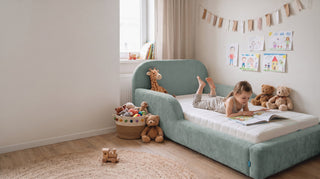
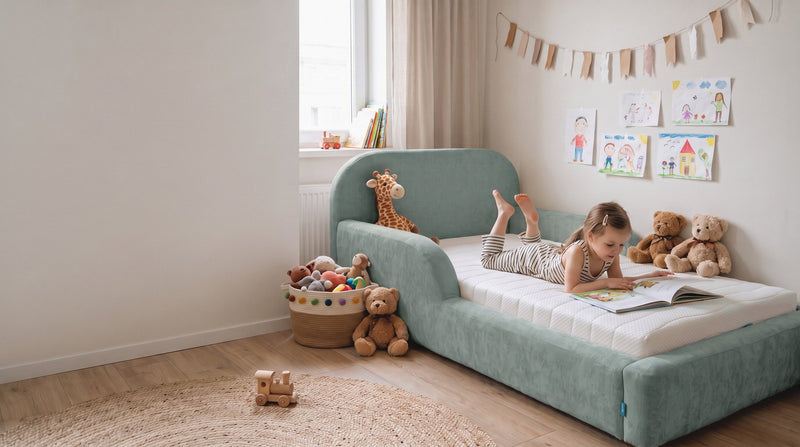
- If you want the independence but miss having a boundary, a low bed with a soft edge is the middle way.
Where the idea comes from
Maria Montessori did not design a bed. What she described is a principle: the prepared environment. A room should be arranged so that a child can act in it independently – reach things, make choices, move about without an adult constantly stepping in. The low bed is that principle applied to the sleeping place.
The practical difference from a cot is smaller than it sounds, and still fundamental. In a cot a child is dependent: they get in because they are lifted in, and they get out when someone comes for them. In a floor bed they decide themselves when to get up. That noticeably changes the dynamic in the evening – in both directions.
The idea has spread strongly over the past ten to fifteen years, often alongside the house bed, which is a related design. Both serve the same wish: a bed that belongs to the child, rather than a piece of furniture they are placed into. We set these forms side by side in our article on house beds for children.
The benefits that show up in practice
No risk of falling out. The most tangible benefit. When the sleeping surface sits 5 to 15 cm above the floor, rolling out is rolling onto the rug, not a fall. For children who move a lot in their sleep, that removes a real stress factor.
Evenings get calmer. Many families describe the power struggle disappearing from bedtime, because nobody is lifted anywhere against their will. The child goes to bed themselves – sometimes later than you would like, but without resistance.
No difficult move later on. The transition from cot to first big bed is a small crisis for many families. Sleeping close to the floor from the start skips it. What that transition otherwise looks like is described in our article from cot to toddler bed.
Self-efficacy in daily life. Getting up in the morning, going to the shelf, fetching a book and returning to bed – that is not educational luxury but a genuine experience of competence for many children. And it buys parents twenty extra minutes on some weekends.
The honest limits
The whole room becomes the bed. This is the point most often underestimated. A child who can get up at night will get up at night – and then every gap in the room's safety applies around the clock. Anti-tip fixings on furniture, socket covers, no reachable cables, no access to windows, no small parts. Without that preparation a floor bed is not a good idea.
Moisture from below. A mattress straight on parquet or laminate cannot dry out. Children release roughly 0.2 to 0.4 litres of moisture a night, some of which travels downwards. Without an air gap, mildew spots form within a few months. A low frame or slatted base solves this – a mattress on the bare floor does not.
Draughts and dust. Near the floor it is one to two degrees cooler, and dust settles where air moves slowly. In older flats with a gap under the door this is noticeable.
Parents' backs. Making the bed, comforting, looking after a sick child – all of it happens at floor level. After a few nights with a fever you notice.
Wandering at night. In the first two to four weeks almost every child gets up several times in the evening. It passes, but it is part of the start.

From what age – and what applies in the first year
In practice a floor bed works well from around 18 months, once a child walks securely, lies down and gets up independently and the room is fully child-proofed. Some families start earlier, as soon as the child crawls confidently; the demands on room safety then rise considerably.
For the first year of life the official safe infant sleep recommendation applies regardless, and it is clear: babies sleep on their back, in their own bed in the parents' bedroom, on a firm flat mattress, without loose blankets, pillows, cot bumpers or soft toys in the bed, at a room temperature of around 18 °C. A sleeping bag replaces the blanket. These recommendations are not an alternative to Montessori – they simply describe the sleeping environment for which the evidence is strongest.
In practice this means: a floor bed is not a baby bed. It is an option for the toddler years, once the developmental steps it builds on have been taken. Whether your child is ready can be checked against the signs in our article is your child ready for a big bed. If you are unsure about your baby's sleep, your paediatrician is the right person to ask.
Preparing the room: the checklist
Before the first night, go through the room at child height – literally, on all fours.
1. Anchor all furniture to the wall. Chest of drawers, shelf, wardrobe. A child pulling themselves up on a drawer can topple a unit.
2. Secure the sockets and put all cables out of reach – including lamp and baby monitor cables.
3. Secure the windows. Lockable handles or restrictors, nothing to climb on beneath the window.
4. Think about doors. A finger guard prevents trapped fingers; decide whether the bedroom door stays open or gets a gate.
5. No cords. Tie up or remove blind and curtain cords.
6. Check the flooring. A rug beside the bed, no hard furniture edges within falling distance.
7. Air under the mattress. A low frame or slatted base rather than the bare floor.
8. Keep stimulation low. Toys in closed baskets, not on open display. A child who gets up at night goes to whatever they can see.
Get CHF 25 off
Subscribe to the newsletter and get a one-off CHF 25 discount. ✓ 100-night trial ✓ 5-year guarantee ✓ Free delivery

The first weeks: what is normal
For most families the change follows a similar pattern. In the first week a child gets up several times in the evening, tests whether the new freedom is real and watches the reaction. That is not a step backwards but the most obvious response to a changed rule.
What helps is consistency without harshness: guide your child back to bed with few words and kindly, the same way every time, without a new negotiation and without extra attention. After two to four weeks on average the frequency drops noticeably. A firm evening ritual is the strongest lever here – more on that under bedtime rituals for toddlers.
If things remain just as restless after four to six weeks, it is worth looking at other factors: is bedtime too early or too late? Is your child still napping, and does that still fit? Is the room too bright? Often the cause is not the bed. Our article when your child won't fall asleep works through these points.
Common mistakes
Laying the mattress straight on the floor. By far the most common mistake, and the only one that reliably destroys the material.
Child-proofing the room only halfway. A floor bed and an unsecured chest of drawers do not go together. Either all of it or none.
Starting too early. A child who cannot walk securely gets little benefit from the independence and a lot of risk from the open room.
Turning the adjustment phase into a matter of principle. Two weeks of getting up is not the concept failing.
Leaving toys on display. A floor bed only works in a room that looks calm in the evening.
Choosing too soft a mattress. On the floor too the rule holds for children: rather firm, so the pelvis does not sag. Details in our article on children's mattress firmness.
The alternatives compared
In the end it comes down to a single trade-off: how much independence do you want to enable, and how much boundary does your child still need? The overview below sets the three common answers side by side.
| Criterion | Floor bed | Cot with bars | Upholstered children's bed |
|---|---|---|---|
| Getting in and out independently | Yes, without restriction | No, the child is lifted | Yes, low entry height |
| Boundary around the sleeping surface | None | Complete, hard bars | Soft, at mattress height |
| Demands on child-proofing the room | Very high, the whole room becomes the bed | Low | Medium |
| Risk of falling out | Practically none (almost no drop) | Only relevant when climbing out | Low, the edge holds them back |
| Ventilation from below | Limited, a frame with an air gap is needed | Good | Good |
| Changing the bedding | Awkward, work at floor level | Comfortable, good height | Comfortable |
| Reading together | Cramped and uncomfortable on the floor | Not possible at all | Works well |
| Typical starting age | approx. 18 months (framed version) | From birth to approx. 2–3 years | approx. 18–24 months |
The middle way often gets overlooked: a low bed with a soft boundary running all round at mattress height. Your child gets in and out independently but still has a boundary they can feel and a nest-like sense of enclosure – without hard bars and without the whole room becoming a sleeping surface. More on this principle under fall protection without bars.

Frequently asked questions about Montessori floor beds
From what age does a floor bed make sense?
In practice it works well from around 18 months, once a child walks securely, lies down and gets up independently and the room is fully child-proofed. Some families start earlier, as soon as the child crawls confidently, but then have to child-proof the room considerably more strictly. For the first year of life the official safe infant sleep recommendations apply.
Can a baby sleep in a floor bed during the first year?
The official safe infant sleep recommendations specify, for the first year, the baby's own cot in the parents' bedroom, with a firm flat mattress, sleeping on the back, without loose blankets, pillows, cot bumpers or soft toys and at a room temperature of around 18 °C. A floor bed is not intended for this. Discuss any questions about your baby's sleeping environment with your paediatrician.
Can I simply put the mattress on the floor?
Better not. Without an air gap, the moisture your child releases at night cannot dry away from the underside, and within a few months mildew spots and odours form. Use a low frame or a slatted base with a few centimetres of clearance. That preserves the mattress and costs hardly any additional height.
What should I do if my child keeps getting up in the evening?
Expect it in the first two to four weeks – it is the obvious response to a new freedom. What helps is an always identical, low-word routine: guide your child back to bed kindly, without a new negotiation and without extra attention. A firm evening ritual and a low-stimulation room are the most effective levers here.
What are the real drawbacks of a floor bed?
Three points stand out in daily life: the whole room becomes the sleeping environment and has to be child-proofed throughout. The mattress needs an air gap, otherwise moisture does not escape. And everything parents do at the bed – changing sheets, comforting, caring for a sick child – happens at floor level. Add to that some draught and dust near the floor.
Is there a middle way between a cot and a floor bed?
Yes. A low children's bed with a soft boundary running all round at mattress height combines both: your child gets in and out independently but still feels a boundary and has a nest-like sense of enclosure. The room does not have to become a sleeping environment in its entirety, and the mattress stays well ventilated.
This article is for general information only and does not replace paediatric advice. If problems persist, please speak to your paediatrician.


