



“Grows with your child” is one of the most reassuring phrases in children's furniture. It promises that a decision made today with a two-year-old will still be right in ten years. Anyone reading it hears: buy once, never think about it again.
In practice the record is more mixed. Some extendable beds deliver exactly what they promise. Others are a good idea that founders on an unavailable spare part – or on the fact that at ten a child wants a bed that no longer looks like a toddler's room.
On top of that comes a calculation error that is easy to make: an extendable bed costs more to buy, but only saves money if all the later purchases – extension kit, longer mattress, often a new slatted base too – together stay below the price of a bed that was simply big enough. That sum works out less often than you would think.
In this article we look at which concepts exist, where their strengths lie, what they founder on in daily life and when the investment genuinely pays off. And we talk about the solution that is rarely advertised, because there is nothing to sell you afterwards.
The short answer: An extendable children's bed pays off if you start very early, if the system offers long-term spare part supply and if you include the extra cost of the extension kit and a new mattress from the outset. If you start at two or three, the simpler and usually cheaper solution is a bed that is 90×200 cm from the beginning – it carries into the teens without any conversion at all. Convertible cots that become junior beds bring the smallest gain, because the sleeping surface becomes too short at around three to four years anyway.
- Always calculate the total: bed plus extension kit plus second mattress plus a possible new slatted base.
- A bed in 90×200 cm is the simplest form of growing with your child – it never needs converting.
- The biggest practical risk is spare parts: ask before buying how long extension kits are guaranteed to be available.
- Convertible cots usually extend usable life by only one to two years.
- The design has to grow too – a bed that looks childish at ten will be replaced, however long it is.
What “grows with your child” actually means
The term is not protected and means something different depending on the manufacturer. Four designs come up most often.
The extendable bed starts with a short sleeping surface, usually 140 or 160 cm, and can later be taken to 190 or 200 cm with an insert. That is the classic design and what most people mean.
The convertible cot starts as a barred cot at 70×140 cm. Later the bars are removed and it becomes an open junior bed. The sleeping surface stays the same – that is the decisive point.
The modular system is a construction kit: bed guards, drawers and add-ons can be added or swapped. It grows less in length than in features.
The height-adjustable frame, finally, changes only the sleeping height, not the length. For cots that makes sense; for children's beds the adjustment is usually used exactly once.
The fourth variant, rarely described this way, is a bed that has its final size from the start. It does not grow – it does not need to.
The calculation that rarely gets made
An extendable bed typically costs more to buy than a simple bed of the same quality. The premium is only justified if the sum of all later expenses stays below it. That sum includes at least three items.
First the extension kit. It consists of inserts for the side panels and usually additional slats. Expect a noticeable amount, not a trifle.
Second the new mattress. This is what gets forgotten most often. A 140 cm mattress does not fit a 200 cm bed. So you inevitably buy a second time – and the mattress is the larger of the two items.
Third, often a new slatted base. Some systems extend the base too, others do not.
Set the alternative against that: a bed in 90×200 cm plus a 90×200 cm mattress, bought today, with no follow-up purchase at all. In many cases that sum is simply lower – and it has zero dependence on future availability. We compared the sizes under 70×140 or 90×200.
The concepts at a glance
The overview below ranks the common variants by what matters in daily life: how long they last and what still falls due afterwards.
| Concept | How it grows with your child | Usable life | Follow-up purchases needed | Biggest risk |
|---|---|---|---|---|
| Extendable bed (e.g. 140 → 200 cm) | An extension kit is inserted | approx. 2 to 12 years | Extension kit, new mattress, often a new slatted base | Kit no longer available years later |
| Convertible cot (cot → junior bed) | The bars are removed, the frame stays | approx. 0 to 4 years | A new bed at about 3–4 years | The sleeping surface stays too short, real gain is small |
| Modular system with add-on parts | Parts are added or swapped | approx. 2 to 14 years | Individual parts depending on configuration | Dependence on a single manufacturer |
| Height-adjustable frame | The sleeping height is raised or lowered | approx. 1 to 6 years | Usually none | The adjustment is often used only once |
| Buy 90×200 cm straight away | Not at all – big enough from the start | approx. 2 to 16 years | None | Looks large in the first year |
| Buy 120×200 cm straight away | Not at all – extra room for parents too | approx. 2 to 16 years | None | Needs a correspondingly large room |
What stands out is that the bottom two rows need no follow-up purchases. That is no coincidence: a bed that already has its final size has skipped the conversion question. The only condition is that your child accepts it as their bed from the switch – and for that they need less length than a sense of security.

Where extendable beds genuinely convince
There are situations in which a conversion system clearly pays off. The most important: you start very early. Anyone starting with a newborn and buying a system that carries from bedside crib to teenage bed uses the same piece of furniture for over 14 years. That makes sense both ecologically and financially.
Small rooms. When 200 cm of length simply does not fit, an extendable bed is the only way to start small now without planning a later replacement for certain. Ideas for tight spaces are collected in our article on setting up a small children's room.
Systems with documented spare part supply. Manufacturers who supply spare and extension parts for ten years and more make the promise deliverable. Ask specifically – a statement like “while stocks last” is not a commitment.
Several children. If the bed is reconfigured after the first child and used again for a sibling, the benefit doubles and the sum works out considerably faster.
Where the idea fails in practice
The spare part is gone. The most common reason. Five to eight years pass between purchase and extension – in that time ranges are discontinued, manufacturers change suppliers or disappear from the market. An extension kit that no longer exists turns the extendable bed into an ordinary short bed.
The design does not grow. A bed may be as extendable as you like: if it comes with painted animals or in candy colours, a ten-year-old no longer wants it. Restrained colours and plain shapes last considerably longer than the material.
The conversion never happens. It requires a free afternoon, tools and a child who sleeps elsewhere meanwhile. Many families put it off until their child sticks out over the end of the bed.
The joints suffer. Every conversion means screwing and unscrewing. Wooden joints that have been undone three or four times no longer sit as firmly as the first time.
The join is noticeable. With some systems a gap appears in the slatted base or an edge in the frame where the extension sits. Rarely dramatic, but perceptible.
Get CHF 25 off
Subscribe to the newsletter and get a one-off CHF 25 discount. ✓ 100-night trial ✓ 5-year guarantee ✓ Free delivery

The quiet alternative: buy the final size straight away
The solution that is advertised least is the simplest: a bed in 90×200 cm from the move out of the cot. A 200 cm sleeping surface is as a rule enough into adulthood, and 90 cm width is the European standard with the widest mattress choice.
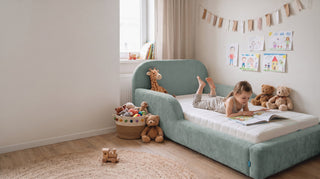
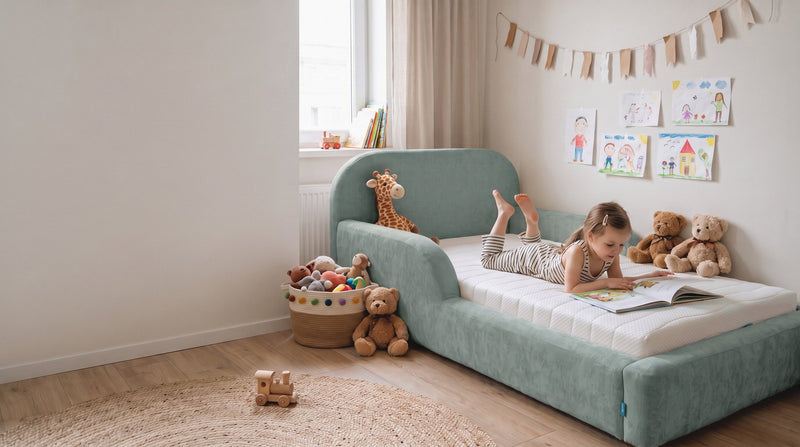
The most common objection: “That is far too big for a two-year-old.” Visually that is true at first glance. In practice it is no problem as long as the bed has a boundary a child can feel. Children orient themselves by the edge, not by the surface – a soft boundary running all round turns a large sleeping surface into a nest. Without that boundary a large bed does indeed feel exposed. More on this under children's bed 90×200.
The second advantage is unspectacular but real: you never have to think about it again. No kit, no second mattress, no question of availability in 2032. And if the room allows it, 120×200 cm additionally solves the problem that reading and comforting get cramped on 90 cm – details in our article on children's bed 120×200.
Common mistakes
Comparing only the purchase price. Always count bed plus kit plus second mattress against bed plus one mattress.
Forgetting the mattress. The most expensive forgotten item in this calculation.
Not asking about spare parts. One minute's effort at purchase, decisive in eight years.
Choosing a design tied to an age. The more neutral the shape, the longer the actual use.
Seeing a convertible cot as a long-term solution. It usually only extends things by one to two years.
Not checking the external dimensions. An extended bed suddenly needs 60 cm more floor space – measure whether it will still fit against the same wall in eight years.
What “growing with your child” means for the mattress
With mattresses, growing along works differently than with the frame: it is not the length that changes but what the child needs. A three-year-old at 15 kilograms and a ten-year-old at 35 kilograms load the same mattress in completely different ways.
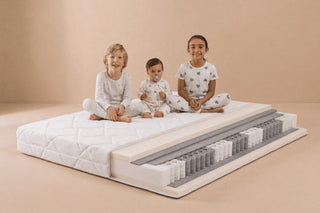
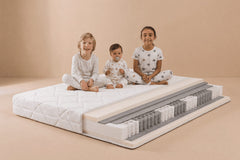
Two constructions cope well with this. Reversible mattresses with two differently firm sides can be turned over as a child grows: the softer side for the light toddler, the firmer one for the school-age child. Pocket spring cores respond to different weights by themselves, because more springs compress when more load rests on them.
In practice this means a good children's mattress in 90×200 cm can carry from two to ten years if it is regularly turned and rotated and the cover stays clean. When a replacement is genuinely due is covered in our article on when to replace a children's mattress. Here the durability of the core matters more than any conversion system.

Frequently asked questions about extendable children's beds
Does an extendable children's bed pay off financially?
Only if you start very early and count in all the follow-up costs. On top of the purchase price come at least the extension kit and a second, longer mattress, often a new slatted base too. If that sum exceeds the price of a bed that is 90×200 cm from the start, the conversion system does not pay off. From a starting age of two to three, the final size is usually cheaper.
What is the difference between extendable and convertible?
Extendable means the sleeping surface is lengthened with an insert, typically from 140 or 160 to 200 cm. Convertible usually refers to a cot whose bars are removed so that it becomes an open junior bed – the sleeping surface stays the same. The second conversion therefore adds considerably fewer years of use.
Isn't a 90×200 cm bed too big for a toddler?
Visually it looks large at first, but in practice it is no problem as long as the bed has a boundary a child can feel. Children orient themselves by the edge rather than the surface: a soft boundary running all round turns a large sleeping surface into a nest. Without any boundary, however, a large bed can indeed feel unsettling to a two-year-old.
What should I check before buying a conversion system?
Ask bindingly how long extension and spare parts will remain available. Five to eight years often pass between purchase and conversion, and a kit that is no longer available makes the promise worthless. Also look for a restrained design that still suits at ten, and check the external dimensions in the extended state.
Does a children's mattress grow along too?
Not in length, but in how it performs. Reversible mattresses with two differently firm sides can be turned over as the child gets heavier, and pocket spring cores respond to different weights by themselves. A good mattress in 90×200 cm can therefore carry from around two to ten years, provided it is regularly turned and rotated.
Can I use a converted cot until my child starts school?
As a rule, no. A cot's sleeping surface is usually 70×140 cm, and most children need more length at around three to four years, at the latest when they stretch out and touch the foot end. The conversion therefore usually extends use by only one to two years and does not replace the later purchase of a larger bed.


