






Every children's bed looks good in the shop. You press the mattress briefly, the child climbs in once, everyone nods – and at home, in week two, it turns out it doesn't fit. Too high, too firm, too noisy, too unfamiliar. A bed is one of the few pieces of furniture whose quality you simply cannot judge in five minutes, because the essential part happens during sleep and because children need time before they accept a new sleeping place. That is exactly what trial sleeping on a children's bed is for. Here is why a long trial period matters even more for children than for adults, what actually happens during the first nights, and how to use the time so that you end up with a real answer.
The short answer: yes, trial sleeping makes sense with a children's bed – and for considerably longer than most people assume. Children need on average two to four weeks before they accept a new sleeping place as theirs; during the first nights almost all children wake more, not less. A 14-day period therefore measures precisely the worst phase. Only after around four to six weeks does your child's sleep actually tell you something about the bed. Offers of 100 nights cover that curve completely.
- Children typically need 2 to 4 weeks to accept a new sleeping place – short return periods measure the adjustment, not the bed.
- During the first 3 to 7 nights more waking is normal and is not a sign of the wrong bed.
- Switzerland has no statutory right of withdrawal for online purchases, so trial sleeping is a voluntary service and a genuine quality signal.
- Use the trial actively: keep the routine, write down observations, and only judge after four weeks.
- Check three things in advance: who collects, who pays, and does the packaging have to be kept?
Why a children's bed only reveals itself at home
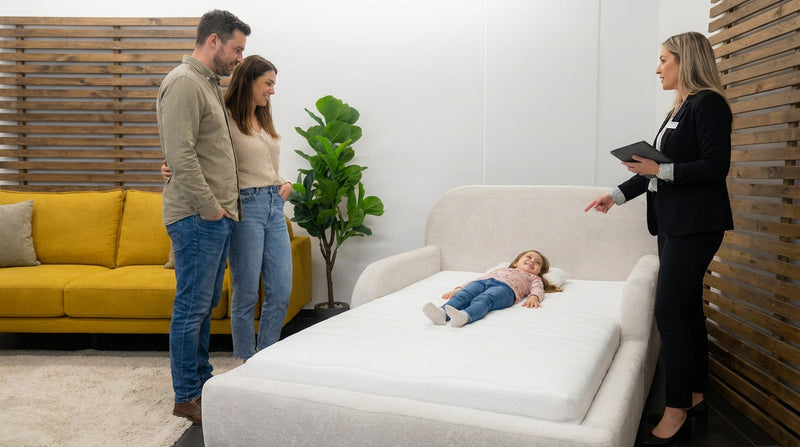
A bed is not a sofa. With a sofa, ten minutes of sitting tells you whether the seat depth works. With a bed, quality is decided over six to eleven hours a night, lying down, unconscious, across weeks. What you can test in a shop is the workmanship – whether the edges are padded, whether the bed wobbles, whether the cover feels pleasant. What you cannot test is the decisive part: whether your child sleeps through in it.
With children there is a second layer. Adults judge a bed by lying comfort. Children judge it by safety. A sleeping place has to feel sheltered, otherwise they cannot let go – and that feeling does not appear on the first evening but through repetition. A bed that feels alien on night one can be the favourite spot by night twenty. Conversely, some beds start well and only show after three weeks that the mattress is too firm or that the child wakes at the edge.
The third point is the surroundings. The same bed behaves differently in a period flat with parquet than in a new build with carpet: creaking, reverberation and room temperature change the picture. The only meaningful test environment is therefore your own child's room. If you are still wondering whether the change is due at all, is my child ready for a big bed? helps you judge.

What actually happens in the first nights
Almost all parents experience the same sequence, and almost all read it wrongly. The first night often goes surprisingly well: the new bed is exciting, the child is proud, curiosity carries it. On nights two to five it frequently tips – the child wakes more often, calls out, wants the old bed back or wants you. That is not a setback but the moment the excitement fades and the brain genuinely processes the place as «new».
The reason lies in how we sleep. Between sleep cycles every person wakes briefly, children several times a night. Normally they do not consciously notice these moments and go straight back to sleep. In an unfamiliar environment the brain checks the situation during those brief windows – and wakes the child properly if something does not match. That is exactly what produces more night-time calling in the first week. There is more on this mechanism in child wakes up at night.
From week two the picture usually calms noticeably, and by weeks three to four the new place is normality for most children. So if you have to decide after ten days, you are deciding at the low point of the curve.
How long does settling in take?
The course is individual, but the range is well described. This overview helps you judge what is normal at which stage.
| Period | What typically happens | What you can do |
|---|---|---|
| Nights 1–2 | Often good nights, carried by curiosity and pride | Leave the routine unchanged, do not make an event of it |
| Nights 3–7 | More waking, calling out, wanting the old bed | React calmly and briefly, always the same, no new rules |
| Week 2 | First nights slept through, still variable | Note observations, check room temperature and darkness |
| Weeks 3–4 | The place becomes habit, sleep stabilises | Judge for the first time now, not earlier |
| Weeks 5–8 | Everyday picture: the bed's true character shows | Compare position, waking times and rest across several nights |
Two factors regularly extend the adjustment: a parallel upheaval – starting nursery, a new sibling, a move – and accumulated tiredness. If your child is already short on sleep, it will be less flexible. In such phases it is wiser to postpone the change by a few weeks than to burn the trial period. Realistic sleep amounts by age are in how much sleep does my child need?
Trial sleeping and returns: the Swiss particularity
Many parents assume they can send an online order back within 14 days anyway. In Switzerland that is not the case: there is no general statutory right of withdrawal for distance purchases here. Whatever a supplier grants in terms of returns, it grants voluntarily.
That has a pleasant side effect: because nobody is obliged to, the length of the period tells you something. A manufacturer offering 100 nights carries the risk that some beds come back – and only calculates that way if the return rate is low. Conversely, a 14-day period on a piece of furniture whose suitability only shows after four weeks is not in practice a test.
When comparing, look at three points that separate a real offer from a decorative one. First: who organises the collection? A children's bed does not go through a parcel counter. Second: who pays? Return costs for bulky furniture can reach three figures. Third: do you have to keep the original packaging? If so, a large box will occupy the cellar for three months – manageable, but worth knowing in advance. More about ordering in buying a children's bed online.

The 4-week plan: using the trial properly
A trial period is only worth something if you run it as a test rather than letting it elapse. This plan works well.
Week 1 – change nothing. Same bedtime, same ritual, same bedding as before, if possible even the familiar pillow or soft toy. The fewer things that are new at once, the cleaner the test. Resist the urge to rearrange the room at the same time.
Week 2 – check the environment. Now measure the conditions: room temperature (around 18 °C is usual at night), darkness, street noise, draughts. Many supposed bed problems are environment problems. Furnishing a child's room is useful here.
Week 3 – observe rather than judge. Note three things each morning in two sentences: when the child fell asleep, how often it woke, what its mood was like in the morning. It takes a minute and is ultimately more informative than any recollection.
Week 4 – evaluate. Compare weeks 3 and 4 with the time before the change. The question is not «was it perfect» but «is it better, or at least as good as before, with a steady trend».
If after these four weeks a clear picture of poor sleep remains, a 100-night period still leaves you plenty of time to return the bed – without pressure.
Common mistakes during trial sleeping
Judging too early. The most common mistake. Night four is not a verdict, it is an interim state.
Changing several things at once. New bed, new mattress, new bedding, new room, new bedtime – and in the end you will not know what caused what. Change one thing at a time.
Letting the child decide. «Would you rather sleep in your old bed again?» gets a yes from almost every toddler, because the familiar is always more attractive. Do not ask about preference, observe sleep.
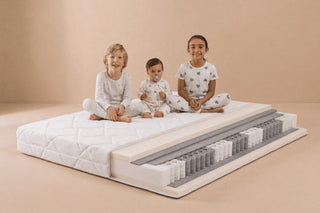
Forgetting the mattress. Very often the problem is not the bed frame but the mattress: too firm, too soft, too thin, too warm. Before returning the whole bed, check that separately – our children's mattress guide helps.
Letting the period lapse. Mundane, but a classic. Put the end date in your calendar on delivery day, with a reminder two weeks before.
How to tell the bed is right
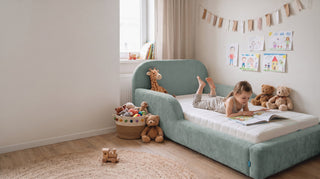
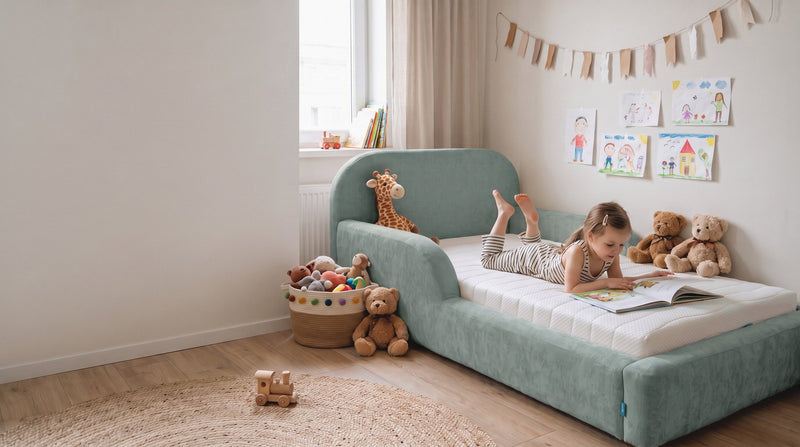
Good signs are usually unspectacular. Your child goes to bed without negotiation, finds its sleeping position quickly and is still roughly where it fell asleep in the morning. It does not roll to the edge at night and does not wake by bumping into something. It also uses the bed voluntarily during the day, for stories or looking at books – a very reliable signal that the place is registered as safe.
Less good signs: your child repeatedly wakes in the same position or at the same spot, complains of stiffness in the morning, sweats noticeably more than before, or still takes conspicuously long to settle after four weeks. Frequent falling out or rolling away is also an indication – either of missing fall protection or of a sleeping surface that is too narrow. On the size question, see 90 or 120 cm wide?
And one thing up front, so there are no false expectations: a good bed does not fix settling problems that have other causes. If your child already struggled to fall asleep before, the new bed will not resolve that. It does, however, remove one possible cause from the equation – and when you are searching, that is worth a lot.

Get CHF 25 off
Subscribe to the newsletter and get a one-time CHF 25 discount. ✓ 100 nights trial ✓ 5-year guarantee ✓ Free delivery
Frequently asked questions about trial sleeping on a children's bed
How long should you trial a children's bed?
Four weeks at minimum, six to eight is better. Children typically need two to four weeks to accept a new sleeping place. Only after that does sleep actually say something about the bed. Fourteen-day periods mainly capture the settling-in phase, which is the hardest part.
Is it normal for my child to sleep worse in the new bed?
During the first three to seven nights more frequent waking is very common and is not a sign of an unsuitable bed. Between sleep cycles every child wakes briefly; in an unfamiliar environment that brief waking more easily becomes a full one. From week two this calms noticeably for most children.
Is there a statutory right of return for online purchases in Switzerland?
No, there is no general statutory right of withdrawal for distance purchases in Switzerland. Return periods and trial sleeping offers are voluntary services from suppliers. It is therefore worth clarifying duration, who bears the costs, and collection before ordering.
Do I have to keep the original packaging for a return?
That depends on the supplier and is set out in the return conditions. For bulky furniture some suppliers require the original packaging, others organise collection including packaging. Clarify this before buying so you do not store a large box unnecessarily.
What if only the mattress does not fit?
Check the bed frame and the mattress separately before returning anything. Very often the cause lies with firmness, height or the climate of the mattress rather than the bed. Swapping the mattress is usually simpler and cheaper than a complete exchange.
Should I ask my child whether they like the new bed?
As a mood check, gladly; as a basis for a decision, rather not. Young children almost always choose the familiar, regardless of how well they sleep in it. Observation over several weeks is more informative: time to fall asleep, night-time waking and morning mood.


