


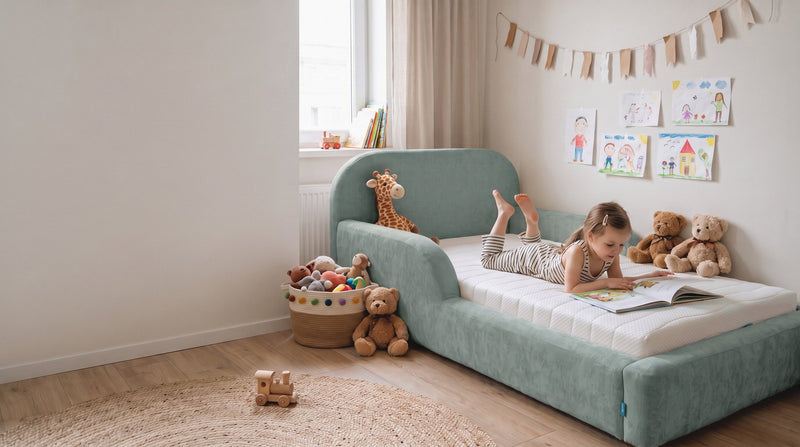

Moving from the cot to the first big bed is a milestone – and suddenly you face a question you may not have considered since the baby days: which mattress should it be? A kids' mattress 90x200 often stays with your child for eight to ten years, from a 12-kilo toddler to a schoolchild weighing 35 or 40 kilos. In shops and online, the choice quickly feels overwhelming: cold foam, pocket springs, latex, firmness ratings, zones, covers. At the same time, you want your child to be well supported, not to overheat and to feel safe in the new bed quickly. Then there is everyday family life: leaking water bottles, bouts of fever, siblings climbing onto the bed to play. In this guide you will find out which criteria really count, which you can safely ignore and how to choose the mattress step by step.
The short answer: A good children's mattress in 90×200 cm is firm rather than soft, point-elastic and designed to cushion your child's low body weight all the same. A breathable core and a removable, washable cover matter more in everyday family life than any marketing promise. The mattress must fit the bed without gaps and rest on a stable slatted base. If you choose a reversible mattress with zones that can also carry an adult's weight, you have a solution that works well into the school years and during bedtime stories together.
- Children are light: the mattress should support them without the hips and shoulders sinking in too far – medium-firm to firm is usually right.
- 90×200 cm is a standard size: sheets, protectors and spare covers are available in every Swiss department store.
- A removable, washable cover and a well-ventilated core are worth their weight in gold with young children.
- The mattress must fit the bed exactly – avoid gaps of more than 2 to 3 cm between the mattress and the frame.
- Turning and airing the mattress regularly noticeably extends its lifespan.
Why the first big mattress is more than an accessory
Depending on their age, children between two and six sleep around 10 to 13 hours a day, including naps. In other words, during these years your child spends more time on the mattress than anywhere else. The spine is growing, the muscles are developing, and children move a surprising amount at night – turning over, lying sideways, feet on the pillow.
A good mattress cannot «shape» this development, but it can provide a calm, even surface on which the body relaxes. Studies on mattress choice for children are scarce; most recommendations come from research on adults and from orthopaedic experience. There is agreement on one point, though: a sagging, overly soft or damp surface is not ideal for anyone.
There is an emotional side too. Moving from the cot to a toddler bed is exciting for many children. If the new mattress feels comfortable and does not wobble or creak, your child will usually settle into the big bed more quickly.
Kids' mattress 90x200: why the standard size is so practical
Junior beds measuring 70×140 cm used to be common; today many families go straight for 90×200 cm. The reason is simple: in the first ten years a child grows from about 85 to around 140 centimetres. With a length of 200 cm there is enough room well into the teenage years, and there is no need to change beds at the age of six. Whether this size suits your room is explained in detail in the article kids' bed 90×200 – does it make sense?
For the mattress, the standard format has real everyday advantages:
Accessories available everywhere: fitted sheets, waterproof mattress protectors and duvets in 90×200 or 160×210 can be found at every major retailer, even at short notice on a Saturday morning when a protector needs to go in the wash.
Suitable for guests: if grandma or a godmother stays the night, she can sleep in the child's bed without any problem – provided the mattress is designed for an adult's weight.
If you would like more room for cuddles, you can also choose 120×200 cm. The comparison kids' bed 90 or 120 cm wide sets out the differences. For most children's rooms in Swiss rental flats, which often measure 9 to 12 square metres, a width of 90 cm is the best compromise.
Firmness and support: what light bodies need
Firmness ratings cause the most confusion. The H1 to H5 labels are not uniformly standardised and are usually designed with adults in mind. A 15-kilo child hardly sinks into a mattress that is «medium» for an 80-kilo adult. For children, the number therefore matters less than how the mattress behaves under a low weight.
Good children's mattresses are point-elastic: they give way where the shoulders and hips rest while supporting the waist and lower back. This keeps the spine roughly straight when lying on the side and preserves its natural gentle S-curve when lying on the back. A mattress is too soft if your child visibly lies in a hollow, and too hard if they turn over unusually often at night or their shoulder barely sinks in when lying on their side.
| Age / weight | What to look for | Typical warning sign |
|---|---|---|
| 2–4 years, approx. 12–18 kg | Rather firm, quick-recovering surface; no deep sinking zone | Child lies in a visible hollow |
| 4–7 years, approx. 16–25 kg | Point elasticity for shoulders and hips, good support at the waist | Frequent turning, complaints of pressure on the shoulder |
| 7–10 years, approx. 22–35 kg | Use zones or the second sleeping side, check shape stability | Hollows where the hips lie |
| From 10 years, from approx. 30 kg | Check the mattress for sagging, replace if necessary | Clear hollow, springs can be felt |
A simple test: let your child lie down and watch whether a straight line forms from neck to bottom when they lie on their side. As children change a great deal within a few years, a mattress with comfort zones or a reversible mattress with two differently designed sides is a good safeguard.

Pocket springs, cold foam or latex compared
All common core materials can make good children's mattresses – the quality of manufacture is what counts. Each type of construction does have its typical strengths, though.
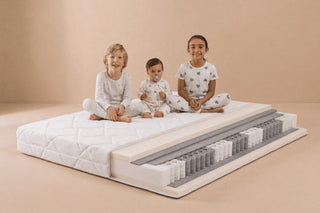
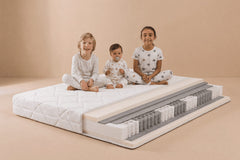
Pocket springs: each spring sits in its own fabric pocket and works largely independently. This gives good point elasticity and plenty of air in the core through which moisture can escape. Pocket spring cores are generally stable in shape and cope well when mum or dad lies down on the mattress during the bedtime routine.
Cold foam: light, comparatively affordable and available in many firmness levels. The quality depends heavily on the density; very light foams can sag more quickly. Open-cell versions are more breathable than simple standard foam.
Latex: very elastic and durable, but heavy and often more expensive. Latex may be unsuitable for children with a known latex allergy – if in doubt, discuss it with your paediatrician.
| Core material | Strengths | Bear in mind |
|---|---|---|
| Pocket springs | Very good air circulation, point-elastic, stable in shape, often high load capacity | Heavier than foam, easier to turn with two people |
| Cold foam | Light, versatile, usually cheaper | Quality depends heavily on density |
| Latex | Very elastic, durable | Heavy, more expensive, unsuitable with a latex allergy |
| Memory foam | Relieves pressure for adults | Slow recovery, less suitable for young children |
Viscoelastic foam («memory foam») only springs back slowly and makes it harder for young children to turn over; for them, quick-recovering materials are usually the better choice.
Hygiene and sleep climate: the underrated factor
Children sweat quite a lot at night. Add to that accidents during potty training, spilt milk or a stomach bug that hits the whole family. Above all, a children's mattress must be able to cope with moisture.
Washable cover: make sure the cover can be removed with a zip and washed in the machine. The label tells you which temperature is possible. A second cover or a waterproof yet breathable mattress protector will save you a lot of stress at night.
Well-ventilated core: the better the air can circulate in the core, the faster the mattress dries after a sweaty night. This is also relevant for children with a house dust mite allergy, as mites like it warm and humid.
Room climate: many sleep guides suggest a temperature of about 16 to 20 °C and a humidity of around 40 to 60 per cent for children's rooms. Opening the windows wide for a few minutes morning and evening, even in winter, helps more than a window that is permanently tilted open.
Testing for harmful substances: textile labels such as OEKO-TEX show that materials have been tested for certain harmful substances. A new smell after unpacking is normal; let the mattress air for one to two days in a well-ventilated room before your child sleeps on it.

Fit: mattress, bed frame and slatted base
An excellent mattress is of little use if it does not suit the bed. Check three points before you buy:
Inner dimensions of the bed: measure whether the bed really offers a 90×200 cm sleeping surface. There should be no gap between mattress and frame into which a hand or foot could slip. More than 2 to 3 cm of space is a sign that the dimensions and the mattress are not an ideal match.
Mattress height relative to the edge: with beds that have side borders, what matters is how much of the edge remains above the mattress surface. If the mattress is very deep, the fall protection becomes lower. What helps restless sleepers is covered in the article child falls out of bed.
Base: a slatted base with slats that are not too far apart, or a stable, ventilated board, is ideal. A mattress placed directly on the floor or on a solid board cannot air well from below; moisture builds up there more quickly in winter.
Common mistakes when buying the first big mattress
Passing on the old adult mattress: well meant, but a mattress used for years is often unevenly worn and hard to assess hygienically. For a child who will sleep on it for many years to come, a new one is usually worthwhile.
Buying too soft because it feels cosy: what feels comfortable to an adult when trying it out is often too yielding for a light child. Cosiness belongs in the duvet and pillow, not in the core.
Looking only at the firmness rating: as mentioned, the ratings are not comparable. Construction, zones and elasticity tell you more.
Forgetting the cover: with young children, a cover that is sewn on quickly becomes a nuisance.
No sleep trial: whether a mattress suits your child only becomes clear after a few weeks. Look for a generous returns policy.
Switching too early: not every child is ready for the big bed at two. The signs are described in the article is my child ready for a big bed?
Step by step to the right children's mattress
This checklist helps you keep track, whether you buy in a shop or online:
- Measure the bed: note the inner dimensions, edge height and type of base.
- Clarify your needs: does your child sweat a lot? Are there allergies? Does your child sleep restlessly? Do you want to join them in bed for stories?
- Choose the core: pocket springs for air circulation and shape stability, cold foam for low weight.
- Check the support: point-elastic, rather firm, ideally with zones or two sleeping sides.
- Check the cover: removable, washable, pleasantly soft.
- Consider the load capacity: if the mattress can also carry an adult, cuddling together will not leave hollows.
- Compare the service: sleep trial, guarantee, delivery and returns.
- Plan for care: turn and rotate every three months, wash the cover regularly, air briefly every day.
An everyday example: the Meier family from Winterthur chose a reversible pocket spring mattress for their three-year-old son. After a week of fever and wet nights, they were glad of the removable cover and a second protector in the cupboard – changing it took less than five minutes.
Get CHF 25 off
Subscribe to our newsletter and receive a one-off CHF 25 discount. ✓ 100-night sleep trial ✓ 5-year guarantee ✓ Free delivery

Frequently asked questions about the kids' mattress 90x200
From what age does a child need a 90x200 mattress?
As soon as your child moves from the cot to a big bed, usually between about 18 months and three years. Age alone is not decisive; what matters is whether your child is ready for a bed without bars.
How firm should a children's mattress be?
Medium-firm to firm and, above all, point-elastic. As children are light, firmness ratings designed for adults are of limited use. What matters is that your child does not lie in a hollow and that the spine stays straight when lying on the side.
Are pocket springs suitable for children?
Yes, a well-made pocket spring core is very suitable for children. It is point-elastic, stable in shape and allows plenty of air to circulate, which helps children who sweat at night.
How often should you turn a children's mattress?
Turn it over and rotate it by 180 degrees about every three months. This spreads the load evenly and keeps the mattress stable in shape for longer. Wash the cover as needed, often every few weeks with young children.
How long does a children's mattress last?
With good care, a high-quality mattress often lasts eight to ten years. If clear hollows, noticeable springs or hygiene problems appear, it makes sense to replace it.
Can I reuse an older sibling's mattress?
That is possible if the mattress is still stable in shape, clean and dry and shows no hollows. Wash the cover thoroughly and inspect the mattress critically. If in doubt, a new mattress is the better choice.
This article is for general information only and does not replace advice from a paediatrician. If problems persist, please consult your paediatrician.


