



When you start looking for a new mattress for your child, you quickly face a fundamental question: cold foam, latex or a pocket spring kids’ mattress? In the shop every option sounds convincing, and online every model claims to be “ergonomic” and “breathable”. Yet the decision does matter: between the ages of three and ten, a child spends around 10 to 12 hours a night on this surface. Many parents also buy the mattress at exactly the moment their child moves from the cot to a big bed – a phase when plenty of other things are changing too. In this guide we compare the three common core types fairly and objectively: how they are built, how they differ in sleep climate, weight, care and lifespan, and which families each type suits best. By the end, you will know exactly what to look for in the shop or when test-sleeping at home.
The short answer: there is no single “right” core – a good cold foam, latex or pocket spring mattress can suit children equally well. What matters is a fairly firm, point-elastic surface, good air circulation, a removable, washable cover and careful workmanship. Pocket springs score mainly on ventilation and stability, cold foam on low weight and quietness, latex on elasticity and durability. Choose according to your child’s needs and your everyday life, not the marketing claims.
- Children usually weigh between 12 and 35 kg and need a fairly firm surface in which the pelvis does not sink in deeply.
- Pocket springs: excellent ventilation, stable, slightly heavier – good for children who sweat at night.
- Cold foam: light, quiet, adaptable – quality depends heavily on density (ideally from around 40 kg/m³).
- Latex: very elastic and durable, but heavy and tends to feel warmer.
- Whatever the core: a washable cover, tested materials and a trial period make buying far less stressful.
What a children’s mattress needs to do
Before we get to springs and foam, it is worth looking at the requirements. A three-year-old weighs roughly 13 to 16 kg, a ten-year-old often 30 to 35 kg. Compared with adults, this weight is spread over a much smaller area, and the spine is still developing. The mattress should therefore support the body evenly, without the shoulders or pelvis sinking in deeply. With children, a surface that is too soft is a more common problem than one that is too firm.
Then there is the sleep climate. Children sweat quite a lot at night, especially as they fall asleep. A mattress that releases moisture well stays drier and more hygienic. As a guideline, a room temperature of about 16 to 19 °C and humidity of around 40 to 60 per cent are recommended for a child’s bedroom.
Last but not least, a children’s mattress has to cope with everyday life: night-time accidents, spilled tea, crumbs from the bedtime book or a tummy bug are all part of family life. A removable cover that can be washed at 40 to 60 °C is therefore at least as important as the core itself. And because many children discover their bed makes a great trampoline, robustness matters too. To decide on the size of the bed, read our article Kids’ bed 90×200: is the standard size a good choice?.
Pocket spring kids’ mattress: construction and strengths
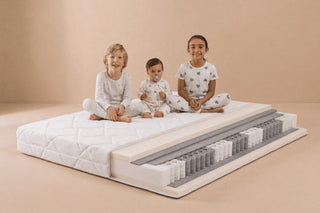
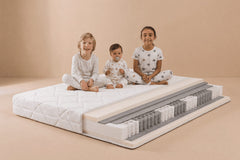
In a pocket spring core, each steel spring sits in its own small fabric pocket. The pockets are joined together, but the springs work largely independently of one another. This sets them apart from the older Bonnell spring, where all springs are wired together and the surface tends to give way as a whole. A pocket spring kids’ mattress therefore responds point by point: where the shoulder rests, it gives; right next to it, it stays stable.
Many models are divided into zones, for example 5 or 7 comfort zones. Springs of different firmness or with a different number of coils are combined so that the head, shoulders, pelvis and legs are each supported appropriately. With children, the effect is smaller than with adults because the body is shorter – but zoning does no harm and can be genuinely useful as your child grows into school age.
Strengths at a glance: there is plenty of air between the springs, which is exchanged with every movement. Moisture is carried away well, which particularly benefits children who sweat heavily at night. Pocket spring cores are also stable and are slower to develop dips. Worth noting: these mattresses are somewhat heavier than foam models, and budget versions with few springs can feel less even on the surface. So look for a good comfort layer above the springs.
Cold foam: light, quiet and adaptable
Cold foam is an open-cell polyurethane foam that is foamed at comparatively low temperatures. Its open cell structure makes it more breathable than standard foam. Cold foam mattresses are light, easy to turn and completely silent. Many parents appreciate how much easier they are to handle in a room with a loft bed or a narrow alcove.
Quality stands or falls with the density, i.e. the weight of one cubic metre of foam. As a rule of thumb: below about 35 kg/m³ the foam wears out faster; from about 40 kg/m³ it is noticeably more durable and stable. Reputable manufacturers state the density – if it is missing, it is worth asking. Incidentally, density says nothing about firmness, which is measured separately via compression hardness.
Strengths at a glance: low weight, quiet sleep, good adaptation to body contours, often an attractive price. Worth noting: foam retains slightly more heat than a spring core. A climate-fibre layer, ventilation channels in the core and a slatted base instead of a solid board balance this out well. Viscoelastic memory foam, on the other hand, is less suitable for younger children because it responds slowly and can make turning over in sleep harder.

Latex: elastic and long-lasting
Latex mattresses are made from natural latex, synthetic latex or a blend of both. The core is usually riddled with numerous ventilation channels. Latex is highly point-elastic and quickly springs back to its original shape after pressure. High-quality latex cores last many years and are therefore a good option if the mattress is later to be handed down to a younger sibling.
Strengths at a glance: very good contouring combined with noticeable support, long lifespan, calm sleeping feel. Worth noting: latex is the heaviest of the three materials – a 90×200 cm mattress can easily weigh 20 kg or more, which makes regular turning and airing a chore. Latex also tends to retain more heat than a spring core. New latex mattresses may smell a little at first; airing them well before the first night helps.
Parents often ask whether latex is a problem for children with allergies. A true latex allergy is rare and mainly involves direct skin contact, for example with gloves. With a mattress, there is always a cover in between. If a latex allergy is known in your family, still discuss the choice with your paediatrician and, if in doubt, go for a different core.
The three cores compared side by side
The overview below summarises the typical properties. Bear in mind that differences within one material group are often greater than those between groups: a very good cold foam core can be better ventilated than a basic spring core, and vice versa. The table is therefore a guide, not a verdict on individual products.
| Criterion | Pocket springs | Cold foam | Latex |
|---|---|---|---|
| Ventilation / moisture release | very good, lots of air in the core | good with open-cell foam and ventilation channels | good with many ventilation channels |
| Feels | rather cool | neutral to slightly warmer | rather warm |
| Point elasticity | high, especially with many springs | medium to high | very high |
| Weight (90×200 cm) | medium to heavy | light | heavy |
| Stability / lifespan | high | strongly dependent on density | high |
| Noise | quiet if well made | silent | silent |
| Ease of turning | manageable | very easy | hard work |
| Suits | children who sweat a lot; long-term use | loft beds, frequent rearranging | long-term use, handing down to siblings |
For most families, then, it is not the material itself that makes the difference, but how core, cover, slatted base and room climate work together. You will find further buying criteria for the bed itself in Buying a kids’ bed: what to look out for.

Myths fact-checked
“Spring mattresses are old-fashioned.” This image comes from the old, fully wired spring core. Modern pocket spring cores with zones and a comfort layer have little in common with it and are now among the most popular constructions of all.
“Foam is always cheap.” Simple polyether foam with a low density is indeed inexpensive and not very durable. High-quality cold foam of 40 kg/m³ and more, however, is a solid material that lasts for many years.
“The firmer, the better for the back.” Children need a fairly firm mattress, but not a plank. Lying on their side, the spine should be roughly straight – shoulders and hips may sink in slightly.
“Springs poke through when children jump.” Jumping puts strain on any mattress, whether foam, latex or springs. A well-made pocket spring mattress with a thick comfort layer generally copes well with family life. Still, using the bed as a trampoline should remain the exception – not least because of the risk of falls.
Finding the right mattress: step by step
1. Check the bed dimensions. The mattress must fit the bed exactly. There should be no more than about 2 cm of gap between mattress and bed frame, so that hands or feet cannot slip in.
2. Observe how your child sleeps. Does your child sweat a lot, often sleep restlessly or turn over frequently? Heavy sweating points towards a well-ventilated core such as pocket springs or latex with ventilation channels.
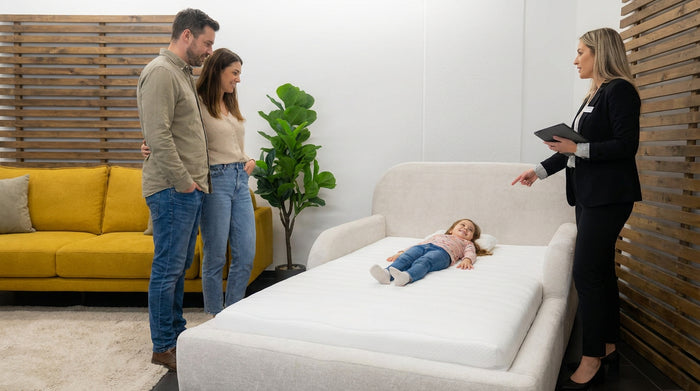
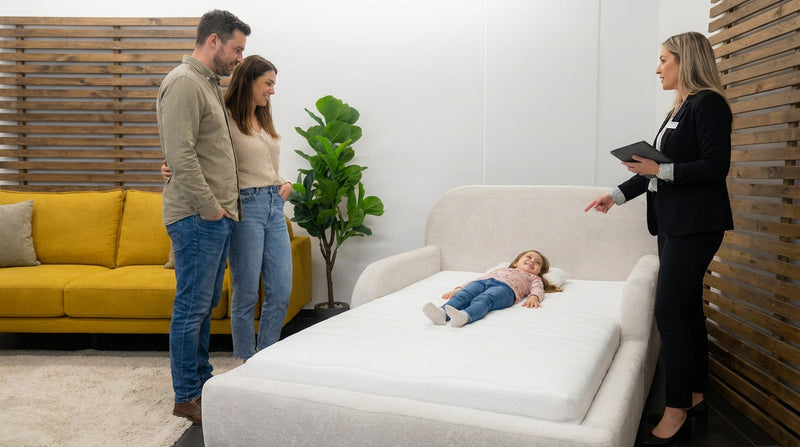
3. Do a lying test. Have your child lie on their side and look from behind: the spine should form as straight a line as possible. If the pelvis sinks in noticeably, the mattress is too soft.
4. Check the cover. Look at the all-round zip, washing temperature, material and test labels such as OEKO-TEX.
5. Consider the base. A slatted base with gaps of no more than about 4 to 6 cm provides even support and lets air reach the underside.
6. Make use of the trial period. Whether a mattress suits often only becomes clear after two to three weeks. A trial sleep offer takes the pressure off the decision. If your child still sleeps restlessly, our article When your child won’t sleep through the night may help.
Common mistakes when buying a mattress
Deciding on price alone. Ideally, a children’s mattress is used for eight to ten years. Worked out per night, solid quality is almost always worth it.
Reusing the old baby mattress. A 70×140 cm mattress from the cot is not suitable for a larger bed. Moving to a kids’ bed goes hand in hand with a new, properly fitting mattress – more on this in From cot to toddler bed.
Buying too soft because it feels “cosy”. Adults often test with their hand and find firmer models uncomfortable. For a light child, the same mattress feels considerably softer.
Forgetting to air it. Every mattress absorbs moisture every night. In the morning, fold back the duvet, air the room thoroughly twice a day for five to ten minutes and turn the mattress every few months if it is designed for that.
Placing it on a solid base. A chipboard panel without ventilation slots restricts airflow, whatever the core. In extreme cases, moisture can build up on the underside.
Get CHF 25 off
Subscribe to our newsletter and get a one-time CHF 25 discount. ✓ 100-night sleep trial ✓ 5-year guarantee ✓ Free delivery

Frequently asked questions about pocket springs and foam in kids’ mattresses
Is a pocket spring kids’ mattress suitable for children?
Yes. A well-made pocket spring mattress with a sufficient comfort layer supports children precisely, is well ventilated and stays stable. What matters is that it is not too soft and fits the bed exactly.
Is cold foam or pocket spring better for children?
Neither material is better in principle. Pocket springs usually offer better ventilation, while cold foam is lighter and quieter. What counts is workmanship, foam density, firmness and a washable cover.
What firmness is right for a child?
Children generally need a fairly firm mattress because they are light. Lying on their side, the spine should be as straight as possible and the pelvis should not sink in noticeably. A lying test at home is the best check.
From what density is cold foam good quality?
As a rule of thumb, cold foam from around 40 kg per cubic metre is considered durable and stable. Below around 35 kg per cubic metre, foam often wears out faster and is more prone to dips.
Are latex mattresses unsuitable for children with allergies?
A true latex allergy is rare and mainly involves direct skin contact. With a mattress, there is always a cover in between. If a latex allergy is known in your family, discuss the choice with your paediatrician.
How long does a children’s mattress last?
A high-quality children’s mattress can be used for eight to ten years if it is aired and turned regularly and the cover is washed. Clear dips, sagging areas or odours are signs that it is time for a new one.
This article is for general information only and does not replace advice from a paediatrician. If problems persist, please contact your paediatrician.


