



When you start looking for a mattress for your child’s first big bed, you quickly come across heights ranging from 8 to 22 centimetres. So when it comes to kids’ mattress thickness, many parents wonder what actually makes sense. The height affects not only comfort but also how much fall protection is left in the end and how easily your child can climb into bed. A mattress that is too thin can bottom out under a heavier child, while one that is too thick makes the edge of the bed seem worryingly low. Then there are questions that rarely come up in the shop: does the mattress actually fit the frame? Does the cover count towards the height? And does a four-year-old really need 20 centimetres of springs? In this guide you will find typical guide values by mattress type and age, a simple calculation for fall protection and a checklist to use at home.
The short answer: For children in a big bed from around two years of age, roughly 10 to 18 centimetres is common, depending on the construction: foam mattresses are usually 10 to 16 cm, pocket-spring mattresses 14 to 20 cm. More important than the number itself is that the mattress offers point-elastic support, does not sag and suits the bed frame. It is also essential that enough fall protection still rises above the sleeping surface once the mattress is in place. The mattress height intended for a specific bed is given in the manufacturer’s information – stick to it.
- Typical heights for kids’ mattresses in a big bed: about 10–18 cm; baby mattresses usually 8–12 cm.
- Height says little about quality – core material, density and zones matter more.
- Always measure fall protection from the top of the mattress, not from the slatted base.
- The maximum mattress height recommended by the bed manufacturer takes priority over any rule of thumb.
- Rolled mattresses often need 24 to 72 hours to reach their full height.
Kids’ mattress thickness: why height is more than a matter of comfort
At first glance, a mattress’s height looks like a minor detail on a spec sheet. In a child’s room, however, it has three practical consequences. First, it partly determines how much material is available for support and pressure relief. A child weighing 15 kilograms puts a very different load on a mattress than a schoolchild weighing 35 kilograms, and a thin, soft core can be pressed right down to the slats under greater weight.
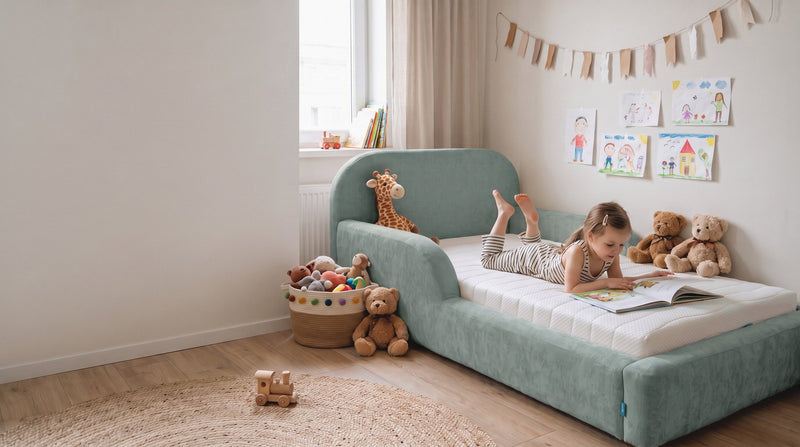
Second, every extra centimetre raises the sleeping surface. That reduces the distance to the top edge of the bed frame or fall guard. On a bed designed for a 12 cm mattress, a 20 cm mattress can reduce the protection considerably. To find out how different solutions work, read our article on fall protection without bars.
Third, height affects everyday life: how high does your two-year-old have to climb, how heavy is the mattress when you change the sheets, and does it fit the frame without bulging? A good choice is therefore always about how child, mattress and bed work together – not simply the thickest option available.
Guide values: how thick should a kids’ mattress be by type and age?
There is no binding one-size-fits-all figure, because the sensible height depends heavily on the construction. A pocket-spring core simply needs more height, because the individual springs and the padding layers above them take up space. High-quality cold foam, on the other hand, can provide good support with fewer centimetres. The following overview shows typical values commonly found in shops – as guidance, not as a rule.
| Mattress type / age | Typical height (guide value) | Notes |
|---|---|---|
| Baby mattress in a cot (0–approx. 2 years) | approx. 8–12 cm | Fairly firm, an exact fit for the cot, no gaps at the edges |
| Cold foam in a kids’ bed (approx. 2–6 years) | approx. 10–14 cm | Light, easy to turn, usually sufficient for lighter children |
| Pocket springs in a kids’ bed (from approx. 2–3 years) | approx. 14–20 cm | Well ventilated, point-elastic, needs height for the springs |
| Latex or natural mattress (from approx. 2 years) | approx. 12–16 cm | Relatively heavy, make sure there is good ventilation from below |
| School-age children and teenagers (approx. 7–14 years) | approx. 16–22 cm | Higher body weight, comfort zones become more important |
Important: these figures describe the total height including the cover. Some manufacturers state the core height separately, which is then one to two centimetres lower. Babies in a cot have their own requirements anyway: the mattress should be fairly firm and fit the frame without gaps. Once your child moves to a big bed, usually at around two to three years, the higher models come into play. To find out whether your child is ready, see our guide Is my child ready for a big bed?.
Construction beats height: what really matters inside
Two mattresses that are each 16 centimetres high can feel completely different. The reason lies inside. With foam, density is an important indicator of durability: values from around 35 to 40 kg/m³ are often recommended for kids’ mattresses, because lightweight foam develops dips more quickly. A thin mattress made of dense foam often lasts longer than a thick one made of light material.
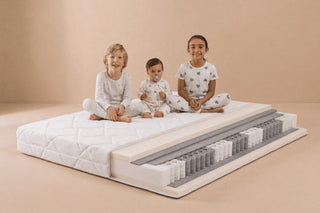
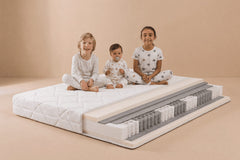
Pocket springs: each spring sits in its own fabric pocket and only gives way where pressure is applied. This provides point-elastic support and plenty of air in the core, which can be pleasant for children who sweat a lot at night. In return, the construction needs height – below about 14 cm, space gets tight for springs plus padding.
Comfort zones and reversibility: zones at the shoulders and hips help keep the spine straight. A reversible mattress can be turned regularly, which spreads the wear.
Cover: with children, a removable, washable cover is almost more important than an extra centimetre of comfort foam. If you want to dig deeper into materials, our kids’ bed buying guide covers further criteria.

Mattress height and fall protection: how to calculate it correctly
The most common mistake: parents look at the height of the bed frame and forget that the mattress “eats up” part of it. What matters is the distance between the top of the mattress and the top edge of the fall guard. A frequently quoted guide value is that the guard should rise at least around 16 centimetres above the sleeping surface – but the bed manufacturer’s information is always what counts.
The simple calculation: height of the guard edge above the slatted base minus mattress height equals effective protection. An example: if the frame rises 30 cm above the slats and a 14 cm mattress lies on top, 16 cm remain. With a 20 cm mattress, only 10 cm would be left – noticeably less safety margin for a child who moves around a lot at night.
Also factor in any mattress topper or thick protector, as these raise the sleeping surface too. Many manufacturers mark the maximum permitted mattress height directly on the bed or state it in the instructions. If you cannot find any information, ask before you order a mattress. What you can do if your child keeps rolling to the edge despite the guard is explained in My child falls out of bed.
Bed frame, access and everyday life: height as part of the whole
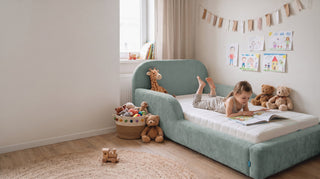
Besides protection, the overall height of the sleeping surface above the floor also plays a role. For toddlers, a low entry has proven its worth, often somewhere between about 20 and 35 centimetres. This lets your child crawl into bed independently and get out in the morning without jumping. A very thick mattress on an already high frame quickly turns a cosy kids’ bed into a climbing session.
Mind the insertion depth: many beds have a frame into which the mattress sits a few centimetres deep, which stabilises it at the sides. If the mattress is much lower than intended, a ledge may form where little fingers or soft toys get caught. If it is higher, it sticks out and can slide sideways.
Fit across the surface: the mattress should match the bed exactly in length and width without being squashed. There should be no larger gaps between mattress and frame. Whether a width of 90 or 120 centimetres suits your room better is covered in Kids’ bed 90×200: is the standard size a good choice?.
Weight in everyday life: a 90×200 mattress with a high spring core can easily weigh 15 to 25 kilograms. You will notice this when changing the sheets, turning it and carrying it up the stairwell.

Common mistakes and myths fact-checked
Myth: the thicker, the better. Not necessarily. A light child hardly sinks any deeper into a tall, soft mattress than into a good 12 cm foam mattress. Extra height mainly helps when the construction requires it, as with springs.
Myth: children need a rock-hard mattress. Children need a supportive surface that does not feel as hard as a board. The body should lie straight, while shoulders and hips may sink in slightly.
Mistake: measuring a rolled mattress straight away. Vacuum-packed mattresses need time. Air it in a heated room at around 18 to 20 °C; full height is often only reached after 24 to 72 hours.
Mistake: forgetting the topper. A 5 cm topper can reduce fall protection by exactly those 5 cm. Children rarely need one.
Mistake: cutting down or reusing an old adult mattress. Used mattresses often have dips and hygiene issues. A mattress suited to your child is the better choice.
Mistake: looking only at the number on the spec sheet. Always check whether the figure includes the cover or not.
Step by step: checking the right mattress height at home
With a folding ruler and ten minutes, you can check for yourself whether bed and mattress go together. Here is how:
- Look for the manufacturer’s information: the assembly instructions or the bed’s product page often state the recommended or maximum mattress height.
- Measure the guard height: measure from the slatted base to the top edge of the fall guard at its lowest point.
- Measure the mattress: lay a ruler across the mattress and measure down the side to the bottom of the mattress, without pressing.
- Work out the difference: guard height minus mattress height minus any toppers. The result is your effective protection.
- Do the hand test: press firmly into the middle with the flat of your hand. If you can feel the slats, the mattress is too thin or too soft.
- Test the access: watch whether your child can get into and out of bed alone and safely.
- Check again: if a dip forms after a few weeks, turn the mattress and measure again.
If you repeat these steps when buying and then about twice a year, you will spot early on when something is no longer right. You will also find an overview of different guard systems in our comparison of fall guard types.
Get CHF 25 off
Subscribe to our newsletter and get a one-time CHF 25 discount. ✓ 100-night sleep trial ✓ 5-year guarantee ✓ Free delivery

Frequently asked questions about kids’ mattress thickness
How thick should a mattress for a toddler be?
For children from around two years of age in a big bed, roughly 10 to 18 centimetres is common, depending on the construction. Foam mattresses often manage with 10 to 14 cm, while pocket-spring mattresses are usually higher. What matters is that the mattress provides good support and suits the bed.
Is a thicker kids’ mattress automatically better?
No. Quality depends more on the core material, density and workmanship than on height. A mattress that is too thick can also reduce fall protection.
How much fall protection should remain above the mattress?
A frequently quoted guide value is that the guard should rise at least around 16 centimetres above the sleeping surface. However, the bed manufacturer’s information on maximum mattress height is what counts.
Does the cover count towards the mattress height?
Usually yes, the total height is stated including the cover. Some manufacturers also give the core height, which is slightly lower. So always compare like with like.
Why is my new rolled mattress lower than stated?
Vacuum-packed mattresses need time to fully expand. In a heated room, this often takes 24 to 72 hours. Only measure after that.
Does a child need a mattress topper?
As a rule, no. A suitable kids’ mattress is enough. A topper raises the sleeping surface and can reduce the effective fall protection, so you should include it in your height calculation.
This article is for general information only and does not replace advice from a paediatrician. If problems persist, please contact your paediatrician.


